
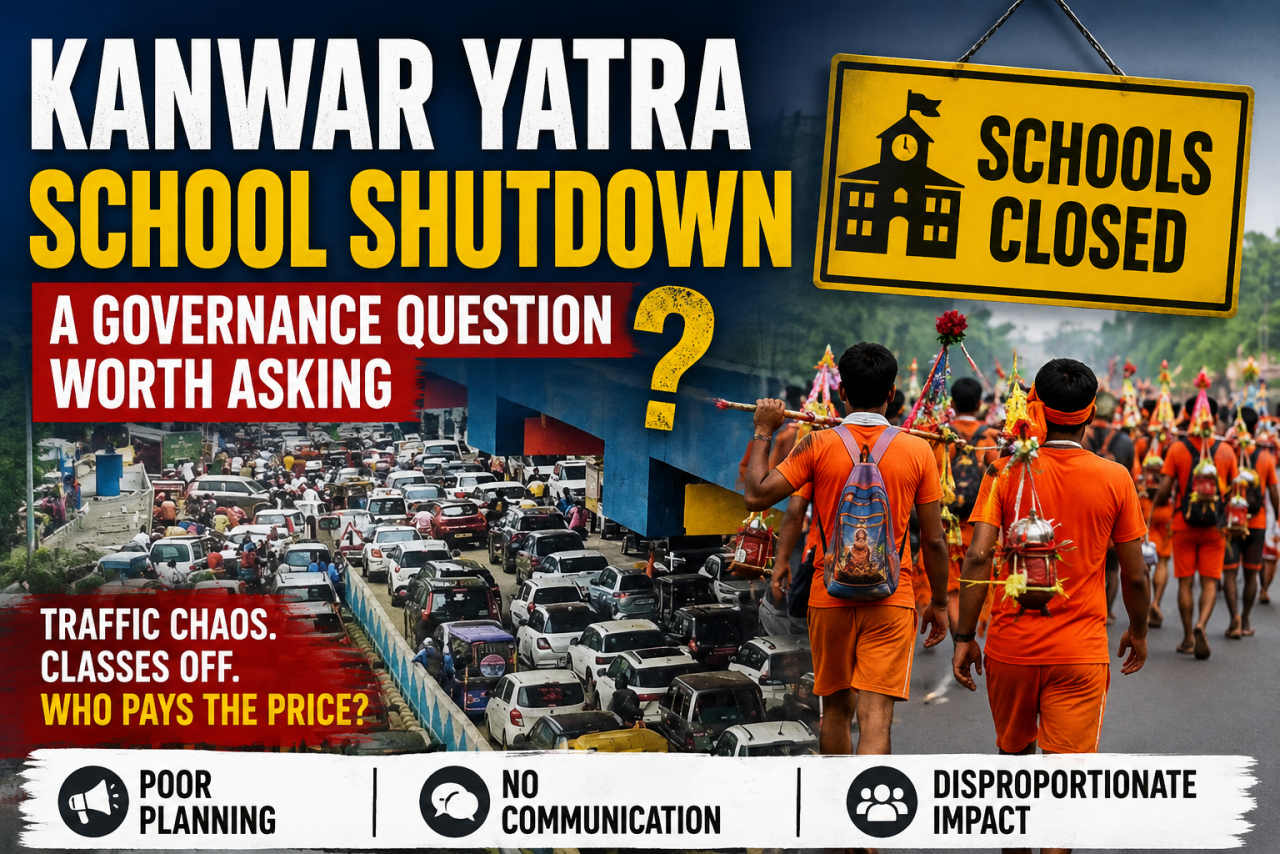
Faith deserves respect. But should students, commuters, and ambulances pay the price every year for predictable administrative failures?
Authorities in Ghaziabad have ordered all schools and colleges to remain closed until August 12 after a surge of Kanwariyas travelling from Uttarakhand prompted the closure of the Meerut-Ghaziabad carriageway of the Delhi-Meerut Expressway, two days ahead of schedule. The order, issued by District Inspector of Schools BP Singh, applies to CBSE and ICSE schools as well as degree colleges, with only institutions conducting scheduled examinations exempted.
The announcement came with little advance notice. On Monday morning, thousands of commuters found themselves stranded in massive traffic jams. Residents reported ambulances and emergency vehicles trapped for long periods. According to media reports, Raj Nagar Extension resident Vikrant Sharma spent nearly 40 minutes trying to reach the district court before giving up, while Muradnagar commuter Himanshu Chauhan said the closure added an hour to his daily journey, forcing him to switch from his motorcycle to a train.
What makes the situation noteworthy is not that it happened, but that it happens almost every year.
A Predictable Event That Continues to Cause Disruption
Every Shravan, parts of Uttar Pradesh, Haryana, and Delhi-NCR witness similar scenes. Highways are partially or fully closed, schools suspend classes for several days, businesses face disruptions, and daily commuters struggle to reach workplaces or hospitals.
This raises an important governance question. If the Kanwar Yatra is an annual event with known dates, routes, and approximate participation, why do authorities continue to rely on last-minute measures that disrupt education, healthcare, and transportation?
The issue is not the pilgrimage itself. It is the quality of planning around it.
Why Authorities Impose Restrictions
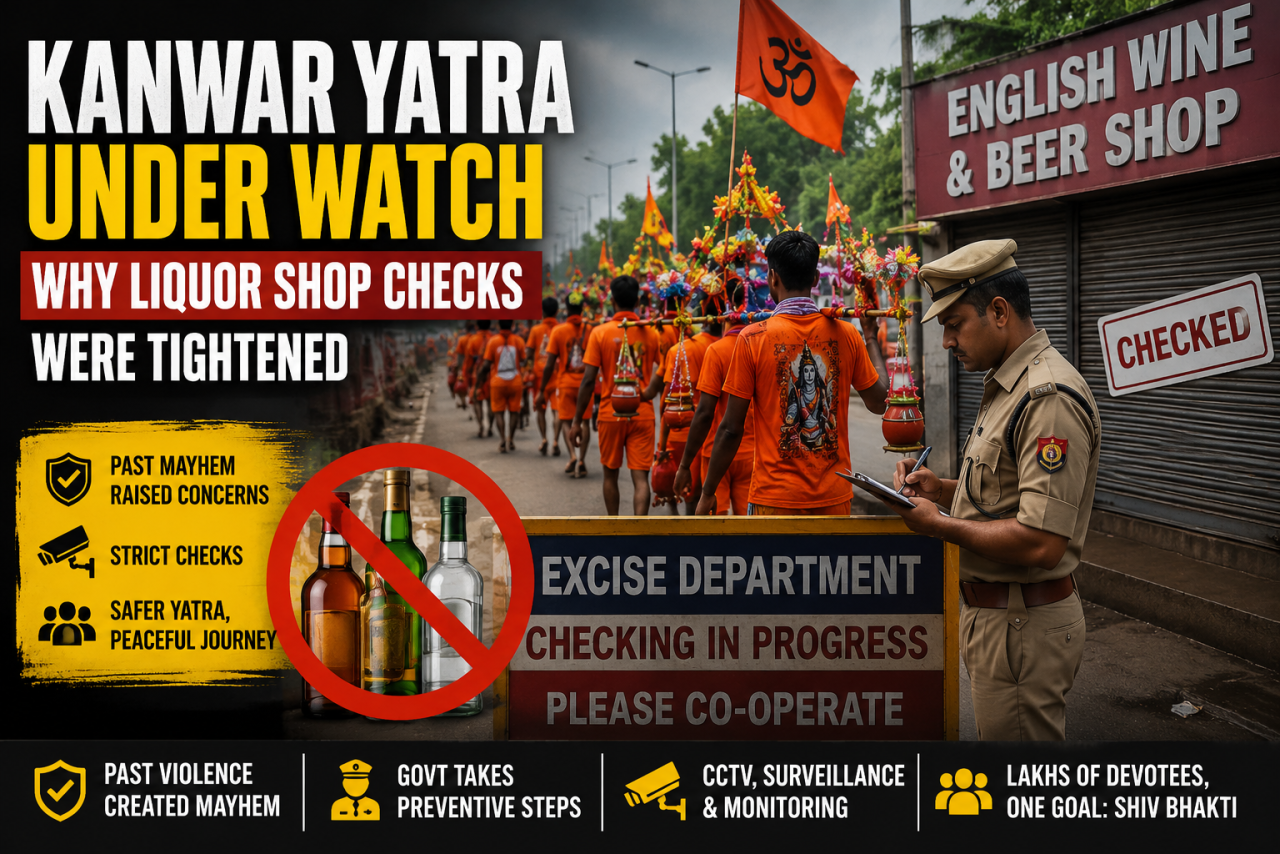
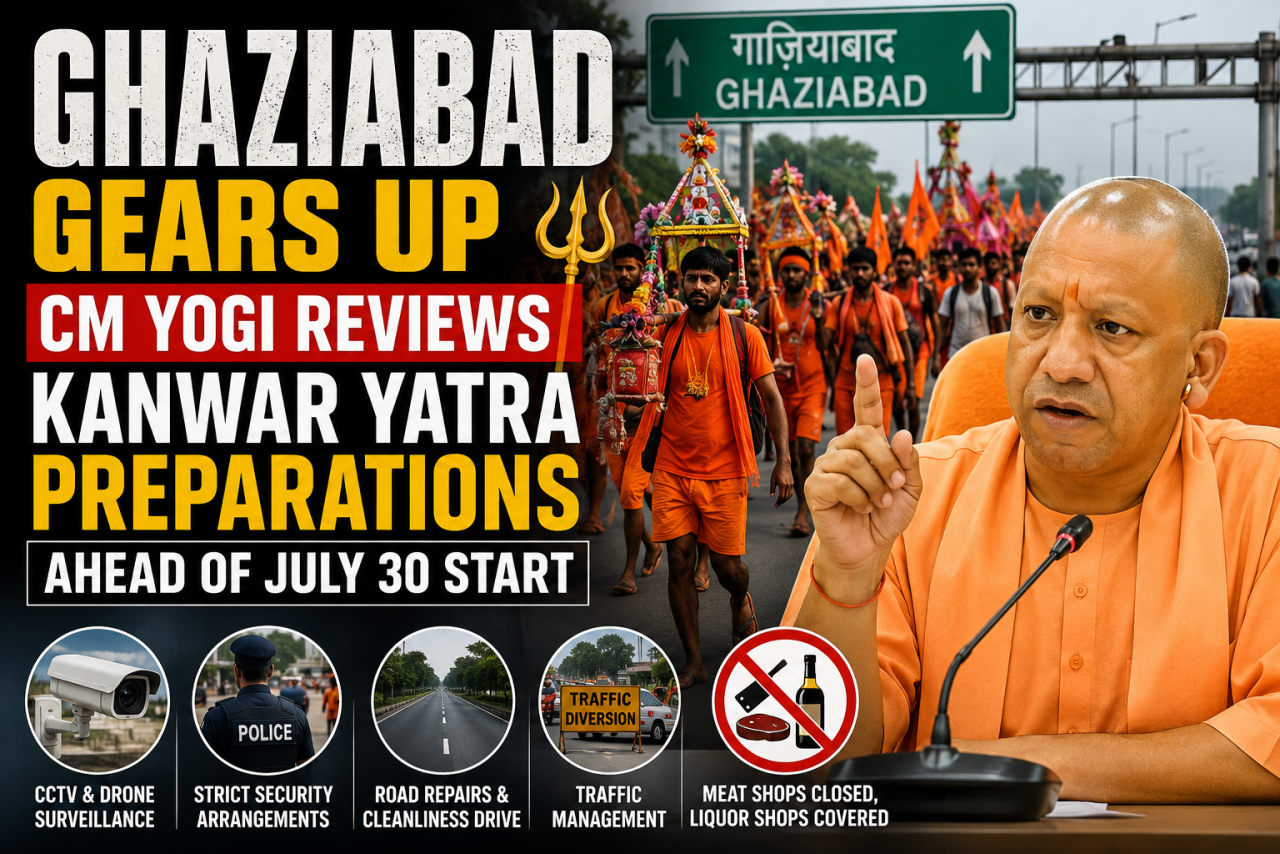
The Kanwar Yatra attracts lakhs of devotees who walk long distances carrying holy water from sacred rivers to offer at Shiva temples. Their journey requires safe, uninterrupted movement along designated routes, making traffic management a significant challenge.
Police officials argue that temporary road restrictions are essential for preventing accidents and ensuring the safety of both pilgrims and motorists. Ghaziabad DCP (Traffic) Trigun Bisen told that restricting one carriageway of the Delhi-Meerut Expressway was intended to separate Kanwariya movement from regular traffic while keeping the opposite carriageway open.
Such arrangements are not unique to the Kanwar Yatra. Similar traffic diversions and security measures are implemented during large religious gatherings such as the Kumbh Mela, the Amarnath Yatra, and Haj-related events. Under Article 25 of the Indian Constitution, citizens have the right to freely practise their religion, and governments have a legitimate responsibility to ensure public safety during mass congregations.
The challenge lies not in accommodating religious events but in managing them efficiently.
Where Governance Falls Short
Three recurring administrative shortcomings stand out.
First, inadequate planning. The Delhi-Meerut carriageway was originally scheduled to close on August 5 but was shut two days earlier, catching residents and commuters by surprise.
Second, poor communication. At the time commuters encountered the closure, Ghaziabad Traffic Police had reportedly not issued a public advisory on its official channels, leaving citizens unaware of alternate routes.
Third, disproportionate restrictions. Closing every school and college across the district, instead of limiting closures to institutions directly affected by the traffic corridor, suggests a broad administrative response rather than a targeted one.
In any democracy, governments must balance constitutional rights with efficient public administration. Citizens may accept temporary inconvenience for public safety, but they also expect timely information, predictable planning, and proportionate restrictions.
When ambulances become trapped in avoidable traffic, students lose classroom days due to sudden announcements, and commuters discover road closures only after entering them, the problem reflects administrative preparedness rather than the religious event itself.
The Need for Consistent Administrative Standards
Another question deserves careful examination. Are large gatherings associated with different religious communities managed with the same level of preparedness, or does administrative urgency vary depending on the political significance of a particular event?
This is a legitimate policy question that should be answered through transparent data rather than political assumptions. Consistency in governance strengthens public confidence regardless of the religious event being managed.
A Better Way Forward
The solution is not to restrict the Kanwar Yatra. It is to plan for it more effectively.
Authorities can significantly reduce disruption through several practical measures:
- Issue traffic advisories weeks before scheduled diversions.
- Publish detailed alternate-route maps in advance.
- Introduce phased or staggered carriageway closures instead of sudden shutdowns.
- Limit school closures to institutions directly affected by traffic restrictions.
- Establish dedicated emergency corridors to ensure uninterrupted movement of ambulances and essential services.
- Coordinate real-time public communication across traffic police, district administration, and emergency services.
These measures would allow pilgrims to undertake the Yatra safely while reducing the burden on students, commuters, businesses, and emergency responders.
Final Take
The Ghaziabad school shutdown is ultimately less about faith and more about governance. The Kanwar Yatra is neither unexpected nor unprecedented. It is a recurring annual event whose timing, routes, and scale are broadly known well in advance.
When predictable events repeatedly result in last-minute road closures, blanket school shutdowns, and severe traffic congestion, the issue is no longer one of religious accommodation. It becomes a question of administrative foresight.
Good governance is measured not by whether authorities respond to predictable events, but by whether they plan well enough that citizens barely feel the disruption.
Authorities in Ghaziabad have ordered all schools and colleges to remain closed until August 12 after a surge of Kanwariyas travelling from Uttarakhand prompted the closure of the Meerut-Ghaziabad carriageway of the Delhi-Meerut Expressway, two days ahead of schedule. The order, issued by District Inspector of Schools BP Singh, applies to CBSE and ICSE schools as well as degree colleges, with only institutions conducting scheduled examinations exempted.
The announcement came with little advance notice. On Monday morning, thousands of commuters found themselves stranded in massive traffic jams. Residents reported ambulances and emergency vehicles trapped for long periods. According to media reports, Raj Nagar Extension resident Vikrant Sharma spent nearly 40 minutes trying to reach the district court before giving up, while Muradnagar commuter Himanshu Chauhan said the closure added an hour to his daily journey, forcing him to switch from his motorcycle to a train.
What makes the situation noteworthy is not that it happened, but that it happens almost every year.
A Predictable Event That Continues to Cause Disruption
Every Shravan, parts of Uttar Pradesh, Haryana, and Delhi-NCR witness similar scenes. Highways are partially or fully closed, schools suspend classes for several days, businesses face disruptions, and daily commuters struggle to reach workplaces or hospitals.
This raises an important governance question. If the Kanwar Yatra is an annual event with known dates, routes, and approximate participation, why do authorities continue to rely on last-minute measures that disrupt education, healthcare, and transportation?
The issue is not the pilgrimage itself. It is the quality of planning around it.
Why Authorities Impose Restrictions
The Kanwar Yatra attracts lakhs of devotees who walk long distances carrying holy water from sacred rivers to offer at Shiva temples. Their journey requires safe, uninterrupted movement along designated routes, making traffic management a significant challenge.
Police officials argue that temporary road restrictions are essential for preventing accidents and ensuring the safety of both pilgrims and motorists. Ghaziabad DCP (Traffic) Trigun Bisen told that restricting one carriageway of the Delhi-Meerut Expressway was intended to separate Kanwariya movement from regular traffic while keeping the opposite carriageway open.
Such arrangements are not unique to the Kanwar Yatra. Similar traffic diversions and security measures are implemented during large religious gatherings such as the Kumbh Mela, the Amarnath Yatra, and Haj-related events. Under Article 25 of the Indian Constitution, citizens have the right to freely practise their religion, and governments have a legitimate responsibility to ensure public safety during mass congregations.
The challenge lies not in accommodating religious events but in managing them efficiently.
Where Governance Falls Short
Three recurring administrative shortcomings stand out.
First, inadequate planning. The Delhi-Meerut carriageway was originally scheduled to close on August 5 but was shut two days earlier, catching residents and commuters by surprise.
Second, poor communication. At the time commuters encountered the closure, Ghaziabad Traffic Police had reportedly not issued a public advisory on its official channels, leaving citizens unaware of alternate routes.
Third, disproportionate restrictions. Closing every school and college across the district, instead of limiting closures to institutions directly affected by the traffic corridor, suggests a broad administrative response rather than a targeted one.
In any democracy, governments must balance constitutional rights with efficient public administration. Citizens may accept temporary inconvenience for public safety, but they also expect timely information, predictable planning, and proportionate restrictions.
When ambulances become trapped in avoidable traffic, students lose classroom days due to sudden announcements, and commuters discover road closures only after entering them, the problem reflects administrative preparedness rather than the religious event itself.
The Need for Consistent Administrative Standards
Another question deserves careful examination. Are large gatherings associated with different religious communities managed with the same level of preparedness, or does administrative urgency vary depending on the political significance of a particular event?
This is a legitimate policy question that should be answered through transparent data rather than political assumptions. Consistency in governance strengthens public confidence regardless of the religious event being managed.
A Better Way Forward
The solution is not to restrict the Kanwar Yatra. It is to plan for it more effectively.
Authorities can significantly reduce disruption through several practical measures:
- Issue traffic advisories weeks before scheduled diversions.
- Publish detailed alternate-route maps in advance.
- Introduce phased or staggered carriageway closures instead of sudden shutdowns.
- Limit school closures to institutions directly affected by traffic restrictions.
- Establish dedicated emergency corridors to ensure uninterrupted movement of ambulances and essential services.
- Coordinate real-time public communication across traffic police, district administration, and emergency services.
These measures would allow pilgrims to undertake the Yatra safely while reducing the burden on students, commuters, businesses, and emergency responders.
Final Take
The Ghaziabad school shutdown is ultimately less about faith and more about governance. The Kanwar Yatra is neither unexpected nor unprecedented. It is a recurring annual event whose timing, routes, and scale are broadly known well in advance.
When predictable events repeatedly result in last-minute road closures, blanket school shutdowns, and severe traffic congestion, the issue is no longer one of religious accommodation. It becomes a question of administrative foresight.
Good governance is measured not by whether authorities respond to predictable events, but by whether they plan well enough that citizens barely feel the disruption.















Leave a Comment