
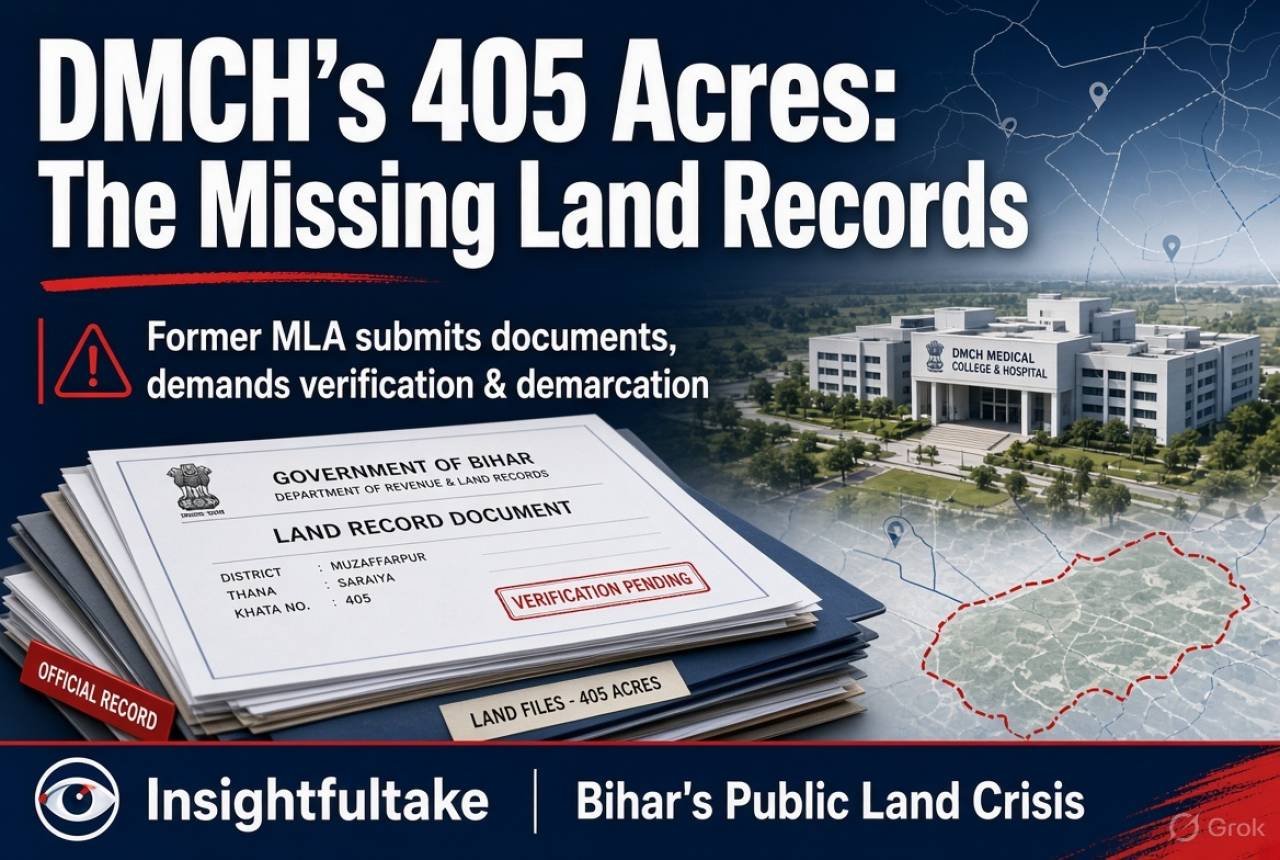
DMCH was reportedly allotted 405 acres. A former MLA now wants the administration to explain where that land stands today.
On 2 November 2026, former Hayaghat MLA Amar Nath Gami approached the Commissioner’s office in Darbhanga with a set of documents and a demand for an official inquiry into the land belonging to Darbhanga Medical College and Hospital (DMCH). He also submitted a written application to the District Magistrate. His concern was specific that the status of the land acquired for one of north Bihar’s most important medical institutions.
According to the documents presented by Gami, the government acquired 405 acres of land for DMCH and paid ₹6 lakh as compensation. He claims that these records are available on the Bihar government's land records portal, but the same documents are reportedly not available with either the district administration or DMCH.
There is another long-standing claim surrounding the institution. It is widely believed that the Maharaja of Darbhanga donated 300 acres of land to the medical college. Gami has sought clarification on this as well. He wants the administration to establish the actual position through official documents rather than rely on accounts that have been repeated over the years.
The questions he has raised are simple but important. Where is the entire 405 acres recorded in the government's land records? How much land is currently in DMCH's possession? Are the original boundaries intact? If there is a difference between the land mentioned in official records and the land available on the ground, what explains it?
Gami has asked the administration to verify the original acquisition documents, prepare a village-wise (mauza-wise) list of the land, examine the compensation records and establish its present revenue status. He has also called for a joint survey by DMCH officials and revenue officers to measure and demarcate the land. If encroachment is found, action should follow the law, with the affected parties given an opportunity to present their claims.
These are reasonable demands. A public institution should know exactly how much land belongs to it, where its boundaries lie and whether any portion has been occupied without authorisation. The fact that these questions have required the intervention of a former MLA points to a larger problem in the way public land is recorded and protected in Bihar.
Public land, missing records and unanswered questions
The DMCH case should not be seen in isolation. Across Bihar, disputes over government land are common. Land originally acquired for schools, hospitals, colleges, playgrounds and other public facilities often becomes the subject of questions about ownership, boundaries and possession.
In many cases, the problem begins with poor record-keeping. Old acquisition documents are difficult to locate, land measurements are not updated, and revenue records do not always reflect changes made over the years. In other cases, portions of public land are gradually occupied, sometimes through construction and sometimes through disputed claims that remain unresolved for years.
The consequences are serious. Once the original boundaries become unclear, establishing ownership and recovering possession can turn into a lengthy administrative and legal exercise. Those responsible for maintaining the land may point to incomplete records, while the people occupying it continue to enjoy possession.
This raises an important question in the DMCH case: if the government acquired 405 acres and the records exist on its own portal, why has the administration not already established the present status of that land?
The question deserves a documented answer, not another round of assurances.
Why DMCH needs every acre of its land
A medical college and hospital cannot function only within the space it occupies today. Its future requirements include additional hospital wards, diagnostic facilities, medical departments, classrooms, laboratories, hostels, staff accommodation, parking and other essential infrastructure.
DMCH serves a large population across Darbhanga and neighbouring districts. The pressure on its hospital facilities makes the availability of land particularly important. Any reduction in its landholding can affect future expansion and the quality of facilities that the institution can provide.
The loss of public land also carries a financial cost. The government acquires land using public money, but if that land is not protected, taxpayers effectively pay twice. First, they pay for the acquisition. Later, they bear the cost of limited infrastructure, overcrowded facilities and disputes over land that should have remained available for public use.
The issue, therefore, is not simply about the ownership of a particular plot. It concerns the ability of a public institution to plan and expand according to the needs of the people it serves.
Bihar's unfinished land-record problem
Bihar's land administration has a complicated history. The abolition of zamindari after Independence and subsequent land reforms changed the state's landholding structure. However, maintaining accurate records of ownership, possession, transfer and government acquisition remained a difficult task.
Land surveys, cadastral maps, mutation entries and revenue records have not always kept pace with changes on the ground. In several areas, discrepancies between old records and present possession have continued for years.
Government land is particularly vulnerable when departments fail to maintain updated records and conduct regular physical inspections. A plot may remain recorded in the name of a government institution, but the absence of proper boundary demarcation can create opportunities for unauthorised occupation and disputes.
Corruption in such cases does not always involve a single transaction or an identifiable act of bribery. Sometimes it operates through administrative neglect: files that cannot be traced, surveys that are repeatedly postponed, complaints that remain unanswered and officials who fail to establish the actual position.
When records are missing or outdated, accountability becomes difficult. The longer the delay, the harder it can become to recover land and establish the facts.
The administration must put the records in the public domain
Gami has clarified that his initiative is not intended to make unsubstantiated allegations against any individual or institution. His demand is for verification of government records and a comparison with the actual position on the ground. That distinction is important.
An allegation of encroachment must be established through evidence. Equally, an institution's landholding cannot be protected merely by referring to old claims or incomplete paperwork. The administration must establish the facts.
The Commissioner and the District Magistrate now have an opportunity to resolve the issue through a transparent process.
First, the original acquisition records for the reported 405 acres should be verified. Second, the administration should prepare and publish a mauza-wise account showing the location, area, ownership and present revenue status of the land. Third, a joint survey involving revenue officials and DMCH representatives should establish the actual boundaries.
The survey findings should be made public. Any difference between the recorded area and the land found on the ground must be explained. Where unauthorised occupation is established, the administration should initiate proceedings under the applicable law, following due process.
DMCH should also maintain an updated land register and ensure that its boundaries are properly marked. Periodic inspections would help prevent similar disputes from emerging in the future.
The question is bigger than 405 acres
Bihar has no shortage of public institutions that need better infrastructure. Hospitals need more space, colleges need classrooms and hostels, and schools need playgrounds and basic facilities. At a time when public money is being spent on new projects, protecting land already acquired for public use should be a basic administrative responsibility.
The DMCH case brings this responsibility into focus. If the government has acquired 405 acres for the institution, the people of Darbhanga have a right to know how much of that land remains available, whether its boundaries are intact and what has happened to any missing portion.
The documents presented by Gami reportedly exist on the state's land records portal. The next step should not be another exchange of applications between government offices. It should be a physical survey, a verified land account and a clear public explanation.
The issue is not about who raises the question or which political party gets credit for it. It is about whether land acquired with public money remains available for public use.
DMCH's 405 acres must be accounted for, measured and protected. The administration owes that answer not just to the former MLA, but to the patients, students and people of north Bihar who depend on the institution.

























Leave a Comment