
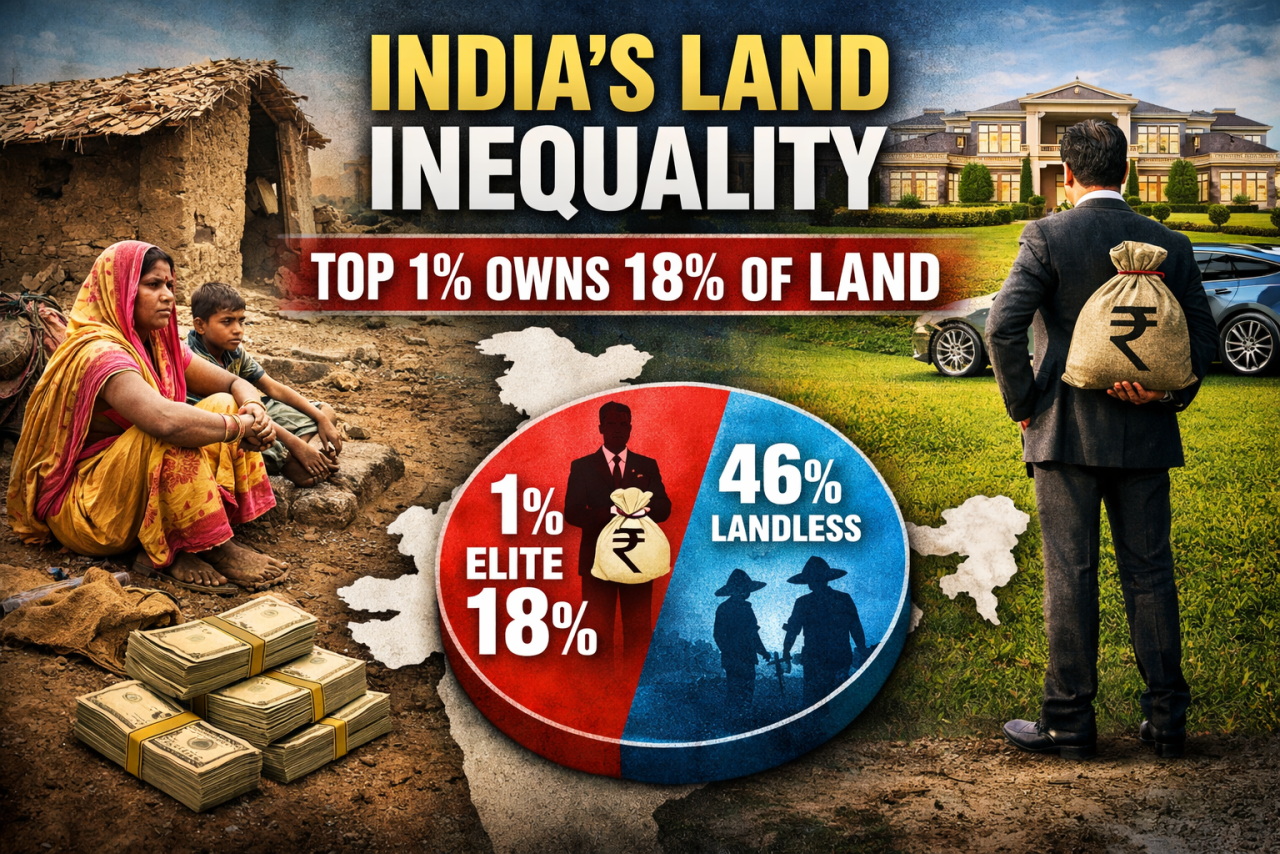
India’s land divide is sharper than ever—nearly half the population owns nothing while a tiny elite controls vast land wealth.
Land in India has never been merely a productive asset. It is identity, status, political leverage, and, often, the only form of security available to millions. From inheritance traditions to caste hierarchies, and from colonial land settlements to modern markets, the story of land in India is deeply intertwined with social structure. A recent study by the World Inequality Lab, titled “Land Inequality in India: Nature, History, and Markets” by Nitin Kumar Bharti and co-authors, brings this reality into sharp focus—revealing levels of land inequality that are both staggering and deeply entrenched.
A Landscape of Extreme Concentration
The study’s findings are striking. The top 10% of households in India own 44% of the total land, while the top 5% control 32%, and the top 1% alone possess 18%. These numbers are not just statistical markers—they reflect a structural imbalance that has persisted across generations.
At the other end of the spectrum lies an equally stark reality: nearly 46% of rural households do not own any land at all. For a country where a significant portion of the population still depends on agriculture and land-based livelihoods, this lack of ownership translates into economic vulnerability and social marginalization.
Drawing on an extensive dataset covering 2.7 lakh villages and nearly 650 million individuals, the study goes beyond macro-level observations. It dives deep into village-level ownership patterns, uncovering how inequality manifests in everyday life. On average, the largest landholder in a village controls 12.4% of the land. Even more revealing is that in about 3.8% of villages, a single individual or family owns more than half of the total land area. Such concentration is not merely unequal—it is structurally dominant.
Beyond Economics: The Social Roots of Inequality
What makes land inequality in India particularly complex is that it cannot be explained through economic factors alone. It is deeply embedded in the country’s social fabric.
Historically, land ownership has been closely linked to caste hierarchies. Upper-caste groups have traditionally held disproportionate control over land, while marginalized communities—particularly Dalits and Adivasis—have been excluded. Even when legal reforms attempted redistribution, entrenched social power often limited their effectiveness.
Land is also tied to identity and dignity. Ownership confers not just income but social recognition and political influence. In rural settings, landowners often dominate local governance institutions, shaping decisions that affect access to resources, welfare schemes, and opportunities.
The study underscores that these inequalities are not accidental—they are the outcome of long-standing institutional arrangements. Colonial land revenue systems, such as zamindari and ryotwari, formalized unequal ownership patterns, many of which continue to persist in modified forms.
The Failure of Redistribution
Post-independence India recognized the urgency of land reform. Policies aimed at abolishing intermediaries, imposing land ceilings, and redistributing surplus land were introduced with the promise of creating a more equitable agrarian structure.
However, the outcomes fell short of expectations. Implementation gaps, legal loopholes, and political resistance diluted the impact of these reforms. In many cases, large landowners managed to retain control through fragmentation of holdings among family members or by exploiting administrative weaknesses.
Moreover, land records in India remain fragmented and often outdated, making enforcement of reform policies difficult. Without clear documentation, redistribution efforts face both legal and logistical challenges.
As a result, while some regions saw modest improvements, the broader pattern of inequality remained largely intact.
Markets and the New Dynamics of Inequality
In recent decades, market forces have added a new layer to the land inequality puzzle. Economic liberalization, urban expansion, and infrastructure development have increased the value of land, particularly in peri-urban areas.
While rising land prices have benefited those who already own land, they have further excluded those without assets. Land has increasingly become a speculative commodity, with investors and corporations acquiring large tracts for industrial, commercial, or real estate purposes.
This shift has significant implications. For small farmers, rising land prices make it harder to expand holdings or even retain existing land in times of financial distress. For landless households, entry into land ownership becomes even more unattainable.
The study highlights how markets, rather than correcting inequality, often reinforce it—amplifying the advantages of those already at the top.
Regional Variations, Common Patterns
India’s diversity is reflected in its land ownership patterns. Some states, particularly in the south and west, have relatively more equitable distributions due to historical reform efforts and different social structures. Others, especially in parts of northern and eastern India, exhibit higher levels of concentration.
Yet, despite these regional variations, the overarching pattern remains consistent: land ownership is highly unequal, and the benefits of economic growth are unevenly distributed.
This has direct consequences for development. Regions with higher inequality often experience lower productivity, weaker human development indicators, and greater social conflict. When large sections of the population lack access to land, their ability to invest in education, health, and livelihoods is severely constrained.
Implications for Policy and Development
The findings of the World Inequality Lab study carry important implications for policymakers. Addressing land inequality is not just a matter of social justice—it is central to economic transformation.
First, there is a need to modernize land records. Digitization, clear titling, and transparent systems can reduce disputes and improve governance. Initiatives like the Digital India Land Records Modernization Programme are steps in the right direction, but their implementation must be accelerated and standardized across states.
Second, tenancy reforms need renewed attention. In many parts of India, informal tenancy arrangements prevail, leaving tenant farmers without legal protection or access to institutional credit. Recognizing and formalizing these arrangements can improve both equity and productivity.
Third, targeted redistribution policies, though politically challenging, remain essential. Even limited redistribution, combined with access to credit and support services, can significantly improve livelihoods for marginalized communities.
Finally, non-land-based opportunities must be expanded. As the economy diversifies, creating jobs in manufacturing and services can reduce dependence on land and provide alternative pathways for economic mobility.
A Question of Justice and Sustainability
Land inequality is not just an economic issue—it is a question of justice. When nearly half of rural households own no land, the promise of inclusive growth remains unfulfilled.
At the same time, addressing inequality is crucial for sustainability. Concentrated ownership often leads to inefficient use of land, while smallholders, when supported, can contribute to more sustainable and diversified agricultural practices.
The study by the World Inequality Lab serves as a reminder that the land question in India is far from settled. It challenges policymakers, researchers, and society at large to rethink assumptions and confront uncomfortable realities.
Final Take
India’s growth story cannot be fully understood without acknowledging the deep inequalities that shape its foundation. Land, as both a material and symbolic resource, lies at the heart of this story.
The evidence is clear: ownership is highly concentrated, exclusion is widespread, and historical structures continue to influence present outcomes. Addressing this imbalance requires more than incremental change—it demands a comprehensive approach that combines institutional reform, market regulation, and social transformation.
As India aspires to become a $5 trillion economy and beyond, the question is not just how fast it grows, but how fairly. And in that journey, land remains one of the most critical—and contested—pieces of the puzzle.





















Leave a Comment