
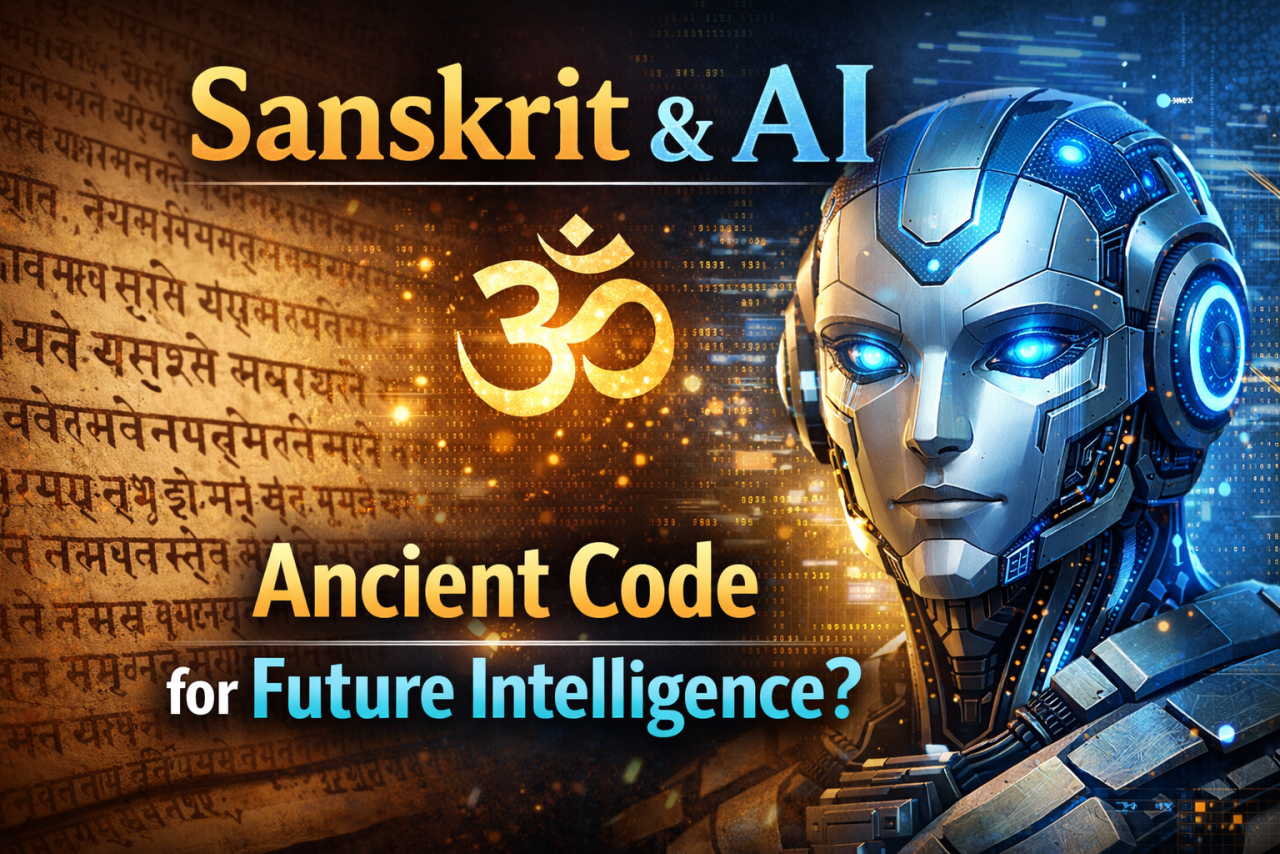
As AI systems grow more complex and expensive, an ancient language is emerging as an unlikely blueprint for faster, cleaner, and more efficient computation.
In the architecture of modern technology, efficiency is the ultimate currency. As we move from human-centric communication to machine-led intelligence, the limitations of organic languages—ambiguity, redundancy, and high "noise"—are becoming costly.
Surprisingly, the solution to these 21st-century bottlenecks may lie in a linguistic system perfected three millennia ago. Sanskrit is emerging not just as a cultural relic, but as the world’s most resourceful and cost-efficient medium for information transfer.
1. High-Density Semantics: The Maximum "Payload" Advantage
In logistics, "payload" refers to the actual cargo being transported, excluding the weight of the vehicle. In linguistics, Sanskrit operates with the highest semantic payload.
The Power of the Root System
Sanskrit is built on approximately 2,000 Dhatus (verbal roots). Through a sophisticated system of prefixes and suffixes, these roots can generate millions of words with surgical precision.
- Resourcefulness: Unlike English, which often requires descriptive phrases to explain a new concept, Sanskrit can "engineer" a single, precise word for it.
- Example: In English, we might say "the specialized study of the stars." In Sanskrit, the single term Jyotirvidya carries the entire conceptual weight without the "empty" filler words like the, of, or of the.
2. Digital Economy: Why Sanskrit is the "Cheapest" for AI
When we talk about the "cost" of a language today, we are talking about Tokens. AI models like Gemini or GPT-4o charge and process information based on token count.
The Token Efficiency Metric
Research in computational linguistics has shown that Sanskrit is naturally "compressed."
- Computational Utilization: Because of its Vibhakti (inflectional system), word order is flexible without losing meaning. One Sanskrit word often does the work of four English words.
- Cost Reduction: For a global enterprise running millions of AI queries, a 30% reduction in token count (made possible by Sanskrit’s density) translates directly into millions of dollars saved in API costs and a significant reduction in the carbon footprint required to power data centers.
3. Algorithmic Integrity: The NASA Perspective
The long-standing association between NASA and Sanskrit isn't about Sanskrit being used to "talk" to satellites. It stems from Rick Briggs' landmark research for NASA’s AI division.
Briggs identified that Sanskrit’s grammar is mathematically complete. It is the only natural language that functions like a programming language. While English relies on "context" (which computers struggle with), Sanskrit relies on "structure." This makes it the most resourceful tool for Knowledge Representation, as it eliminates the "logic errors" common in other human tongues.
4. The Cognitive ROI: Sharpening the Human Processor
Resourcefulness isn't just about silicon; it’s about the human brain. Experts refer to the "Sanskrit Effect" to describe the cognitive dividends of engaging with the language.
- Memory Optimization: The rigorous structure of Sanskrit chanting and grammar has been linked to increased cortical thickness in the brain.
- Analytical Thinking: Mastering the rules of Pāṇini—the world’s first "software engineer"—trains the human mind in logical sequencing, much like learning Python or C++.
5. Overcoming the "Entry Barrier"
If Sanskrit is so resourceful, why isn't it the global standard?
- The Complexity Wall: Its precision is a double-edged sword; it requires a high initial "investment" of time to learn.
- Modern Interfacing: Until recently, the tools to bridge Sanskrit’s ancient scripts with modern keyboards and LLMs were lacking. However, as of 2026, new NLP frameworks are finally unlocking Sanskrit's potential for mainstream data science.
Conclusion: Investing in the Ancient for a Leaner Future
Sanskrit is the most resourceful language because it provides a mathematical framework for thought. It is the "cheapest" because it conveys the most information in the least amount of digital space.
As we seek to build AI that is faster, more accurate, and less resource-heavy, we are discovering that the "Old Code" is actually the most advanced operating system ever designed.
Are you curious how linguistic structures impact your business's AI costs?
Learn more about the latest trends in Science & Technology or explore our Culture & Heritage section to see how history is shaping the future.



























Leave a Comment