
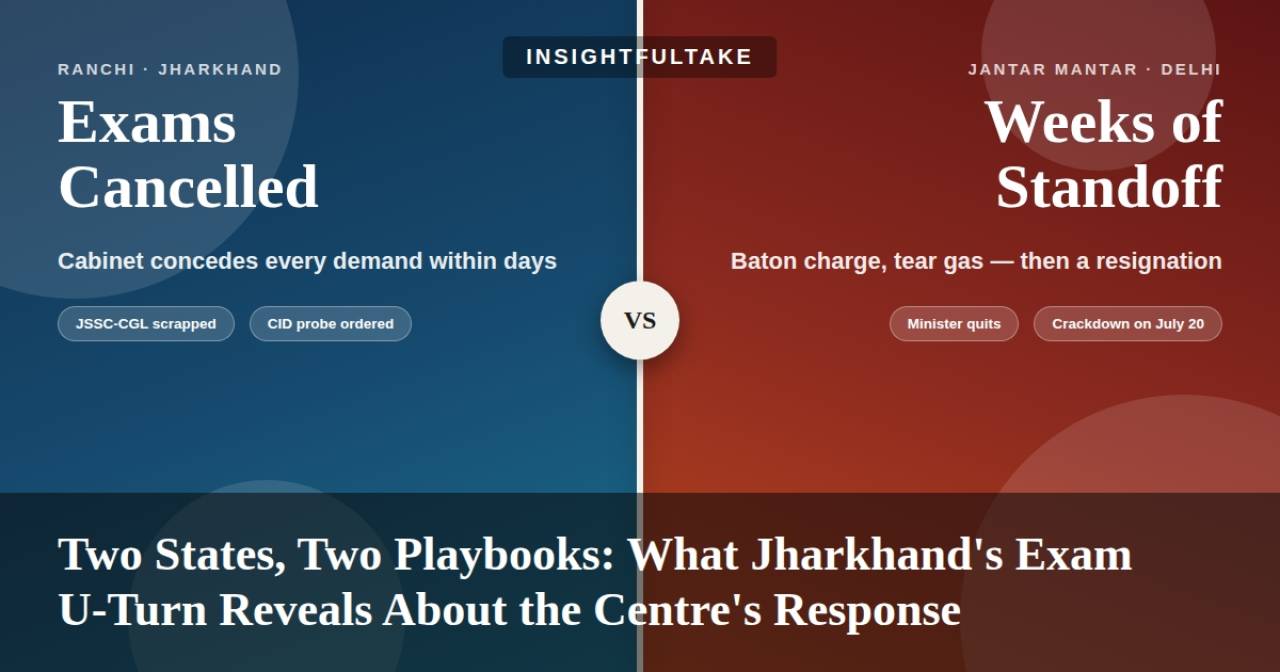
Two student movements. Two governments. Two very different responses. What does Jharkhand’s exam U-turn tell us about how India handles an increasingly frustrated generation of job and exam aspirants?
Student protests over examination irregularities have once again exposed a striking difference in how governments respond to public anger. In Jharkhand, the state government moved quickly to cancel disputed recruitment examinations and announce sweeping reforms. In Delhi, a student-led agitation at Jantar Mantar escalated into a confrontation with the police before reaching a political resolution.
The two episodes are not identical. But placed side by side, they raise an important question: Does early engagement with protesting students prevent a crisis, or do governments sometimes wait until the political cost of inaction becomes too high?
Jharkhand’s Swift Course Correction
The Jharkhand government cancelled the JSSC-CGL examination and all recruitment tests conducted by private agency TDPL on Monday, conceding one of the central demands of protesting job aspirants as their agitation intensified.
Chief Minister Hemant Soren announced the decision after a marathon cabinet meeting. The government also constituted an examination reforms committee headed by senior IAS officer Amitabh Kaushal and directed the CID to investigate irregularities in every recruitment examination conducted in the state since 2014.
The response came after days of protests in Ranchi, with some aspirants reportedly remaining on hunger strike for more than two weeks.
Once the government acted, however, it addressed several major demands simultaneously. The disputed examinations were cancelled, a state-wide investigation was ordered and a dedicated mechanism for examination reforms was established.
There was no baton charge, no tear gas and no dismantling of a protest camp.
The speed and breadth of the response have inevitably invited comparisons with a very different student movement that unfolded in the national capital.
The Jantar Mantar Confrontation
The Delhi agitation began in June, when Ladakhi activist Sonam Wangchuk joined students protesting over the NEET-UG paper leak controversy at Jantar Mantar and began an indefinite hunger strike demanding the resignation of Union Education Minister Dharmendra Pradhan.
For weeks, the protest continued without a major breakthrough.
The confrontation intensified on July 20, when thousands of students attempted to march towards Parliament during the monsoon session despite police orders to disperse. Delhi Police responded with baton charges and tear gas before subsequently dismantling the protesters’ tents at the protest site.
Images of the confrontation, along with posters carrying the message “They are students, not terrorists,” became defining visuals of the agitation.
The protest was eventually called off five days later, following intervention by opposition leaders and Pradhan’s resignation on July 25. However, demands concerning compensation for affected families and withdrawal of cases against protesters remained unresolved.
Two Governments, Two Approaches
Viewed against this timeline, Jharkhand’s response appears markedly different.
The Ranchi protesters had already been on the streets for days, and some had been fasting for more than a fortnight. Yet once the cabinet intervened, the government chose a comprehensive response rather than a piecemeal one.
The contrast quickly became political ammunition.
Congress leader Rahul Gandhi, whose party is part of Soren’s coalition government, praised the peaceful nature of the Ranchi protest and urged the chief minister to meet the students personally. He has made a similar demand of the Centre in connection with the Jantar Mantar agitation.
The optics are difficult to ignore. One government responded to an escalating student movement by expanding its intervention. The other faced criticism over the use of force before the dispute eventually moved towards a political resolution.
But the Comparison Has Limits
A direct comparison, however, would be too simplistic.
The Jharkhand dispute was primarily a state-level administrative issue involving recruitment examinations and allegations concerning a private examination agency. The government was dealing with a relatively identifiable group of job aspirants and had direct administrative responsibility for the examinations in question.
The Jantar Mantar agitation was a national political flashpoint involving the Union Education Ministry and the handling of one of India’s largest medical entrance examinations.
It also unfolded in the high-security environment surrounding Parliament during a live legislative session. The protesters’ demand included the resignation of a Union minister, a political demand that governments are rarely inclined to concede quickly.
Security agencies responsible for protecting Parliament during a monsoon session operate under a different set of considerations from a state police force dealing with a sit-in outside a stadium.
That distinction does not automatically justify the use of force against students. But it does make a simple comparison based solely on the idea of governmental “ruthlessness” incomplete.
The Common Thread: Trust in the Examination System
What connects the two episodes is more significant than what separates them.
Both protests were triggered by concerns over examination irregularities. Both reflected growing frustration among young Indians who see competitive examinations as one of the few pathways to stable employment and upward mobility.
And both demonstrated the political consequences of failing to address that frustration quickly.
In Jharkhand, the government’s decision to cancel the examinations and announce a wider investigation may help prevent the agitation from becoming a prolonged confrontation.
In Delhi, the situation escalated before a political resolution emerged.
The larger lesson is therefore not simply about Jharkhand or Delhi. It is about the relationship between governments and a generation of students whose careers can hinge on a single examination.
The Cost of Waiting
For governments, early intervention may be politically uncomfortable. Cancelling an examination, ordering an investigation or admitting that an examination system needs reform can appear like an acknowledgement of administrative failure.
But delaying action can carry a much greater cost.
Once students begin to believe that their grievances are being ignored, a dispute over an examination can quickly become a question of dignity, fairness and trust in the system itself.
Jharkhand’s experience suggests that comprehensive concessions, when offered before a protest hardens into confrontation, can potentially lower tensions.
The Delhi episode offers the opposite lesson. When a movement continues without a meaningful resolution to its core grievance, the confrontation can escalate until the political cost of ignoring it becomes greater than the cost of addressing it.
The Bigger Question for India’s Exam-Sick Youth
India conducts millions of competitive examinations every year. For many young people, these tests represent years of preparation, financial sacrifice and family expectations.
That makes examination integrity more than an administrative issue. It is a question of public trust.
The real test for governments, therefore, is not how effectively they can control a protest once it erupts. It is whether they can build examination systems credible enough to prevent such protests from becoming necessary in the first place.
Jharkhand and Delhi offer two contrasting playbooks.
One points towards early engagement, institutional reform and comprehensive action.
The other shows what can happen when a protest continues to escalate until confrontation and political intervention become unavoidable.
The choice between these approaches may determine how the next generation of India’s exam-scarred youth chooses to make itself heard.
Because when young people are protesting for fairness in an examination, the first question a government should ask is not how long they can be made to wait, but how quickly their trust can be restored.
Student protests over examination irregularities have once again exposed a striking difference in how governments respond to public anger. In Jharkhand, the state government moved quickly to cancel disputed recruitment examinations and announce sweeping reforms. In Delhi, a student-led agitation at Jantar Mantar escalated into a confrontation with the police before reaching a political resolution.
The two episodes are not identical. But placed side by side, they raise an important question: Does early engagement with protesting students prevent a crisis, or do governments sometimes wait until the political cost of inaction becomes too high?
Jharkhand’s Swift Course Correction
The Jharkhand government cancelled the JSSC-CGL examination and all recruitment tests conducted by private agency TDPL on Monday, conceding one of the central demands of protesting job aspirants as their agitation intensified.
Chief Minister Hemant Soren announced the decision after a marathon cabinet meeting. The government also constituted an examination reforms committee headed by senior IAS officer Amitabh Kaushal and directed the CID to investigate irregularities in every recruitment examination conducted in the state since 2014.
The response came after days of protests in Ranchi, with some aspirants reportedly remaining on hunger strike for more than two weeks.
Once the government acted, however, it addressed several major demands simultaneously. The disputed examinations were cancelled, a state-wide investigation was ordered and a dedicated mechanism for examination reforms was established.
There was no baton charge, no tear gas and no dismantling of a protest camp.
The speed and breadth of the response have inevitably invited comparisons with a very different student movement that unfolded in the national capital.
The Jantar Mantar Confrontation
The Delhi agitation began in June, when Ladakhi activist Sonam Wangchuk joined students protesting over the NEET-UG paper leak controversy at Jantar Mantar and began an indefinite hunger strike demanding the resignation of Union Education Minister Dharmendra Pradhan.
For weeks, the protest continued without a major breakthrough.
The confrontation intensified on July 20, when thousands of students attempted to march towards Parliament during the monsoon session despite police orders to disperse. Delhi Police responded with baton charges and tear gas before subsequently dismantling the protesters’ tents at the protest site.
Images of the confrontation, along with posters carrying the message “They are students, not terrorists,” became defining visuals of the agitation.
The protest was eventually called off five days later, following intervention by opposition leaders and Pradhan’s resignation on July 25. However, demands concerning compensation for affected families and withdrawal of cases against protesters remained unresolved.
Two Governments, Two Approaches
Viewed against this timeline, Jharkhand’s response appears markedly different.
The Ranchi protesters had already been on the streets for days, and some had been fasting for more than a fortnight. Yet once the cabinet intervened, the government chose a comprehensive response rather than a piecemeal one.
The contrast quickly became political ammunition.
Congress leader Rahul Gandhi, whose party is part of Soren’s coalition government, praised the peaceful nature of the Ranchi protest and urged the chief minister to meet the students personally. He has made a similar demand of the Centre in connection with the Jantar Mantar agitation.
The optics are difficult to ignore. One government responded to an escalating student movement by expanding its intervention. The other faced criticism over the use of force before the dispute eventually moved towards a political resolution.
But the Comparison Has Limits
A direct comparison, however, would be too simplistic.
The Jharkhand dispute was primarily a state-level administrative issue involving recruitment examinations and allegations concerning a private examination agency. The government was dealing with a relatively identifiable group of job aspirants and had direct administrative responsibility for the examinations in question.
The Jantar Mantar agitation was a national political flashpoint involving the Union Education Ministry and the handling of one of India’s largest medical entrance examinations.
It also unfolded in the high-security environment surrounding Parliament during a live legislative session. The protesters’ demand included the resignation of a Union minister, a political demand that governments are rarely inclined to concede quickly.
Security agencies responsible for protecting Parliament during a monsoon session operate under a different set of considerations from a state police force dealing with a sit-in outside a stadium.
That distinction does not automatically justify the use of force against students. But it does make a simple comparison based solely on the idea of governmental “ruthlessness” incomplete.
The Common Thread: Trust in the Examination System
What connects the two episodes is more significant than what separates them.
Both protests were triggered by concerns over examination irregularities. Both reflected growing frustration among young Indians who see competitive examinations as one of the few pathways to stable employment and upward mobility.
And both demonstrated the political consequences of failing to address that frustration quickly.
In Jharkhand, the government’s decision to cancel the examinations and announce a wider investigation may help prevent the agitation from becoming a prolonged confrontation.
In Delhi, the situation escalated before a political resolution emerged.
The larger lesson is therefore not simply about Jharkhand or Delhi. It is about the relationship between governments and a generation of students whose careers can hinge on a single examination.
The Cost of Waiting
For governments, early intervention may be politically uncomfortable. Cancelling an examination, ordering an investigation or admitting that an examination system needs reform can appear like an acknowledgement of administrative failure.
But delaying action can carry a much greater cost.
Once students begin to believe that their grievances are being ignored, a dispute over an examination can quickly become a question of dignity, fairness and trust in the system itself.
Jharkhand’s experience suggests that comprehensive concessions, when offered before a protest hardens into confrontation, can potentially lower tensions.
The Delhi episode offers the opposite lesson. When a movement continues without a meaningful resolution to its core grievance, the confrontation can escalate until the political cost of ignoring it becomes greater than the cost of addressing it.
The Bigger Question for India’s Exam-Sick Youth
India conducts millions of competitive examinations every year. For many young people, these tests represent years of preparation, financial sacrifice and family expectations.
That makes examination integrity more than an administrative issue. It is a question of public trust.
The real test for governments, therefore, is not how effectively they can control a protest once it erupts. It is whether they can build examination systems credible enough to prevent such protests from becoming necessary in the first place.
Jharkhand and Delhi offer two contrasting playbooks.
One points towards early engagement, institutional reform and comprehensive action.
The other shows what can happen when a protest continues to escalate until confrontation and political intervention become unavoidable.
The choice between these approaches may determine how the next generation of India’s exam-scarred youth chooses to make itself heard.
Because when young people are protesting for fairness in an examination, the first question a government should ask is not how long they can be made to wait, but how quickly their trust can be restored.























Leave a Comment