
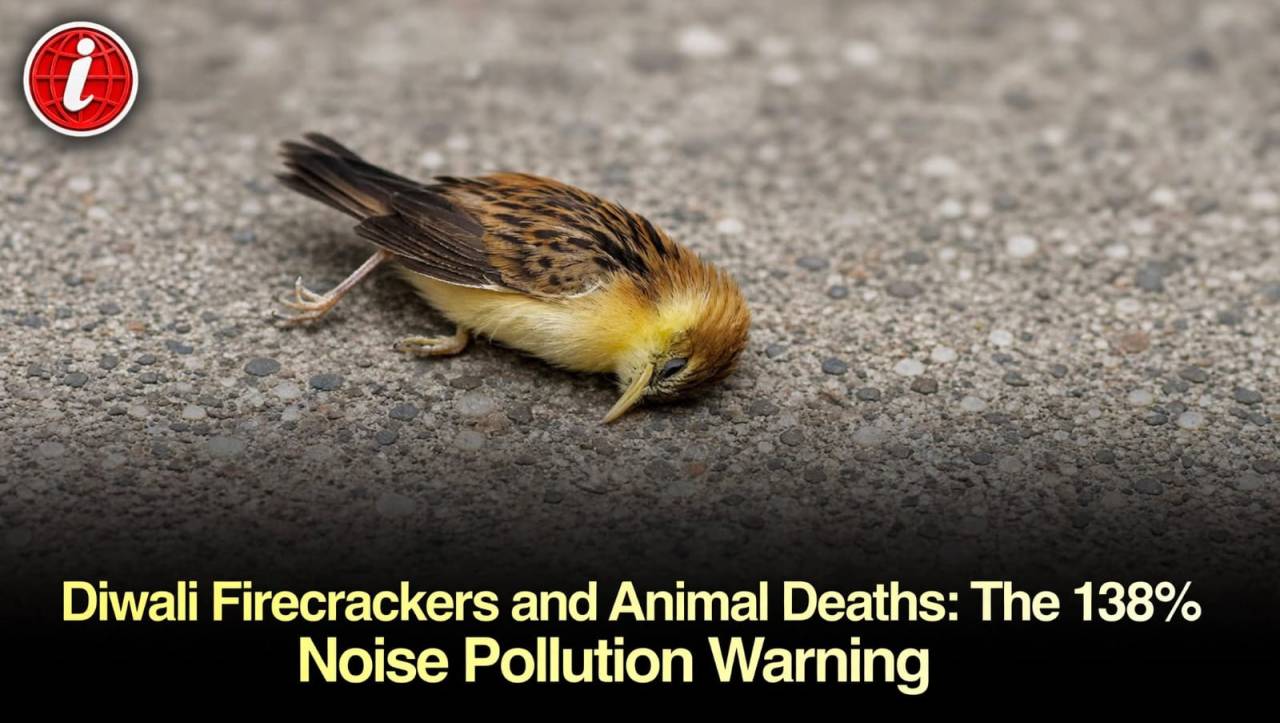
The sound we celebrate for a few hours can become a source of fear, injury and death for animals that have no way to escape it. New scientific research offers a disturbing warning, but India still does not count the full toll.
Diwali is a festival of light, renewal and celebration. Across India, homes glow with earthen lamps, families exchange sweets and neighbourhoods come alive with festivities. But as darkness falls, the explosions of firecrackers takes over the streets.
For people, the noise is often part of the celebration. For animals, it can be something entirely different.
Dogs hide beneath vehicles, birds abandon their resting places, cattle become restless and smaller creatures struggle to escape the sudden explosions. While humans return to their celebrations, the animals are left dealing with the consequences.
A new scientific study published in the journal Science has given this concern a much wider significance.
The 138% warning from scientific research
Published on November 5, 2026, the research paper Echoes of the Anthropocene: Noise Pollution as a Global Threat, by researchers Hansjoerg P. Kunc and Rouven Schmidt of Queen's University Belfast, examined the biological consequences of human-generated noise.
The researchers analysed 214 experimental studies involving 177 aquatic and terrestrial species across six continents. It is one of the most comprehensive analyses of its kind.
The findings are troubling. Human-generated noise affected at least one physiological, developmental or behavioural characteristic in 80% of the species studied. The research also identified declining fitness and abundance, alongside disruptions in predator-prey interactions.
Reports highlighting the study have cited increases in animal mortality of up to 138% associated with noise exposure.
The distinction matters. This is not a finding that 138% more animals die during Diwali. It is evidence of how seriously human-generated noise can affect animal survival.
The larger message is difficult to ignore. Noise is not merely an inconvenience for wildlife. It is an environmental pressure that can alter how animals live, reproduce, find food and survive.
When Diwali fireworks become a threat
The implications are particularly relevant to India, where firecrackers remain a prominent feature of Diwali celebrations.
Unlike regular urban noise, fireworks produce sudden, unpredictable explosions accompanied by bright flashes and smoke. Animals cannot anticipate when the next explosion will occur or where it will come from.
Dogs and cats have more sensitive hearing than humans. Loud explosions can trigger intense fear, trembling, excessive barking, attempts to escape and loss of appetite.
Birds face a different set of dangers. Sudden explosions can disturb roosting patterns, trigger panic flights and force birds to abandon their resting places.
A 2023 study published in Scientific Reports, titled L-band Radar Quantifies Major Disturbance of Birds by Fireworks in an Urban Area, examined bird movements in Birmingham, United Kingdom.
Researchers used radar to monitor flying birds during Diwali, Bonfire Night and New Year's Eve celebrations. During Diwali fireworks, bird flight activity increased significantly compared with normal periods. Birds also flew at higher altitudes, suggesting disturbance and attempts to escape.
The researchers warned that such sudden movements could increase energy expenditure and expose birds to additional risks, including collisions with buildings and other structures.
This is particularly relevant to India, where Diwali coincides with the autumn and winter period, when migratory birds are arriving in different parts of the country.
The consequences of fireworks are therefore not limited to household pets. They can extend into urban ecosystems and affect birds that depend on relatively undisturbed spaces for feeding and resting.
India's animal casualties remain largely uncounted
Perhaps the most disturbing part of this story is that India does not have a comprehensive national database documenting animal deaths and injuries caused by Diwali fireworks.
Individual incidents are reported every year, but there is no reliable nationwide figure that captures the scale of the problem.
Recent reports from Diwali 2026 illustrate the human-made dangers.
In Jalore, Rajasthan, four newborn puppies reportedly died after a firecracker spark ignited bushes where they were sleeping.
In Bengaluru, an eight-month-old stray dog reportedly died after panicking during fireworks and jumping from a height.
In Himachal Pradesh, a fire triggered by fireworks reportedly killed six female goats, four male goats and a calf.
Reports also documented seven pregnant buffaloes in Haryana suffering premature labour after prolonged firecracker explosions, with their unborn calves reportedly dying.
Animal hospitals and rescue organisations also recorded cases of injured dogs, cats and birds.
In Mumbai, Parel Animal Hospital received 38 animals and birds affected by fireworks on Diwali day alone. In Ahmedabad, an animal welfare organisation recorded more than 450 cases involving injured animals and birds during five days of Diwali in 2024.
These are reported incidents, not a national mortality estimate. They nevertheless reveal how much suffering can remain outside official environmental and public-health statistics.
Noise is only one part of the damage
Firecrackers do not harm animals through sound alone.
The smoke and fine particulate matter released during fireworks can worsen respiratory conditions. Chemical residues can contaminate surfaces, soil and water. Burning crackers can also cause direct injuries, fires and destruction of animal shelters.
Research conducted in Delhi found that particulate pollution increased substantially during Diwali celebrations between 2006 and 2008. Ambient noise levels were also 1.2 to 1.3 times higher than on normal days.
Another study conducted in Northeast India during Diwali 2015 recorded a 65% increase in noise levels and an 81% increase in average PM10 concentrations compared with other days.
The evidence suggests that the environmental cost of fireworks extends well beyond the few hours of celebration.
Can a festival of light celebrate without frightening life?
The debate over firecrackers should not become an argument against Diwali or its cultural significance.
Diwali has a much deeper meaning than fireworks. Lighting diyas, sharing sweets, meeting relatives and celebrating the triumph of good over evil are traditions that do not require deafening explosions.
There are practical ways to reduce the damage. Communities can organise quieter celebrations, avoid fireworks near animal shelters, bird habitats and veterinary facilities, and discourage high-decibel crackers. Pet owners can prepare safe indoor spaces for animals during celebrations. Municipal authorities and animal welfare organisations can also establish emergency response systems.
More importantly, India needs systematic research. A national monitoring mechanism could document animal injuries, deaths, missing pets, bird displacement and veterinary emergencies during major festivals. Without reliable data, the scale of the problem will remain difficult to measure and address.
The sound we stopped hearing
Human beings have gradually become accustomed to the sounds of modern life. Traffic horns, construction machinery, loudspeakers and exploding firecrackers have become part of the everyday urban experience.
But familiarity does not make noise harmless.
The new research published in Science reminds us that the soundscape created by human civilisation is changing the conditions in which other species survive.
For animals, there is no switch to turn down the volume. There is no safe neighbourhood guaranteed to remain silent. And there is no way to understand why a celebration happening thousands of times around them suddenly becomes a threat.
Diwali celebrates the victory of light over darkness. Perhaps it is time to ask whether that celebration should come at the cost of the lives that share our streets, trees and skies.
The question is no longer whether animals can hear our celebrations. It is whether we are willing to hear their suffering.





















Leave a Comment