
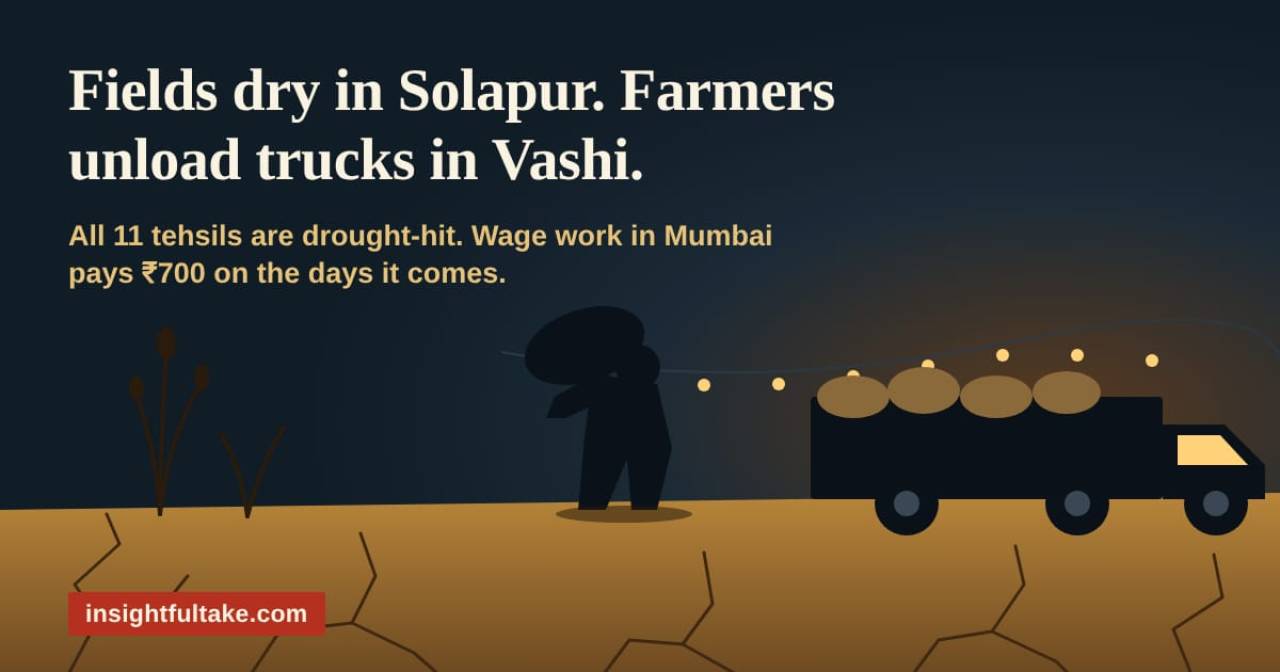
A failed monsoon has emptied Solapur's fields and pushed farmers to Mumbai, where owning land no longer guarantees a family's survival.
A failed monsoon has pushed farmers out of their villages and into Mumbai's wholesale vegetable market, where they unload trucks through the night to feed their families
On Thursday night, the wholesale market at Vashi in Navi Mumbai was operating as usual. Trucks arrived, sacks were unloaded, and traders prepared for auctions that would be over before the city woke up. Among the men carrying vegetables was 65-year-old Moroddin Hussain, a farmer from Maharashtra's Solapur district. He owns agricultural land, but this year it has failed to provide him with a livelihood.
Hussain had spent approximately ₹16,000 to ₹17,000 on sunflower seeds and tractor services to prepare his field. But the rains never arrived in sufficient quantity. His crop dried before harvest, leaving him with nothing to sell. Now, instead of working on his own land, he spends nights unloading vegetables in Mumbai to earn enough to feed his family.
His story reflects a growing rural crisis. All 11 tehsils of Solapur district have been declared drought-hit. Rainfall is approximately 58% below the average, placing the district among the worst-affected regions in Maharashtra. Sangola has recorded a 52% rainfall deficit, while Mohol has received just 193.2 mm of rainfall.
The situation is reportedly worse than during the 2015 drought in some respects. Compared with that year, 47% more wells in the district are showing declining water levels. Sunflower and tur, two important crops for local farming households, have suffered extensive damage. With the kharif season largely lost, farmers are now worried about the prospects of rabi cultivation, particularly jowar.
When Farming Stops Paying, Migration Begins
The size of agricultural holdings explains why the drought has hit so many families hard. Most farmers in Solapur own between three and six acres. Such holdings offer little financial protection when an entire crop fails.
Farmers invest in seeds, tractor services, labour and other inputs before the monsoon. When rainfall fails, these expenses become unrecoverable losses. But household responsibilities do not disappear. Food, children's education, healthcare and other essential expenses continue.
For many families, migration becomes the only available option.
Shivsharma Koli, 27, from Sangola, arrived in Mumbai a month ago. He earns ₹700 on days when he finds work at the Vashi market. He rents a room in Turbhe for ₹2,000 a month and sends whatever remains after meeting his basic expenses back home.
Mehboob Kheraj, 43, is another farmer who has left Solapur. Despite owning six acres, he found himself unable to sustain his family after sugarcane and tur cultivation failed. With eight family members, including children attending college, managing household expenses has become increasingly difficult.
Kishor Chavan, a supervisor who arranges work for labourers at the market, says farmers from Solapur keep contacting him to ask whether they can also come to Mumbai.
Mumbai's Labour Market Offers No Guarantee
Reaching Mumbai does not necessarily mean escaping financial uncertainty.
The Vashi market provides opportunities for daily-wage labour, but employment is irregular. Workers are paid only when they are hired. A labourer may earn ₹700 on one day and find no work the next.
The situation has become more complicated because the drought has also affected the supply of agricultural produce. Fewer vegetable trucks are reaching the market, reducing the availability of unloading work just as more desperate workers are arriving.
For someone paying ₹2,000 in monthly rent, buying food and supporting a family in the village, irregular employment can quickly become another financial trap.
According to the report, approximately 40 to 50 drought-hit farmers from Solapur are currently working at the Vashi market.
They have not abandoned agriculture by choice. They have been pushed away from their fields by the absence of a viable alternative.
Rural Migration Could Become Permanent
Migration from drought-affected regions of Maharashtra is not new. Farmers and agricultural labourers have traditionally moved towards cities in search of employment during difficult agricultural seasons.
However, researchers are concerned about the scale of migration this year and whether these movements will remain temporary.
Prabhakar Kolekar, associate professor of sociology at Punyashlok Ahilyadevi Holkar Solapur University, says migration from the district is significantly higher than in previous years. He warns that if agricultural conditions do not improve, temporary migration could gradually turn into permanent displacement.
He also highlights a change in the profile of those leaving rural areas.
Educated young people who had returned to farming are once again moving towards urban centres. While some are heading to Pune and Mumbai, others are looking for opportunities in Hyderabad and Bengaluru, where skilled employment is available.
This trend raises a larger concern about the future of agriculture in drought-prone districts. When even educated young people begin abandoning farming, the problem extends beyond one failed monsoon. It raises questions about agricultural viability, rural employment and the ability of small farmers to sustain their livelihoods.
Employment Schemes and the Question of Timely Support
The administration has pointed to government employment initiatives, including the Viksit Bharat–Guarantee for Rozgar and Ajeevika Mission (Gramin), as part of its response to the situation.
District officials have acknowledged that agriculture remains the principal source of livelihood in Solapur, making the impact of a failed monsoon particularly widespread.
However, the immediate question is whether employment support reaches affected households before their savings are exhausted.
The experiences of farmers working at Vashi suggest that many could not afford to wait for assistance. They had to leave their villages and travel hundreds of kilometres to find work.
Employment guarantees and rural livelihood programmes can provide an important safety net, but their effectiveness depends on timely implementation and the availability of actual work.
For a farmer who has already lost an entire crop, a promise of employment is meaningful only when it translates into income at the right time.
The Human Cost Behind the Drought Figures
There is another dimension to this crisis that rainfall statistics and agricultural loss estimates cannot capture.
Around Diwali, ministers visited the homes of drought-affected farmers to celebrate the festival with them. Meanwhile, many farmers from the same communities were spending the festive period away from their families, unloading vegetable trucks in Mumbai.
Their fields remained dry. Their families remained in their villages. Their festival was spent wherever daily work was available.
The journey from Solapur to Vashi is not simply a story of rural workers moving towards a city. It is a story of farmers who invested in their land, lost their crops and were forced to sell their labour to survive.
A drought does not end with a failed harvest. It continues through unpaid debts, interrupted education, family separation and the gradual loss of confidence in farming.
When a 65-year-old landowner has to unload vegetables through the night because his own field cannot feed his family, the crisis deserves attention beyond rainfall figures and official declarations.





















Leave a Comment