
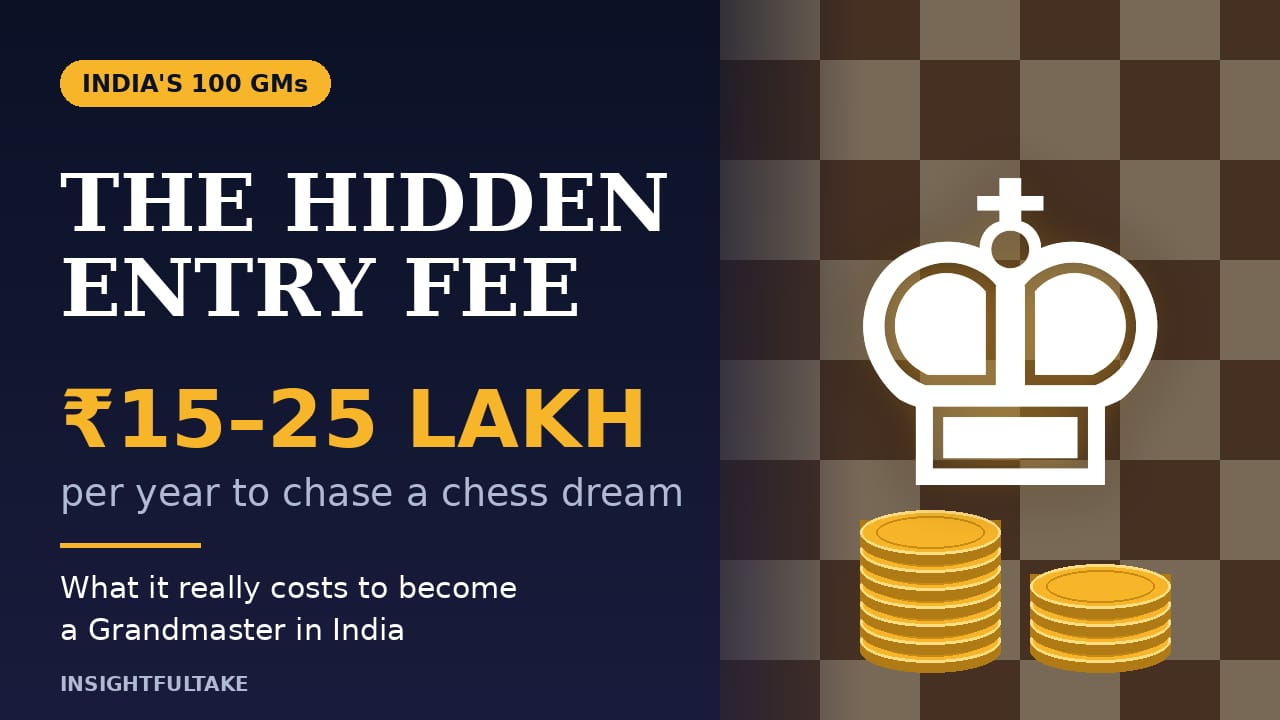
India's 100 grandmasters mark a historic achievement, but behind every title lies a costly journey of family sacrifices, overseas tournaments and financial uncertainty.
India now has 100 chess grandmasters, a milestone that would have seemed almost unimaginable a generation ago. The achievement deserves celebration. But behind the growing list of titles lies a less celebrated story. How much does it cost to become a grandmaster, and who bears that cost?
The answer is not recorded on any scoresheet. It is written in bank statements, depleted savings and difficult family decisions.
For many aspiring players, becoming a grandmaster is not just a test of chess ability. It is also a financial challenge that begins long before the title is within reach.
A Title That Comes Without a Paycheque
Here is a surprising fact. The grandmaster title carries no prize money. There is no cheque waiting when a player earns the distinction. What the title offers is access to opportunities that may come later, including better tournament invitations, waived entry fees and, sometimes, complimentary hotel accommodation.
Reaching that stage, however, requires substantial investment.
A player must earn three GM norms and achieve a FIDE rating of at least 2500. The journey involves years of coaching, tournament participation, international flights, visas, accommodation and entry fees.
Families have reported spending between ₹15 lakh and ₹25 lakh annually during the intensive norm-chasing phase. For many Indian households, that amount is higher than their total annual income.
The financial burden is particularly difficult because there is no guarantee of success or a predictable timeline for earning the title.
The Geography of Opportunity
Chess coach RB Ramesh has pointed out that more than 90 per cent of Indian GM norms are earned abroad, largely because India does not have enough norm tournaments.
This creates an unusual disadvantage for Indian players. A norm cannot be earned simply by playing well. It requires participation in tournaments with the right combination of opponents, ratings and competitive conditions.
When most suitable events take place in Europe, talent alone is not enough. Players also need passports, visas, international air tickets and money for accommodation.
Consider a gifted teenager from a small town whose family cannot afford an overseas trip. The player may have the ability to compete with the best, but without access to the right tournament, that potential remains unrealised.
This is one of the less visible filters in Indian chess. The question is not merely who has the ability to become a grandmaster, but who can afford to travel to places where that ability can be recognised.
Financial Planning Becomes a Second Game
The journeys of several young Indian players reveal how much financial planning takes place behind their achievements.
Ethan Vaz's family initially concentrated on domestic tournaments because international competitions were too expensive. Later, the family spent approximately ₹15 lakh to ₹20 lakh annually on coaching, travel and tournament fees.
Even then, costs influenced their decisions. They preferred relatively affordable international destinations such as Dubai and Malaysia. Vaz became a grandmaster within a year of earning his International Master title, reducing the period during which his family had to finance the pursuit of GM norms.
Pranav Venkatesh, now a world junior champion, faced a different set of limitations during his childhood. He missed important overseas age-group tournaments because he was too young to travel independently, while his family could not afford to send a parent along with him.
International travel became possible only after his rating crossed 2100.
Mayank Chakraborty, the Northeast's first grandmaster, encountered another challenge: access to experienced coaching.
In 2018, his mother hosted a grandmaster at home for specialised training. She paid for the coach's airfare from Kolkata and ₹42,000 for approximately five to six days of instruction. Another coach charged ₹10,000 per day.
These examples reveal an important aspect of competitive chess in India. Financial management becomes almost a second sport. Families must decide which tournaments to skip, which destinations are affordable, when to invest in coaching and how long they can sustain the expense.
Sometimes, these decisions can influence a player's career as much as preparation for an important opening.
Where the Money Finally Comes In
At the highest level, professional chess can be financially rewarding. But the earnings are concentrated among a relatively small group of players.
According to Chess.com, 26 leading grandmasters earned six-figure prize totals in 2025. Among the Indian players, Arjun Erigaisi led with approximately ₹4.04 crore in prize money, followed by R Praggnanandhaa with around ₹2.97 crore and D Gukesh with approximately ₹1.89 crore.
Pranav Venkatesh earned around ₹38 lakh from just three tournaments during the year. His victory at the World Junior Championship also brought greater visibility and tournament invitations.
Appearance fees provide another source of income, although they depend heavily on a player's rating and reputation. At the 2026 Serbia Open, these fees reportedly ranged from approximately ₹21,000 for lower-rated participants to around ₹1.57 lakh for players rated above 2650.
However, the earnings of elite players should not be mistaken for the financial reality of an average grandmaster.
Most never reach the commercial heights of India's leading chess stars. Anuj Shrivatri, India's 100th grandmaster, reportedly turned down a software engineering job to pursue the title. He also coached alongside playing to support himself.
For many players, coaching eventually becomes a more dependable source of income than tournament competition. It offers greater financial stability in a profession where prize money can be unpredictable.
The Grandmaster Title as a Family Investment
Perhaps the best way to understand the economics of becoming a grandmaster is to compare it with building a startup.
A family makes a substantial investment. Years pass without any assured return. Success depends on talent, preparation, health, opportunities and a degree of luck. Meanwhile, the expenses continue.
For some families, the money runs out before the player gets close to the title.
This perspective gives the milestone of 100 Indian grandmasters a different meaning. The achievement is impressive, but another question deserves attention. How many talented players were unable to continue because their families could not afford the journey?
Ramesh's assessment is particularly relevant here. India's chess progress, in his view, has happened despite the existing system rather than because of it.
Making the Grandmaster Dream More Affordable
The solutions are not particularly complicated, although they require institutional commitment.
India needs more internationally recognised norm tournaments on home soil. This would reduce the cost of overseas travel and give promising players greater access to competitive opportunities.
A stronger system of travel assistance, sponsorship for talented juniors and affordable access to quality coaching could make an equally important difference.
Chess federations, state governments, corporate sponsors and private institutions all have a role to play. Financial support should reach promising players before they become famous, not only after they have secured international recognition.
Every additional norm tournament organised in India means one less expensive international trip for a family to finance.
The next time India celebrates a new grandmaster, it is worth remembering the people sitting behind the player: parents who funded tournaments, rearranged household budgets, paid for coaching and continued believing when the results were uncertain.
The 101st Indian grandmaster may already be preparing for the next tournament. The country must ensure that the player's biggest challenge is finding the right move on the chessboard, not finding the money to reach it.









Leave a Comment