
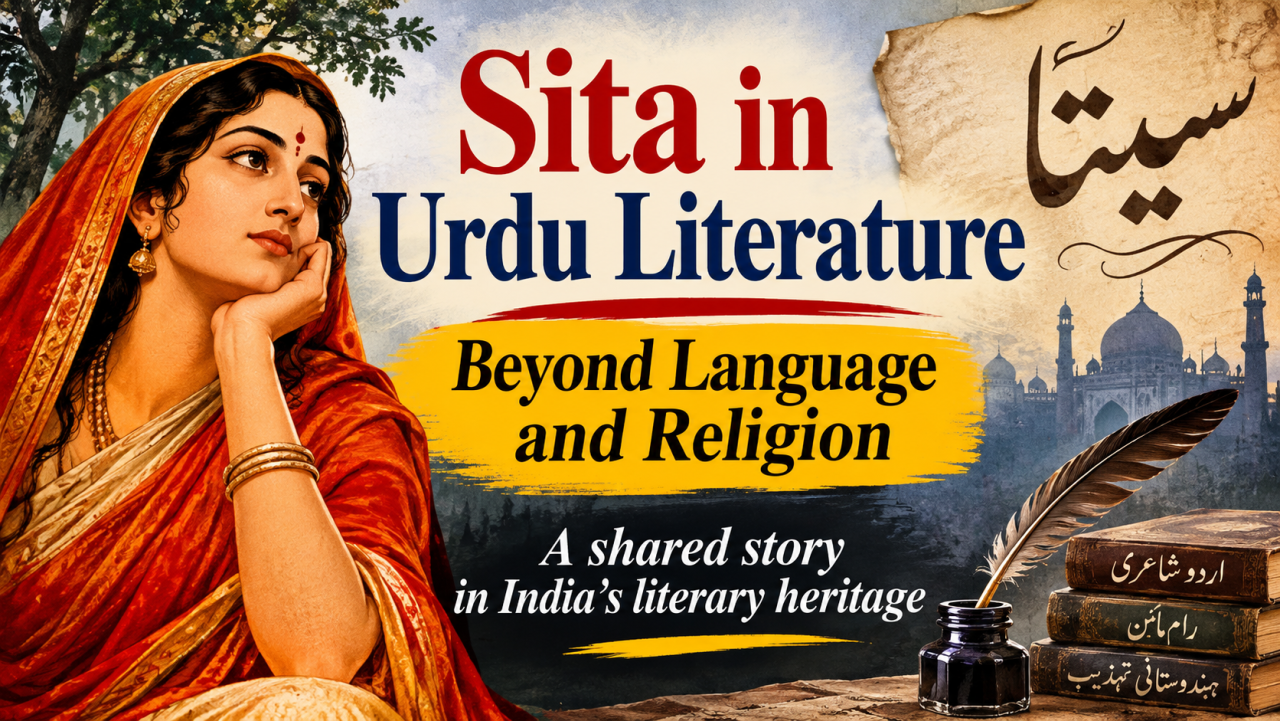
A literary tradition that is often misunderstood reveals a remarkable body of Urdu writing on Sita, exploring her exile, dignity, suffering and resistance across generations.
Sita is one of the most recognisable women in Indian literature. Her story has travelled through generations in the Ramayana, regional retellings, folk performances, theatre, poetry and popular culture. But there is another literary journey that receives far less attention. Sita has also found a lasting place in Urdu literature.
This may surprise readers who have grown accustomed to viewing Indian languages and literary traditions through religious categories. Urdu is frequently associated with Muslim writers and Islamic cultural traditions, while the Ramayana is often placed within the boundaries of Hindu religious literature. Yet the history of Urdu writing tells a much richer story. Its poets, novelists and playwrights have repeatedly drawn upon the Ramayana, finding in its characters themes that speak to human experience beyond religious identity.
Sita, in particular, has inspired some deeply moving literary interpretations.
A literary tradition larger than commonly imagined
The Urdu engagement with the Ramayana is neither new nor limited to a handful of poems. Literary historian and writer Rakhshanda Jalil has drawn attention to the remarkable number of Urdu retellings of the Ram Katha. Her research and writing point to more than 300 versions in the Awadh region alone, many composed in verse.
These works demonstrate that the Ramayana was not confined to one language or a single community's imagination. It became part of a wider literary culture in which writers interpreted familiar characters through their own social, philosophical and artistic concerns.
The Urdu tradition also produced works that approached the epic from perspectives that were not always central to conventional retellings. One notable example is Agha Hashar Kashmiri's play Sita Banwas, which presents the story from Sita's perspective.
That choice matters. Rather than treating Sita merely as a character in Ram's journey, it brings her experience to the centre of the narrative.
Sita as a woman, not merely a symbol
Much of Sita's literary significance comes from the questions her life raises. She experiences exile despite having committed no wrongdoing. She is abducted through deception, separated from her husband and later subjected to questions about her purity. Her suffering raises uncomfortable questions about the treatment of women, the burden of social expectations and the meaning of justice.
Urdu poets have found in these experiences a language for discussing much more than the events of an ancient epic.
For some, Sita represents innocence and endurance. For others, she becomes a metaphor for displacement, injustice and the restrictions imposed on women. Her story offers a way to discuss the unequal standards through which society judges women's conduct while often overlooking the actions of those who harm them.
This is where literary interpretation becomes particularly interesting. The same Sita can represent patience in one poem and resistance in another. She can be an emblem of cultural memory as well as a woman whose suffering exposes the contradictions of society.
When exile becomes a metaphor for modern India
One of the most compelling aspects of Urdu writing on the Ramayana is its ability to connect ancient narratives with contemporary events.
Kaifi Azmi's poem Doosra Banwas is an important example. It draws upon the idea of exile in the context of the demolition of the Babri Masjid on December 6, 1992. The imagery of Ram's departure from Ayodhya becomes a way of expressing the pain of a society confronting religious division and the destruction of a shared cultural inheritance.
The idea of banwas thus moves beyond the forest of the Ramayana. It becomes a metaphor for alienation, loss and the feeling of being uprooted from one's own home.
Qurratulain Hyder's novella Sita Haran, translated into English as Sita Betrayed, offers another striking interpretation. Its central character, Sita Mirchandani, is a Hindu refugee from Sindh whose separation from her homeland after Partition echoes the displacement associated with Sita's abduction and exile.
The connection is not simply symbolic. It brings together two different historical experiences through a shared language of loss. The ancient story becomes a lens through which the trauma of Partition can be understood.
Such writing demonstrates the power of literature to make old narratives speak to new generations.
The Lakshman Rekha and the question of women's freedom
Perhaps the most revealing interpretations emerge when Urdu poets revisit the Lakshman Rekha.
In popular understanding, the boundary drawn by Lakshman represents protection. But it also raises a difficult question: where does protection end and restriction begin?
Wajid Chughtai and Pratap Somvanshi, among others, have used the imagery of the Lakshman Rekha to challenge conventional assumptions about danger and responsibility. The suggestion that the Ravans women encounter may also exist within their own homes turns the familiar episode into a commentary on domestic violence and social hypocrisy.
This is a significant shift in perspective. Instead of placing the entire burden of caution upon Sita, the poetry asks readers to examine the conduct of those who exploit her vulnerability.
Women poets have taken this questioning further. Bilquis Zafirul Hasan, for instance, challenges the expectation that women should silently endure suffering in the name of patience. Her response to the familiar image of Sita refusing to undergo another trial of fire offers a different understanding of dignity.
It is no longer enough to praise a woman for enduring injustice. Society must also ask why she was expected to endure it in the first place.
Urdu and the shared inheritance of Indian culture
The presence of Sita in Urdu literature carries significance beyond literary appreciation. It challenges the artificial division of Indian cultural heritage into religious compartments.
Languages do not develop in isolation. They absorb stories, expressions, metaphors and memories from the societies in which they grow. Urdu, with its long history in the Indian subcontinent, has drawn upon a wide range of cultural traditions. The Ramayana is one such source.
Allama Iqbal's celebrated description of Ram as Imam-e-Hind is another reminder that the cultural imagination of Urdu poets was not restricted by narrow religious boundaries. While much attention has traditionally been given to Urdu poetry about Ram, Sita's presence deserves equal recognition.
This is not simply a matter of celebrating communal harmony. It is about recognising the actual history of Indian literature, where creative expression frequently crossed the boundaries that modern public discourse attempts to reinforce.
A poet does not need to belong to a particular religion to understand the anguish of exile, the pain of separation or the injustice of a woman's suffering.
A story that still asks uncomfortable questions
Sita's journey through Urdu literature also invites us to reconsider how we read the Ramayana today. Should she be remembered only for her patience and sacrifice? Or should her story also prompt a discussion about the expectations placed upon women, the meaning of consent, the burden of proving innocence and the social structures that determine their freedom?
Different poets have offered different answers. That diversity is precisely what makes the literary tradition valuable.
Sita has survived not merely because her story is sacred to millions, but because her experiences continue to raise questions that remain relevant. Her exile speaks to displaced communities. Her ordeal speaks to women facing injustice. Her dignity speaks to those who refuse to let suffering define their worth.
Perhaps the most important lesson from her journey through Urdu literature is that cultural inheritance cannot be divided so easily. A story belongs to everyone who reads it, questions it, interprets it and finds a part of their own humanity within it.
Sita travelled through languages without losing her identity. In Urdu literature, she found not a different home, but another voice through which India could tell her story.





















Leave a Comment