
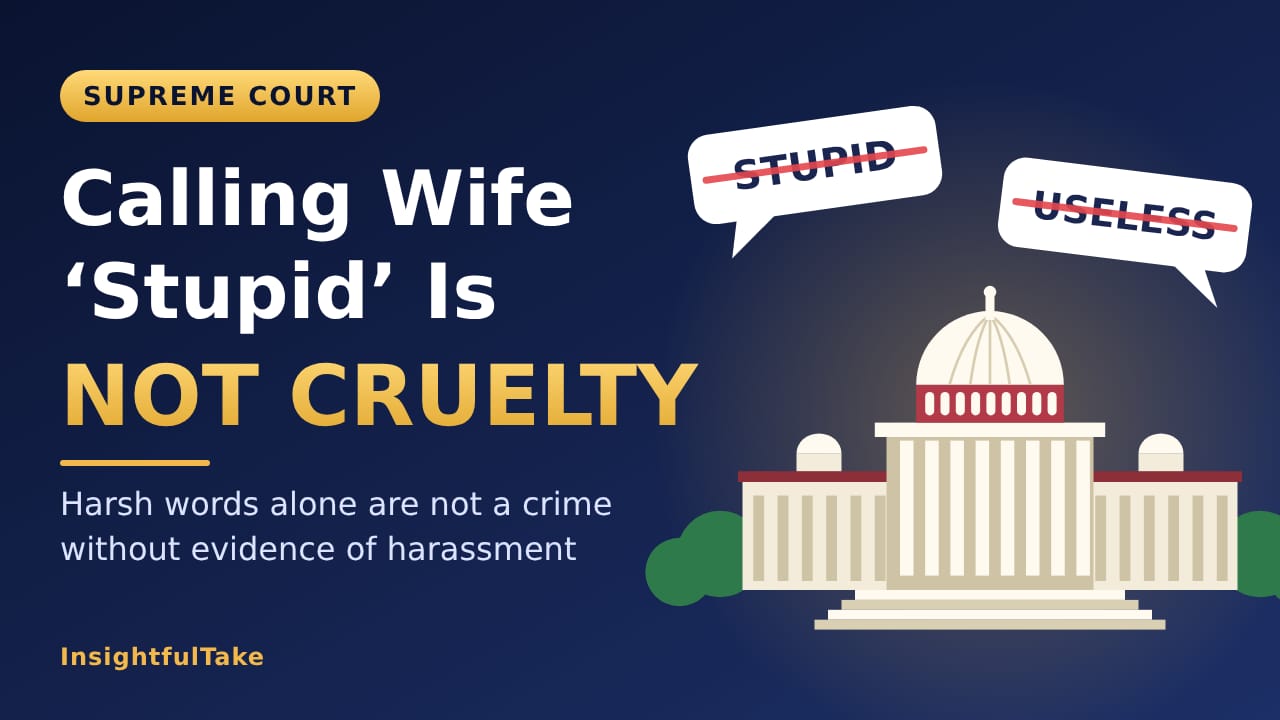
Can calling a wife “stupid” or “useless” be a crime? The Supreme Court draws the legal line between marital discord and criminal cruelty.
The Supreme Court says verbal insults and temperamental differences between spouses cannot be treated as criminal cruelty without evidence of harassment, coercion or conduct meeting the legal threshold.
The Supreme Court has ruled that a husband calling his wife “stupid” or “useless” does not, by itself, amount to cruelty or criminal intimidation. The court cautioned trial courts and police against giving a criminal colour to temperamental differences between spouses when there is no evidence of harassment or abuse.
The judgment was delivered on November 2 by a bench of Justices BV Nagarathna and Manmohan. The court quashed criminal proceedings against a man whose wife died by suicide in Canada.
The Case Behind the Supreme Court Ruling
The couple married in 2021 and lived with the husband's family in Maharashtra before moving to Toronto in 2022. On June 11, 2023, the woman died after jumping from the 22nd floor of their apartment building. A handwritten note was found in the home.
Her father subsequently alleged that the husband and his in-laws had demanded 15 tolas of gold before the wedding and continued making unlawful demands afterwards.
He also alleged that the husband frequently criticised his wife for failing to find employment in Canada, assaulted her during a visit to India and maintained extramarital relationships.
An FIR was registered under Sections 304B (dowry death), 323 (voluntarily causing hurt), 498A (cruelty by husband or relatives) and 504 (intentional insult) of the Indian Penal Code (IPC), read with Section 34, along with provisions of the Dowry Prohibition Act.
The Bombay High Court refused to quash the proceedings in January 2025, prompting the husband to approach the Supreme Court.
What the Supreme Court Found
The bench noted that neither the coroner's report nor the police investigation indicated foul play or a struggle. The husband was not present at home when the incident occurred. CCTV footage showed him returning to the building nearly half an hour later.
On the dowry allegations, the court observed that there was no material establishing that gifts and money exchanged between the families were given in response to unlawful demands. Therefore, such exchanges could not automatically be treated as dowry.
The court also questioned why no concrete action had been taken earlier if the alleged demands and harassment were as serious as claimed.
Addressing the husband's alleged remarks, the bench observed that a spouse's short temper or habit of scolding over trivial matters cannot automatically be classified as criminal conduct.
Nor can such behaviour, without further evidence, establish that the person was responsible for the spouse's suicide.
At best, the court observed, such conduct reflected on the husband's temperament.
The Legal Test for Abetment of Suicide
The Supreme Court emphasised that a husband or his family members cannot automatically be held criminally responsible for a suicide.
The prosecution must establish that their actions or omissions coerced the deceased to such an extent that taking her own life appeared to be the only way out.
In the absence of evidence meeting this legal threshold, criminal proceedings cannot be sustained merely because a suicide occurred within a marriage.
The bench also acknowledged the emotional trauma faced by families who lose their daughters in such circumstances. It recognised that courts must remain sensitive to their grief.
However, sympathy cannot replace evidence in a criminal trial.
Why the Judgment Matters
India's matrimonial laws, particularly Section 498A and the provisions dealing with dowry deaths, were introduced to protect women against genuine harassment, domestic abuse and dowry-related violence.
These provisions have played an important role in addressing serious crimes against married women. However, the Supreme Court has repeatedly cautioned against their misuse through vague, exaggerated or general allegations that do not meet the requirements of criminal law.
The latest ruling reinforces an important legal distinction. Verbal insults, arguments and temperamental differences within a marriage, however hurtful, do not automatically constitute criminal cruelty or abetment of suicide.
Investigating agencies and prosecutors must establish specific acts of harassment, coercion or other conduct that satisfy the relevant legal provisions.
For families seeking justice after losing a daughter, the judgment does not diminish the seriousness of their loss. Rather, it reiterates that criminal accountability must rest on evidence and not merely on allegations or the tragic outcome of a failed marriage.
The larger message is that matrimonial cruelty must be taken seriously, but criminal liability cannot be established by treating every marital disagreement as a crime.




















Leave a Comment