
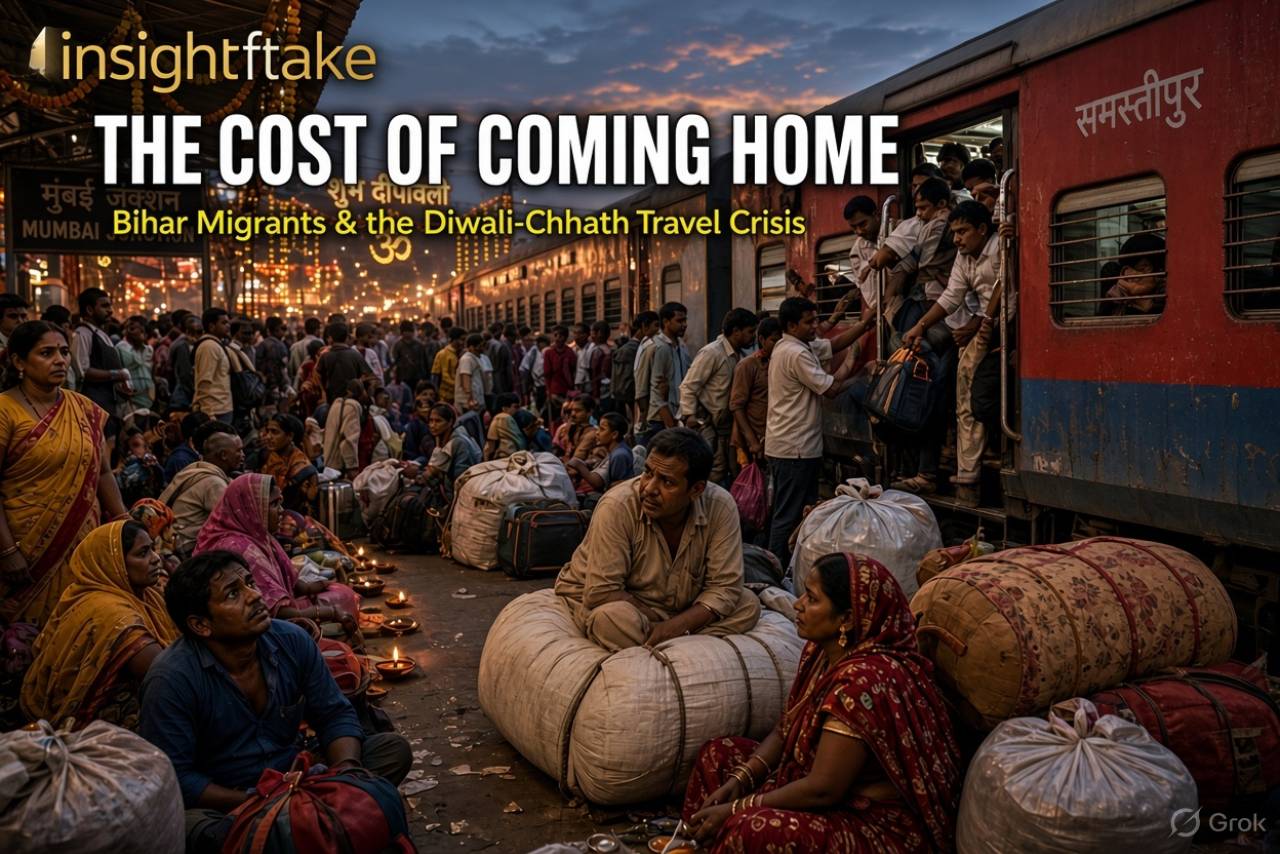
Millions of Bihari workers build India's cities, but reaching home for Chhath remains an annual struggle against costly tickets and overcrowded trains.
Every year, as Diwali approaches and preparations begin for Chhath Puja, millions of people from Bihar attempt to return to their villages from cities and industrial centres across India. Construction workers in Delhi and Mumbai, factory workers in Bengaluru and Tirupur, and employees in Ahmedabad, Surat and other cities begin planning their journey home. For them, the journey is about more than a festival. It is an opportunity to reunite with their families, reconnect with their villages and participate in traditions that remain central to their lives.
But reaching home has become increasingly difficult. Confirmed railway tickets are hard to secure, waiting lists stretch into hundreds, unreserved coaches become severely overcrowded, and airfares rise beyond the reach of ordinary workers. The annual rush exposes a recurring weakness in India's transport planning. Millions of workers contribute to the economies of other states, yet the transport system continues to struggle with the predictable demand created by their seasonal journeys.
Bihar's Migration Economy and the Numbers Behind It
Migration from Bihar is a major feature of the state's economy. However, estimates vary considerably depending on whether they count individual workers, seasonal migrants, interstate migration or households dependent on migration.
In December 2025, Pushpendra Kumar, former director of the Tata Institute of Social Sciences, presented an estimate of more than 63 lakh migrant workers from Bihar, with approximately 71 per cent moving outside the state. This figure provides an indication of the scale, although it should not be treated as a comprehensive government census of all migrants.
Another useful indicator comes from the government's e-Shram database. As of August 2025, Bihar had approximately three crore registrations of unorganised workers. These registrations include agricultural labourers, construction workers, domestic workers and other categories. They cannot be counted as three crore interstate migrants.
Research published on rural Bihar's migration patterns also highlights the extent of the phenomenon. One study found that nearly two-thirds of the households in its sample had at least one migrant member. This was a finding from the surveyed households, not a statewide estimate.
The economic implications are considerable. Migrant workers contribute to construction, manufacturing, transport, hospitality and urban services across the country. Money sent home supports families, education, healthcare, agriculture and everyday consumption in Bihar.
The state's employment structure offers another explanation for continued migration. According to NITI Aayog's assessment based on the Periodic Labour Force Survey, manufacturing accounted for just 5.7 per cent of Bihar's workforce in 2022–23, compared with 11.4 per cent nationally. The figures underline the state's limited manufacturing employment base.
These workers help build India's cities and sustain its industries. Yet when they seek to return home for major festivals, securing an affordable and reasonably comfortable journey remains a struggle.
The Festival Rush That Railways Knows Is Coming
The scale of festive travel is not a surprise. It follows a familiar pattern every year, particularly around Diwali and Chhath.
In October 2025, a report by The Times of India cited an estimate of 15–20 lakh people expected to travel to Bihar during the Chhath period, with the festival rush coinciding with the Assembly election season. The figure was an estimate for that particular period, not a verified annual passenger count.
The pressure is visible on major railway routes connecting Bihar with Delhi, Mumbai, Bengaluru, Chennai, Ahmedabad and other employment centres. Regular trains fill up quickly after reservations open. Waiting lists increase, and passengers who cannot obtain confirmed tickets turn to special trains, buses or expensive flights.
Indian Railways has expanded its special-train operations considerably. According to the Ministry of Railways, it operated 12,383 special train trips for Chhath Puja between October 1 and November 30, 2025, compared with 7,990 during the corresponding festive arrangement in 2024. These are train trips, not 12,383 separate trains.
The expansion is substantial, but the existence of additional services does not automatically mean that sufficient affordable seats are available on the routes and dates when workers need them.
Reports from the festive season continue to document long waiting lists and trains under heavy pressure. In November 2026, for instance, waiting lists on several services connecting major cities with Bihar and Jharkhand remained high, with some routes showing limited or no booking availability.
For workers travelling with children, elderly parents and luggage, a journey that should be an occasion for celebration can become physically exhausting. Unreserved coaches, which are often the most accessible option for low-income passengers, face particularly intense pressure.
When Air Travel Becomes a Luxury
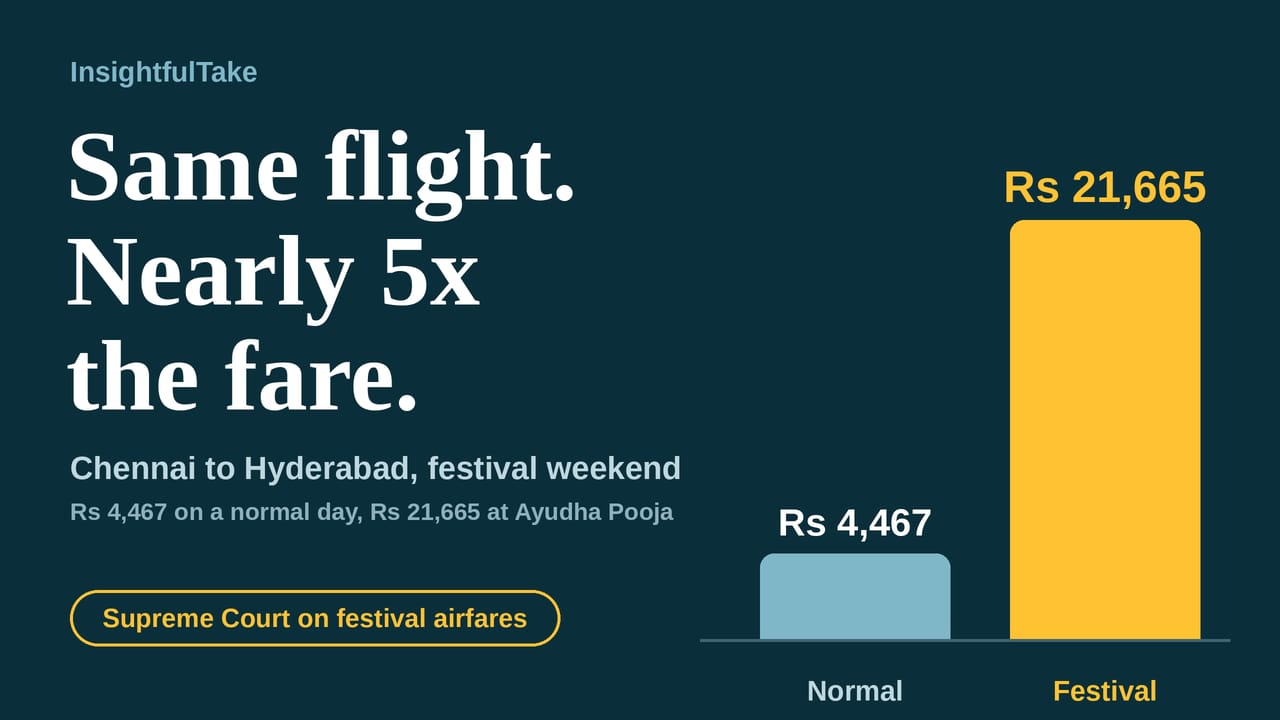
Air travel offers an alternative, but the cost puts it beyond the reach of most daily-wage and low-income workers.
The 2026 festive season provides a clear illustration. A Times of India report published on October 6 found that one-way Mumbai–Patna fares had crossed ₹26,000 on some dates, with certain fares exceeding ₹35,000. Bengaluru–Patna tickets also crossed ₹25,000 on selected dates, while Delhi–Patna fares were above ₹15,000–19,000. These were date-specific booking prices, not standard fares for the entire season.
An India Today report published on October 15 also documented Mumbai–Patna fares of approximately ₹25,643 and Bengaluru–Patna fares of ₹26,053 for November 7, based on booking information checked on October 13.
For a construction worker earning ₹700–1,000 a day, a ticket costing ₹20,000 or more is financially unrealistic. Even a worker earning a relatively stable monthly salary may find it difficult to spend such an amount on a one-way journey.
The result is a sharp divide. Those with sufficient money can consider flying, while the majority depend on railway reservations, unreserved coaches or increasingly expensive bus services.
The problem is not simply that airfares increase during peak demand. It is that affordable alternatives are often unavailable precisely when the need for travel is greatest.
A Predictable Problem Without a Permanent Solution
The annual rush raises an important question. Why does a country that knows the timing and broad direction of this passenger movement continue to depend so heavily on temporary arrangements?
Holi, Diwali and Chhath generate predictable travel demand. The railway authorities have years of passenger data, booking patterns and information about the busiest routes. Yet the response frequently revolves around announcing special trains and managing crowds at major stations.
Special services are necessary, but they cannot substitute for long-term planning. Additional trains need to be announced sufficiently early, operate on routes where demand is highest and provide affordable options for passengers who cannot pay premium fares.
The 2026 arrangements also show that the Railways is capable of introducing dedicated services. A Delhi–Patna Vande Bharat Festival Special, for example, was introduced for selected dates during October and November. Its chair-car fares were ₹2,615 for AC Chair Car and ₹4,695 for Executive Chair Car. Such services add capacity, although their fares and seating arrangements do not address the needs of every low-income migrant.
The challenge is to combine premium and regular services with sufficient sleeper and unreserved capacity.
The Human Cost of an Uncertain Journey
The consequences extend beyond crowded railway platforms.
Workers who cannot obtain tickets may have to spend additional days away from their jobs, losing wages while searching for a way home. Others may abandon their plans altogether. Families in Bihar wait for relatives who may arrive late or not arrive at all.
For people who spend most of the year away from their homes, Chhath carries particular emotional and cultural importance. The festival involves family participation, community preparation and rituals that bring people together. Missing it is not comparable to missing an ordinary holiday.
The pressure also affects employers and businesses in destination states. Construction sites, factories, workshops and service establishments can experience temporary labour shortages when workers travel home in large numbers. This makes seasonal migration a matter of economic coordination, not merely a transport inconvenience.
For Bihar, the annual exodus is also a reminder of the state's employment challenges. When large numbers of people must travel elsewhere for work, the question of local job creation cannot be separated from the question of migration.
What Governments Need to Do
The responsibility does not rest with Indian Railways alone. The governments of Bihar and the states employing its workers must recognise seasonal migration as a recurring policy concern.
Several measures deserve serious consideration.
First, railway authorities should develop a permanent festive-season transport plan for high-demand Bihar routes. Passenger data from previous years can help identify the busiest origin-destination pairs and estimate additional sleeper and unreserved capacity.
Second, special trains should be announced well in advance, with transparent information about routes, stops, fares and booking arrangements. Workers should not have to depend on last-minute announcements or uncertain information.
Third, state governments should coordinate with the Railways and destination states to identify major migrant-worker clusters and assess their seasonal travel requirements. The e-Shram database could help in understanding the geographical distribution of registered workers, provided registration is not treated as proof of interstate migration.
Fourth, railway stations handling large passenger volumes need better holding areas, drinking water, sanitation, ticket facilities and crowd-management arrangements. Additional trains alone cannot ensure safe journeys if station infrastructure remains inadequate.
Finally, Bihar needs a sustained employment strategy that expands manufacturing, small industries, services and local enterprises. NITI Aayog's employment data show the gap in manufacturing participation, making industrial job creation an important part of the state's development challenge.
The states benefiting from migrant labour must also recognise their responsibility towards the people who keep their economies running. Seasonal transport planning should form part of a broader inter-state framework for migrant workers, alongside access to social security and other essential services.
The Right to Return Home Should Not Depend on Income
Festivals are moments of reunion. For workers who spend months away from their families, the journey home is often as important as the celebration itself.
When a railway ticket becomes difficult to obtain and an air ticket costs more than a worker can earn in several weeks, the problem goes beyond seasonal inconvenience. It raises questions about affordability, dignity and the treatment of people whose labour supports the country's economic growth.
India has expanded its railway network, increased special-train operations and developed the administrative capacity to manage large passenger movements. The figures from recent festive seasons demonstrate that additional services can be organised when the need is recognised.
What remains necessary is a more predictable and inclusive approach that places ordinary passengers at the centre of planning.
The workers who build India's roads, metros, factories and homes should not have to struggle every year for the basic opportunity to return to their own families. When Diwali lamps are lit and Chhath offerings are prepared along the riverbanks of Bihar, reaching home should not be a privilege reserved for those who can afford expensive tickets.



















Leave a Comment