
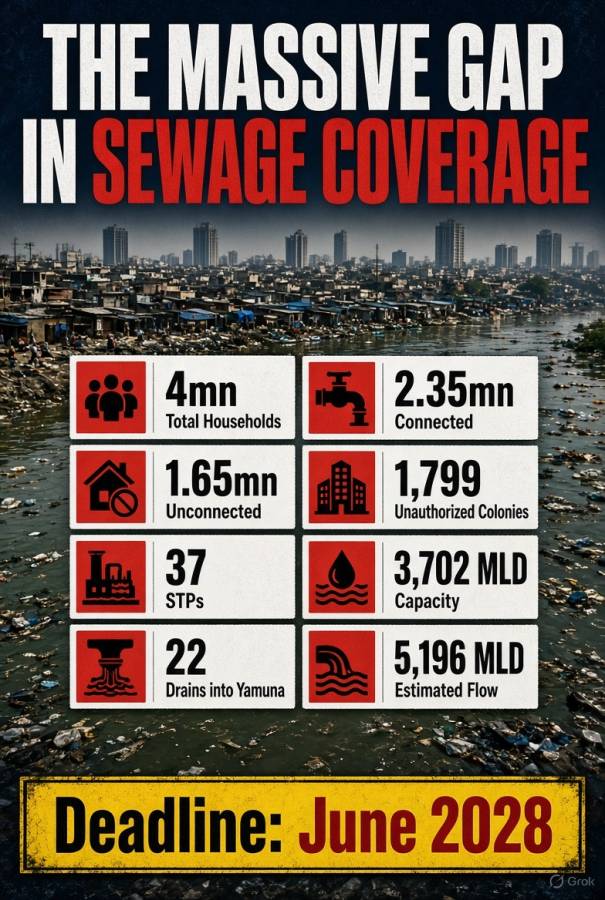
Around 41% of Delhi households remain outside the city’s sewage network, leaving millions dependent on septic tanks and raising concerns about untreated waste entering drains and the Yamuna.
Delhi’s sewage problem is bigger than the capacity of its treatment plants.
Around four in every 10 households in the capital are still not connected to the city’s sewer network. Most of these households are located in unauthorised colonies and slum clusters.
The Delhi Jal Board (DJB) has set a target of June 2028 to connect all remaining households. But the scale of the gap, along with regulatory and geographical barriers in several areas, makes the deadline a major challenge.
The numbers behind Delhi’s sewage gap
Delhi has around 40 lakh households. Of these, about 23.5 lakh are connected to the sewage network.
That leaves nearly 16.5 lakh households, or 41.3%, without a sewer connection.
The DJB operates 37 sewage treatment plants (STPs) with a combined treatment capacity of 3,702 million litres per day (MLD).
At the same time, 22 drains in Delhi discharge directly into the Yamuna. Their combined flow is estimated at 5,196.44 MLD.
Monthly reports from the Delhi Pollution Control Committee (DPCC) have recorded high levels of faecal coliform in the river. The presence of faecal coliform is an indicator of contamination from sewage and other sources of faecal matter.
The numbers show the central problem. Treatment capacity matters only when sewage actually reaches a treatment plant.
What happens in homes without sewer connections
Households without sewer connections generally depend on septic tanks.
When these tanks fill up, families call private operators to remove the accumulated waste. According to DJB officials, some operators illegally dump the collected waste into drains and other channels instead of taking it to treatment facilities.
Delhi notified the Water Board Septage Management Regulation in 2018, which provides for a ₹50,000 penalty for illegal disposal.
The government has authorised 137 private vendors to collect septage and dispose of it at STPs and 86 sewage pumping stations.
However, officials say only around 19 to 23 million litres of wastewater is being legally deposited at these designated points each month.
The actual quantity of waste generated in these areas is several times higher.
A DJB official also said septic-tank cleaning machines have been empanelled to serve these areas, but only a small proportion of the sewage is currently being covered.
The DJB says it is now working on a project to provide free septage-cleaning services in areas without sewer connections, with the aim of improving coverage and reducing illegal dumping.
Unauthorised colonies remain the hardest part
Delhi has 1,799 unauthorised colonies.
Sewerage work has been completed in 1,317 colonies, while work is underway in around 100 more. Another 191 colonies have reached the tendering stage.
The DJB wants to connect the remaining colonies over the next two years.
But there are significant obstacles.
A DJB official said the board has not received the required no-objection certificates (NOCs) to lay sewer lines in 88 colonies.
Another 82 colonies fall within the Yamuna’s O-Zone, where restrictions on construction and infrastructure work create an additional hurdle.
According to the official, the DJB cannot undertake work in these areas without permission from the agencies concerned under the prevailing rules.
Why the Yamuna’s O-Zone matters
The O-Zone, or Zone O, is the protected floodplain along the Yamuna. It covers around 9,700 hectares and stretches along the roughly 22-km urban section of the river between Wazirabad and Okhla.
This relatively short urban stretch has an outsized role in Delhi’s pollution problem.
According to the amicus curiae appointed in the Yamuna pollution case, this 22-km stretch accounts for around 76% of the river’s pollution load, even though it represents only about 2% of the river’s total length.
The amicus has recommended that the DJB focus on closing a 249 MLD treatment gap.
It has also recommended that connections for the remaining 16.5 lakh households be provided against annual and verifiable milestones. Such a system would allow progress to be measured rather than assessed only through broad targets.
Why the sewerage gap matters
Cleaning the Yamuna has remained a stated priority of successive Delhi governments.
Much of the focus has been on increasing sewage treatment capacity. But treatment plants can only treat sewage that reaches them.
When a household has no sewer connection, its wastewater has limited routes. It can remain in a septic tank until it is removed, be transported by a tanker, or enter an open drain.
If that waste is illegally discharged into a drain connected to the river, the pollution eventually reaches the Yamuna.
DJB officials have themselves identified the lack of sewer connections as one of the biggest challenges to achieving the government’s target of cleaning the river within the next three years.
There is also a public-health concern.
Untreated sewage in drains and floodplain areas can expose nearby communities to contaminated water and unhygienic surroundings. The risk can be particularly serious in densely populated settlements where open drains run close to homes.
What to watch before 2028
Three issues will determine whether the June 2028 target translates into actual sewer connections on the ground.
Permissions: The DJB will need to secure NOCs for the 88 colonies where approvals are pending and find legally workable solutions for the 82 colonies located in the O-Zone.
Septage management: The ₹50,000 penalty for illegal disposal will matter only if it is effectively enforced. Free septage-cleaning services will also need to reach the colonies that currently depend on septic tanks.
Public tracking: Annual, verifiable progress figures could show whether the remaining 16.5 lakh households are actually being connected at the required pace.
For now, a large part of Delhi’s wastewater continues to move through septic tanks, tankers and drains.
Until that waste is reliably collected, treated and kept out of the river system, the Yamuna’s clean-up challenge will remain much larger than the number of sewage treatment plants Delhi operates.
Delhi’s sewage problem is bigger than the capacity of its treatment plants.
Around four in every 10 households in the capital are still not connected to the city’s sewer network. Most of these households are located in unauthorised colonies and slum clusters.
The Delhi Jal Board (DJB) has set a target of June 2028 to connect all remaining households. But the scale of the gap, along with regulatory and geographical barriers in several areas, makes the deadline a major challenge.
The numbers behind Delhi’s sewage gap
Delhi has around 40 lakh households. Of these, about 23.5 lakh are connected to the sewage network.
That leaves nearly 16.5 lakh households, or 41.3%, without a sewer connection.
The DJB operates 37 sewage treatment plants (STPs) with a combined treatment capacity of 3,702 million litres per day (MLD).
At the same time, 22 drains in Delhi discharge directly into the Yamuna. Their combined flow is estimated at 5,196.44 MLD.
Monthly reports from the Delhi Pollution Control Committee (DPCC) have recorded high levels of faecal coliform in the river. The presence of faecal coliform is an indicator of contamination from sewage and other sources of faecal matter.
The numbers show the central problem. Treatment capacity matters only when sewage actually reaches a treatment plant.
What happens in homes without sewer connections
Households without sewer connections generally depend on septic tanks.
When these tanks fill up, families call private operators to remove the accumulated waste. According to DJB officials, some operators illegally dump the collected waste into drains and other channels instead of taking it to treatment facilities.
Delhi notified the Water Board Septage Management Regulation in 2018, which provides for a ₹50,000 penalty for illegal disposal.
The government has authorised 137 private vendors to collect septage and dispose of it at STPs and 86 sewage pumping stations.
However, officials say only around 19 to 23 million litres of wastewater is being legally deposited at these designated points each month.
The actual quantity of waste generated in these areas is several times higher.
A DJB official also said septic-tank cleaning machines have been empanelled to serve these areas, but only a small proportion of the sewage is currently being covered.
The DJB says it is now working on a project to provide free septage-cleaning services in areas without sewer connections, with the aim of improving coverage and reducing illegal dumping.
Unauthorised colonies remain the hardest part
Delhi has 1,799 unauthorised colonies.
Sewerage work has been completed in 1,317 colonies, while work is underway in around 100 more. Another 191 colonies have reached the tendering stage.
The DJB wants to connect the remaining colonies over the next two years.
But there are significant obstacles.
A DJB official said the board has not received the required no-objection certificates (NOCs) to lay sewer lines in 88 colonies.
Another 82 colonies fall within the Yamuna’s O-Zone, where restrictions on construction and infrastructure work create an additional hurdle.
According to the official, the DJB cannot undertake work in these areas without permission from the agencies concerned under the prevailing rules.
Why the Yamuna’s O-Zone matters
The O-Zone, or Zone O, is the protected floodplain along the Yamuna. It covers around 9,700 hectares and stretches along the roughly 22-km urban section of the river between Wazirabad and Okhla.
This relatively short urban stretch has an outsized role in Delhi’s pollution problem.
According to the amicus curiae appointed in the Yamuna pollution case, this 22-km stretch accounts for around 76% of the river’s pollution load, even though it represents only about 2% of the river’s total length.
The amicus has recommended that the DJB focus on closing a 249 MLD treatment gap.
It has also recommended that connections for the remaining 16.5 lakh households be provided against annual and verifiable milestones. Such a system would allow progress to be measured rather than assessed only through broad targets.
Why the sewerage gap matters
Cleaning the Yamuna has remained a stated priority of successive Delhi governments.
Much of the focus has been on increasing sewage treatment capacity. But treatment plants can only treat sewage that reaches them.
When a household has no sewer connection, its wastewater has limited routes. It can remain in a septic tank until it is removed, be transported by a tanker, or enter an open drain.
If that waste is illegally discharged into a drain connected to the river, the pollution eventually reaches the Yamuna.
DJB officials have themselves identified the lack of sewer connections as one of the biggest challenges to achieving the government’s target of cleaning the river within the next three years.
There is also a public-health concern.
Untreated sewage in drains and floodplain areas can expose nearby communities to contaminated water and unhygienic surroundings. The risk can be particularly serious in densely populated settlements where open drains run close to homes.
What to watch before 2028
Three issues will determine whether the June 2028 target translates into actual sewer connections on the ground.
Permissions: The DJB will need to secure NOCs for the 88 colonies where approvals are pending and find legally workable solutions for the 82 colonies located in the O-Zone.
Septage management: The ₹50,000 penalty for illegal disposal will matter only if it is effectively enforced. Free septage-cleaning services will also need to reach the colonies that currently depend on septic tanks.
Public tracking: Annual, verifiable progress figures could show whether the remaining 16.5 lakh households are actually being connected at the required pace.
For now, a large part of Delhi’s wastewater continues to move through septic tanks, tankers and drains.
Until that waste is reliably collected, treated and kept out of the river system, the Yamuna’s clean-up challenge will remain much larger than the number of sewage treatment plants Delhi operates.




















Leave a Comment