
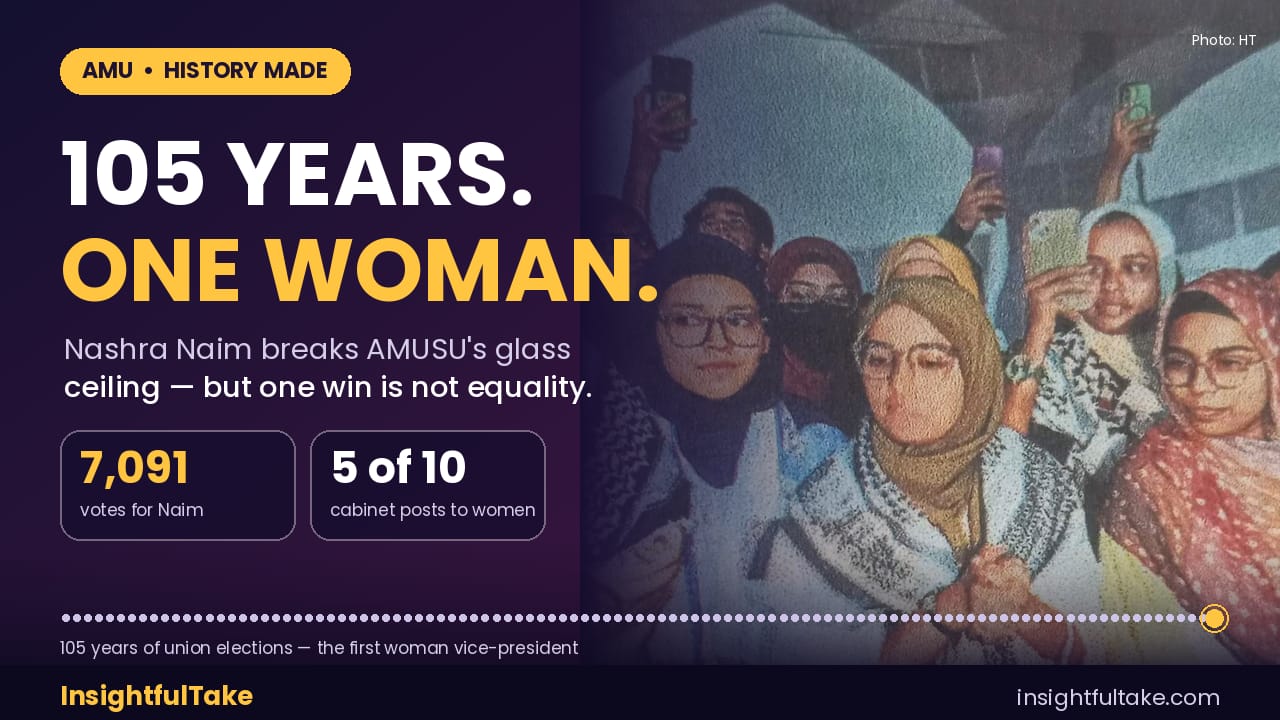
A 106-year barrier has fallen at AMU. Nashra Naim's victory is historic, but the real test is whether women will finally get equal space in campus politics.
For 106 years, the Aligarh Muslim University Students' Union has witnessed elections, campaigns and victory celebrations. Yet, in all that time, no woman had ever won one of its top office-bearing positions. It changed this week when 22-year-old law student Nashra Naim was elected vice-president, breaking a century-old barrier in the university's student politics.
Naim, a fourth-year BA LLB student, secured 7,091 votes, defeating her nearest rival, Saqib Ali Khan, who received 5,818 votes. A margin of 1,273 votes is a decisive mandate, not merely a symbolic victory.
Her election marks an important moment for women in campus politics.
The Numbers Behind the Historic Victory
Naim's victory was not the only significant development in the election. Women candidates also won five of the ten cabinet member positions, compared with three in 2016. The election reportedly witnessed the largest number of women candidates in the union's history.
These numbers suggest that women are no longer participating in campus politics merely as voters or campaign supporters. They are increasingly stepping forward as candidates and competing for positions of influence.
Naim's account of her campaign offers another perspective. She reportedly had limited time, resources and support when she began her campaign. However, the people who joined her brought commitment and determination.
Her assertion that women have to create space for themselves, and that she did precisely that, captures the challenge faced by women entering traditionally male-dominated institutions.
She did not inherit a space that had been waiting for her. She contested for it and won.
Why Did It Take More Than a Century?
It is tempting to celebrate this as a feel-good story about a barrier finally falling. But the more important question is why that barrier remained in place for 106 years.
Student politics in Indian universities often depends on informal networks, hostel connections, late-night meetings, campaign resources and the freedom to remain politically active across campus. These advantages are not always equally available to women.
Stricter hostel curfews, family expectations, concerns about personal safety and social restrictions can limit women's participation. In many cases, women students also face pressure to avoid being overly visible or outspoken in public spaces.
A male student may be able to spend hours building political networks, attending meetings and organising campaigns. A woman student may have to negotiate each of these activities within additional restrictions.
Consequently, the absence of women from leadership positions cannot be explained simply by voter preferences. It also reflects unequal access to political networks, campaign opportunities and institutional support.
The question is not merely whether women were willing to contest. It is whether the university environment gave them an equal opportunity to do so.
One Woman's Victory Cannot Change an Institution Overnight
Nashra Naim's election deserves recognition. But a historic first should not be mistaken for institutional transformation.
India has witnessed similar moments across politics, education, administration and corporate leadership. A woman breaks a barrier, headlines celebrate her achievement, and the institution receives recognition for becoming more inclusive. Yet the structures that made her journey difficult often remain untouched.
The first woman elected to a position does not automatically make the institution gender-equal. Nor does one successful candidate guarantee opportunities for those who follow.
Consider the young woman from a small town who must convince her family to allow her to study in another city. Consider the first-generation female graduate who has to establish her credibility repeatedly. Consider the student who wants to enter politics but is discouraged because public leadership is still considered unsuitable for women.
Their challenges do not disappear because one woman has won an election.
There is also a danger that institutions may use individual achievements as evidence that discrimination no longer exists. Celebrating one successful woman is easier than examining why many others never get the opportunity to compete.
What Must Change Beyond the Election?
For the AMU Students' Union and universities across India, the real test begins after the election.
1. Equal opportunities for campaigning
Women candidates must have equal access to campus spaces, student networks and campaigning opportunities. Safety arrangements should protect students without unnecessarily restricting women's participation.
2. Meaningful authority after election
An elected woman must have an effective voice in decision-making. Her position should carry real responsibility and authority, rather than becoming a symbolic addition to the leadership.
3. A stronger pipeline of women leaders
Universities should encourage women to contest elections at different levels. Participation in student bodies, debates, campus organisations and representative committees can help build future political leadership.
4. Institutional accountability
Universities should regularly examine how many women contest elections, how many win and whether elected representatives have an equal role in decision-making. Gender representation should be measured through sustained participation, not occasional milestones.
A Victory That Must Lead to Something Bigger
Nashra Naim's victory matters because it demonstrates what women can achieve when they enter the electoral contest and receive the support of voters. The election of women to five cabinet positions adds to the significance of the result.
It should also prompt a difficult question for educational institutions: if women were capable of winning these positions today, what prevented them from reaching the same positions earlier?
The answer cannot be reduced to tradition or the passage of time. Institutions are shaped by rules, practices, opportunities and attitudes. If these remain unequal, representation will continue to depend on individual courage rather than equal opportunity.
AMU has witnessed a historic change. But the real measure of progress will be whether the next woman can contest for a top position without having to fight the same battles that Naim faced.
The best tribute to her achievement would be a campus where women in student leadership are no longer an exception, and where another century does not have to pass before the next milestone.



















Leave a Comment