
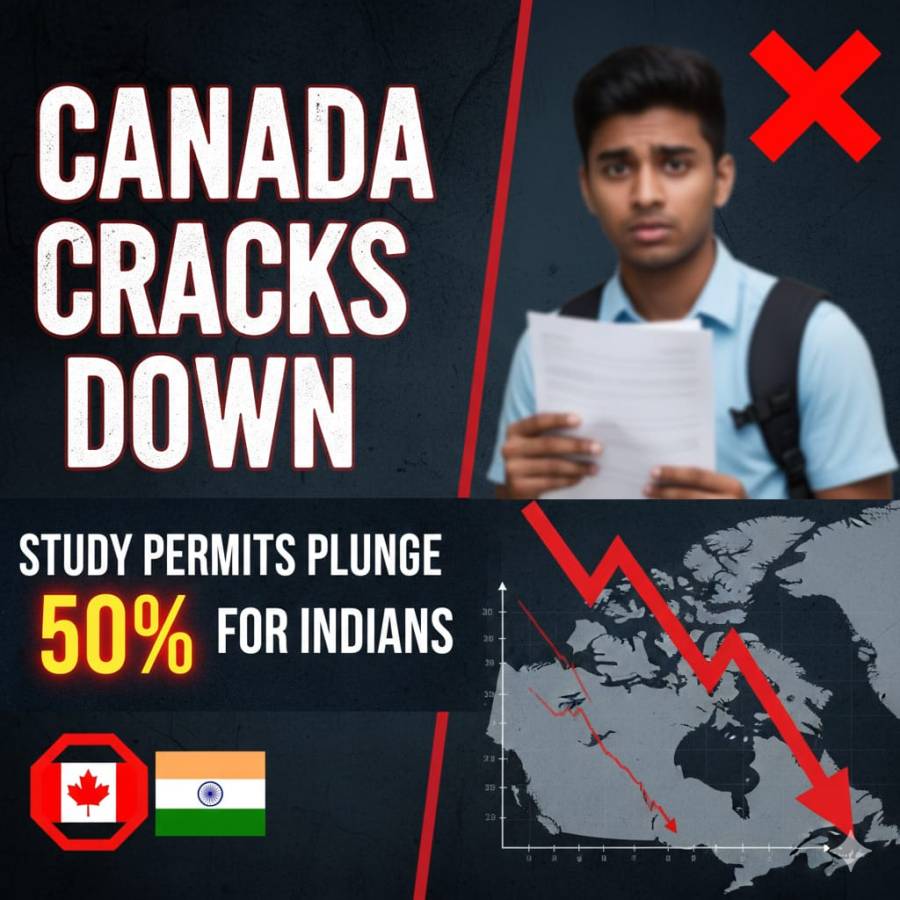
For years, India’s brightest students flocked to Canada, chasing degrees and a pathway to residency. Now, sudden policy changes have halved their opportunities — signaling the end of an era of unchecked growth in international education
Canada’s international education landscape is undergoing a decisive transformation. In what officials describe as a recalibration toward “sustainable levels,” the federal government has significantly tightened its immigration policies — a move that has sharply reduced the number of study permits issued, particularly to Indian students.
Recent figures released by Immigration, Refugees and Citizenship Canada (IRCC) reveal a dramatic contraction. Study permits issued to Indian students have fallen by nearly 50 percent since 2024, signaling the end of an era defined by record-breaking growth in international enrollments.
For years, Indian students formed the largest cohort within Canada’s international education system. Now, that long-standing trend appears to be reversing.
A Steep National Decline
The broader numbers underline the magnitude of the shift. Canada issued 514,915 study permits globally in 2024. That figure fell to 383,905 in 2025 — a 25 percent reduction within a single year. This continues a downward trajectory from the record high of 680,795 permits granted in 2023.
The contraction is even more pronounced among Indian applicants. Study permits issued to Indian students dropped from 188,715 to 94,605 during the same period — nearly halving in just one year.
Government officials insist the move is deliberate.
The Push for “Sustainable Levels”
The IRCC has framed the policy shift as necessary to restore balance and public confidence in Canada’s immigration system. Authorities argue that the rapid expansion of temporary residents — including international students — placed mounting pressure on housing, infrastructure, healthcare, and other public services.
In a recent address in Toronto, Immigration Minister Lena Metlege Diab emphasized that the government’s priority is to restore “control and balance” after years of accelerated intake.
Appointed by Prime Minister Mark Carney last spring, Minister Diab acknowledged that while international students bring economic and cultural value, previous growth levels proved difficult to sustain. The current mandate, she stated, is to safeguard system integrity while ensuring newcomers can be adequately supported.
Structural Tightening, Not Falling Demand
The drop in permits is not the result of declining interest in Canada as a destination. Instead, it stems from a series of structural reforms introduced by federal authorities.
Key measures include:
- Mandatory verification of acceptance letters: Educational institutions must now directly confirm admission letters with IRCC to combat fraud and misuse.
- Higher financial proof requirements: Applicants must demonstrate greater financial self-sufficiency to ensure they can sustain themselves amid rising living costs.
- Hard caps on applications: For the first time, Canada has imposed strict limits on the number of study permit applications processed.
The result has been immediate and substantial. IRCC reports 61 percent fewer new student arrivals in 2025 compared to the previous year — a decline of 177,595 individuals.
Importantly, the policy primarily targets new entrants, while closely regulating extensions for those already studying in the country.
2026: Continued Restrictions
The tightening is set to continue. The government has announced that study permits for 2026 will be capped at 408,000.
This total will be divided into:
- 155,000 permits for new international students
- 253,000 extensions for current and returning students
The structure suggests a strategic pivot — prioritizing those already within Canada’s academic ecosystem while narrowing entry for new applicants.
For Indian students, long drawn by Canada’s education quality and clear pathways to permanent residency, the new framework presents a far more competitive and scrutinized process.
Ripple Effects Across Campuses and Beyond
The consequences extend beyond individual applicants.
Many Canadian colleges and universities have grown financially reliant on the significantly higher tuition fees paid by international students. A sustained drop in enrollment could strain institutional budgets, reshape recruitment strategies, and alter campus demographics.
Diplomatic and economic ties between India and Canada may also feel the impact. Education has long served as a vital bridge between the two nations, strengthening both people-to-people connections and long-term economic engagement.
A New Chapter in Canadian Immigration
Canada’s international education boom once symbolized opportunity and openness. Today, that narrative is being rewritten under the banner of regulation and recalibration.
Officials maintain that the reforms are necessary to preserve system integrity and maintain public trust. Critics, however, warn that overly restrictive measures could dampen Canada’s global competitiveness in attracting top talent.
For thousands of aspiring Indian students, the path to a Canadian education — once seen as accessible and predictable — has become markedly narrower.
The era of rapid expansion has given way to cautious governance. And in that transition, the global academic ambitions of many now hang in the balance.

























Leave a Comment