
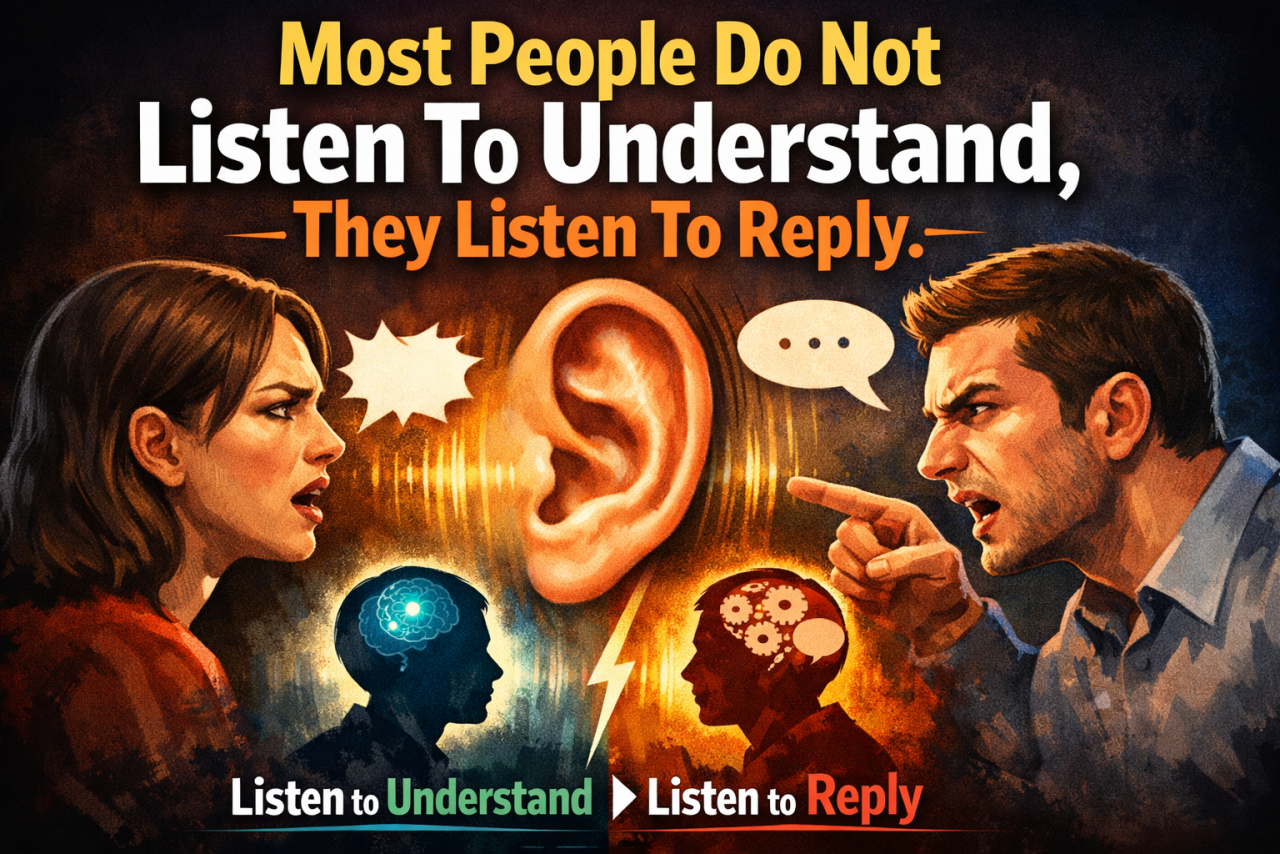
“Most people do not listen with the intent to understand; they listen with the intent to reply.” — Stephen R. Covey
In an age of endless notifications, televised debates, and social media arguments, conversation has quietly transformed into competition. We interrupt faster. We react quicker. We respond before the other person has even finished their sentence. And in doing so, we prove the enduring truth of Stephen R. Covey’s famous observation: we are not really listening — we are preparing our comeback.
The tragedy is subtle. No one wakes up intending to misunderstand others. Yet misunderstandings dominate families, offices, politics, and public discourse. The reason is not always disagreement. It is often the absence of genuine listening.
Hearing Is Automatic. Listening Is Intentional.
There is a scientific distinction between hearing and listening. Hearing is biological — the brain registering sound waves. Listening is cognitive and emotional — it requires focus, empathy, and interpretation.
Research in communication studies shows that most people remember only 25–50% of what they hear in a conversation. That means half of what is said is either filtered, distorted, or mentally edited out. Why? Because the human brain processes information faster than people speak. While someone talks, our mind races ahead — analyzing, judging, rehearsing.
In other words, we are not present. We are strategizing.
The Reply Reflex
Why do we listen to reply?
Psychologists suggest several reasons:
- Ego Protection: We instinctively defend our beliefs. When someone challenges our perspective, our brain activates a mild threat response. Instead of absorbing new information, we prepare a defense.
- Social Conditioning: From classrooms to corporate boardrooms, we are rewarded for quick answers, sharp rebuttals, and persuasive arguments — not for patient silence.
- Digital Influence: Social media platforms encourage instant reactions. The faster the reply, the stronger the engagement. Thoughtfulness is often replaced by immediacy.
The result? Conversations feel like debates. Dialogue becomes monologue in rotation.
What We Lose When We Don’t Listen
When we listen only to respond, three critical losses occur:
- Loss of Accuracy: We interpret statements through personal bias. Instead of understanding what was said, we interpret what we expect to hear.
- Loss of Emotional Insight: Words carry emotion beneath them. Tone, pauses, and facial expressions communicate vulnerability, frustration, or uncertainty. When focused on replying, we miss these cues.
- Loss of Trust: Nothing damages relationships faster than feeling unheard. Whether in marriage, friendship, or leadership, the sense that “you don’t really listen to me” creates emotional distance.
Ironically, many conflicts are not rooted in disagreement but in perceived dismissal.
The Power of Listening to Understand
Listening to understand shifts the dynamic of any interaction. It requires curiosity over control.
When someone feels heard:
- Defensiveness lowers
- Cooperation increases
- Conversations deepen
In leadership studies, active listening is consistently ranked as one of the most essential traits of effective managers. Employees who feel heard demonstrate higher engagement and loyalty. In relationships, couples who practice reflective listening report stronger emotional bonds.
Understanding does not require agreement. It requires acknowledgment.
What Active Listening Actually Looks Like
Listening to understand is not passive silence. It is deliberate engagement. Here’s how it manifests in practice:
- Pause Before Responding: Resist the instinct to jump in. Silence is not weakness; it is processing.
- Reflect Back: Paraphrase what you heard: “So you’re saying you felt overlooked in that meeting?” This simple technique clarifies meaning and signals attention.
- Ask Open Questions: Instead of countering with a rebuttal, ask: “Can you tell me more about why you feel that way?”
- Observe the Unspoken: Notice tone shifts, hesitation, or body language. Often the real message lies beneath the words.
These habits transform conversation from competition into collaboration.
The Cultural Shift We Need
Modern society rewards visibility and voice. But perhaps it is time to reward attention and restraint.
In politics, public discourse has become louder but less thoughtful. In workplaces, meetings are filled with interruptions. Even at dinner tables, phones compete for attention. Listening — the most basic human courtesy — is becoming rare.
And yet, it remains one of the most powerful skills available to us.
The Quiet Revolution
Listening to understand does not demand eloquence or intelligence. It demands humility. It asks us to accept that our first reaction may not be complete, that another perspective might expand our own.
Covey’s quote endures because it confronts a universal habit. We all do it. But awareness is the first step toward change.
The next time you find yourself mid-conversation, notice your impulse. Are you listening to absorb — or to respond?
The difference may determine whether the conversation builds a bridge or a wall.
In a world overflowing with noise, the rarest act is not speaking brilliantly. It is listening completely.




















Leave a Comment