
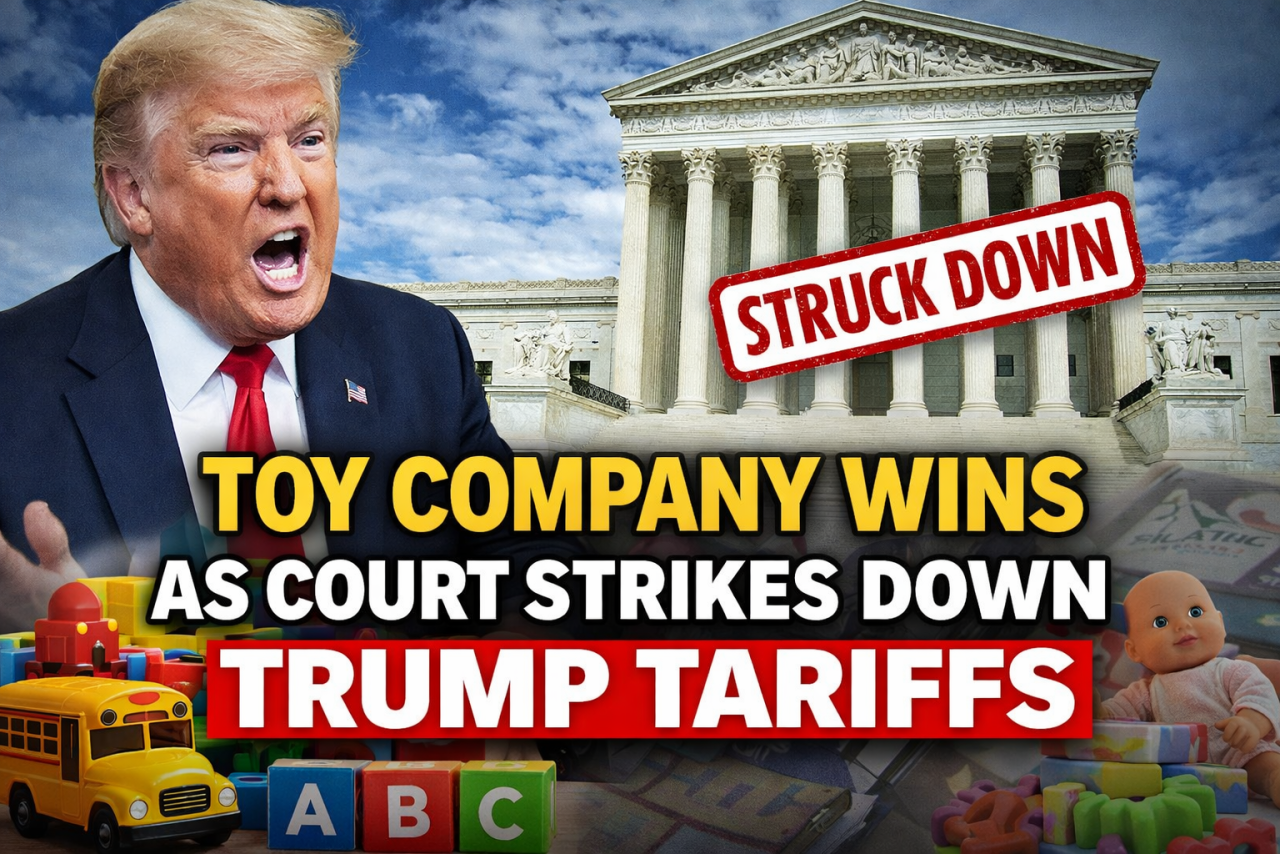
A small toy company challenged sweeping presidential tariffs — and America’s highest court just handed it a stunning victory.
In a major legal setback for President Donald Trump’s tariff regime, a small American toy company has secured a significant court victory that could reshape the future of U.S. trade policy. The ruling offers relief to businesses that struggled under sweeping import duties imposed on goods from China and reinforces judicial limits on executive economic power.
The case centers on Learning Resources, an Illinois-based educational toy company. For years, the family-run firm built its business by designing products in the United States while manufacturing many of them in China. When President Trump imposed extensive tariffs on Chinese imports under emergency economic powers, the company found itself facing millions of dollars in unexpected costs.
Rather than quietly absorbing the financial blow, Learning Resources chose to fight back. It became one of the first small businesses to challenge the tariffs in court, arguing that the administration exceeded its authority by using the International Emergency Economic Powers Act to justify broad and long-lasting trade duties.
In a landmark ruling, the U.S. Supreme Court struck down the imposition of certain tariffs introduced under these emergency powers. The decision does not instantly resolve all refund claims, and legal procedures may take time. However, it delivers a powerful message that the executive authority in trade matters is not unlimited.
For Learning Resources and other small importers, the tariffs had immediate and painful consequences. Company leaders estimated paying millions of dollars in additional duties. Expansion plans were put on hold. Investment in new product development slowed. Resources were diverted toward covering increased import costs instead of growing the business.
The situation was not unique. Small and mid-sized businesses across the United States faced similar challenges. Many depend on global supply chains that cannot be relocated overnight. Manufacturing infrastructure, supplier relationships, logistics systems, and quality controls are built over decades. Sudden tariff hikes disrupted these carefully constructed networks.
While the administration defended the tariffs as necessary to confront trade imbalances and protect American industry, critics argued that the policy placed a heavy burden on domestic companies. In practice, tariffs function as taxes paid by U.S. importers. When costs rise, businesses must either absorb the losses, raise prices for consumers, or cut operational expenses.
The court’s ruling is significant because it addresses not just economics but constitutional boundaries. Emergency economic powers are designed for urgent and extraordinary threats. Using them for broad, long-term trade restructuring raised concerns about executive overreach. By striking down the tariffs in question, the Supreme Court reaffirmed the principle that sweeping economic measures require clear legal grounding.
Experts caution that the broader trade debate is far from over. Refund processes may be legally complex. The administration could explore alternative legal frameworks to maintain elements of its tariff strategy. Nonetheless, the ruling represents a clear check on the manner in which the tariffs were imposed.
For small businesses, the decision offers both relief and validation. It demonstrates that even in disputes involving national policy, smaller companies can challenge powerful institutions through the courts. It also underscores the importance of predictability in economic policymaking.
Trade reform remains a deeply debated issue in the United States. Concerns about domestic manufacturing, supply chain resilience, and fair competition continue to shape political discourse. However, this case highlights that policy tools must be carefully chosen and legally sound.
The victory of a family-owned toy company may seem modest in scale, but its implications are substantial. It shows how judicial oversight can temper aggressive economic strategies and protect businesses from sudden regulatory shocks.
In the end, this ruling is not only about tariffs. It is about balance — between national ambition and legal restraint, between executive power and institutional oversight, and between political strategy and economic reality. For many American importers, it marks a turning point in a long and costly chapter of trade conflict.
























Leave a Comment