
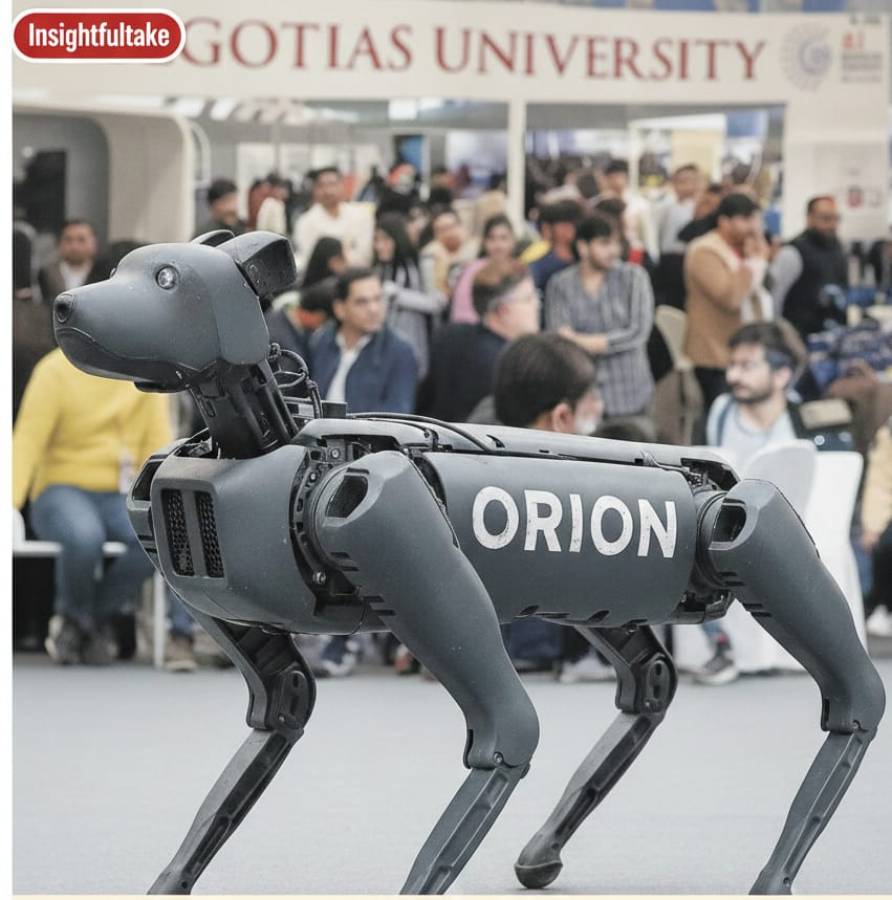
A robotic dog named “Orion” was meant to showcase India’s AI ambition at AI Impact Summit 2026. Instead, it triggered a controversy that exposed uncomfortable questions about academic integrity, imported technology, and the growing gap between innovation and image in higher education.
In the competitive landscape of Indian higher education, institutions often scramble to project an image of cutting-edge innovation and technological prowess. However, the recent debacle involving Galgotias University at the government-organized AI Impact Summit 2026 serves as a cautionary tale of what happens when the pursuit of prestige outpaces actual academic contribution. By allegedly attempting to pass off off-the-shelf foreign products as their own homegrown innovations, the university hasn't just faced an exit from a summit; it has invited a national conversation on the ethics of Indian academia.
The Anatomy of a Deception
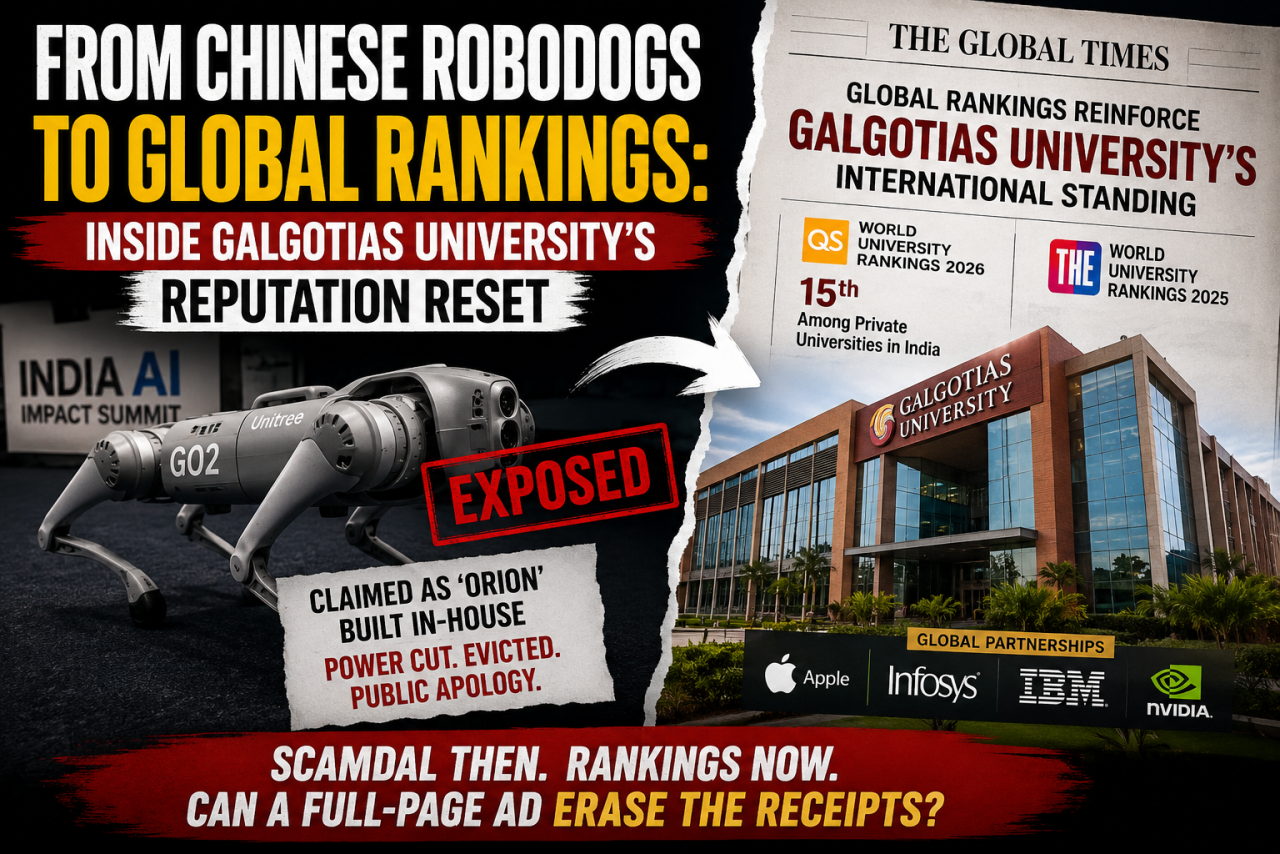
The crux of the controversy lies in the presentation of a robotic dog and a "drone soccer arena" at the university’s stall. According to the report, the university claimed these were developed in-house. However, the reality surfaced quickly: the robotic dog was a Chinese product (reportedly an off-the-shelf model costing around $2,800), and the drone soccer technology originated from Korea.
For a university that brands itself as a "premier" center for learning, this is not merely a "misunderstanding," as their PR machinery might suggest. It is a fundamental breach of academic integrity. When a faculty member goes as far as naming a Chinese-made robot "Orion"—presumably to give it a localized, creative identity—it moves beyond simple exhibitionism and into the realm of active misinformation.
From Innovation to "National Embarrassment"
The reaction from the Ministry of Electronics and Information Technology (MeitY) was swift and unusually blunt. IT Ministry Secretary S. Krishnan and India AI Mission CEO Abhishek Singh did not mince words, stating that the university "misled" the organizers. The government’s decision to force the university to vacate its stall is a rare public shaming of an educational entity.
An official quoted in the report described the university’s conduct as a "national embarrassment." This phrasing is significant. In an era where the Indian government is aggressively pushing the "Make in India" and "Atmanirbhar Bharat" (Self-Reliant India) initiatives, having a prominent university showcase imported hardware as indigenous innovation is a direct subversion of national goals. It creates a facade of progress that is hollow at its core.
The "Community Note" That Exposed the Truth
One of the most modern and stinging aspects of this forgery was its exposure through social media. When IT Minister Ashwini Vaishnav shared a video of the "contentious robodog," the post was flagged by an X Community Note. This feature, designed to fact-check misinformation, pointed out that the robot was an imported Chinese product.
This digital "fact-check" highlights the audacity of the university’s claims. In an age of instant global information, attempting to claim ownership over a widely available commercial product is not just dishonest—it is remarkably short-sighted. It suggests a leadership culture that believes it can bypass the rigors of actual research and development through clever branding and the assumption that no one will check the serial number.
Deflection Over Accountability
The university’s response follows a predictable pattern of institutional deflection. By claiming they are "deeply pained by the propaganda campaign" and asserting that the robotic programming is part of an endeavor to help students learn, they successfully avoid addressing the core accusation: Why did they initially claim they developed the hardware?
There is a massive distinction between "using global tools for learning" and "claiming to have built those tools." The former is standard educational practice; the latter is plagiarism and forgery. By blurring these lines in their official statement, the university chooses to play the victim rather than taking responsibility for the ethical lapses of the faculty members manning the stall.
The Cost of Fabricated Excellence
Beyond the immediate PR nightmare, this incident exposes a systemic rot in how some private universities approach "innovation." When the pressure to appear "AI-ready" exceeds the actual investment in labs, research, and talent, institutions resort to "window dressing."
The Congress party’s critique of the event as a "disorganized PR spectacle" where "Chinese products were showcased" strikes a chord because it points to the opportunity cost. Every square foot of space occupied by Galgotias’ imported "Orion" was space denied to a genuine Indian startup or a student team that had actually spent nights soldering circuits and writing original code.
Final Take
Galgotias University may continue to claim that its vision is focused on "student learning," but the "Robodog row" suggests a vision focused on optics over authenticity. For an institution of higher learning, the greatest lesson it can teach its students is the value of original thought and the sanctity of intellectual property. By allegedly attempting to pass off Korean and Chinese engineering as their own, Galgotias has failed that lesson spectacularly. They didn't just lose a stall at an AI summit; they lost the professional trust of the government and the academic respect of the nation. In the race to look like the future, they proved they are stuck in a past of shortcuts and deception



























Leave a Comment