
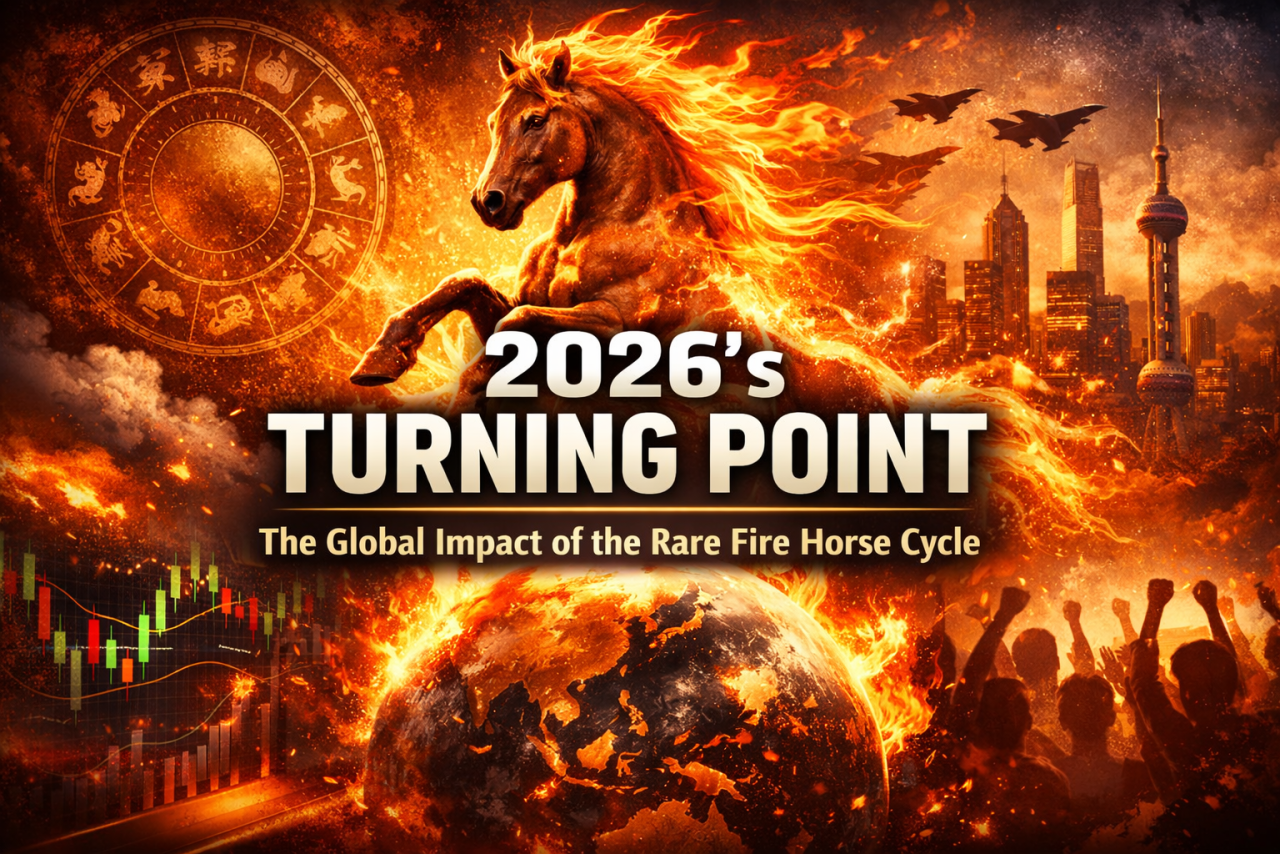
Some years pass quietly. Others arrive with a sense that the pace of the world is about to quicken. As 2026 begins, many are wondering whether this rare Fire Horse cycle will be one of those years that pushes everything — politics, markets and personal ambitions — into a higher gear.
On February 17, 2026, millions across Asia and beyond welcome the Lunar New Year and the arrival of the Fire Horse—a rare zodiac alignment that appears only once every 60 years. In traditional Chinese metaphysics, the Fire Horse is often described as “double fire” — the raw intensity of the fire element combined with the Horse’s fast-moving and restless spirit. Its energy layered upon energy, momentum meeting momentum. The result is a cycle associated with acceleration, ambition, volatility and decisive change.
But to treat 2026 as just another horoscope milestone would be to miss its deeper resonance. Across boardrooms, political circles and cultural institutions, the symbolism of the Fire Horse is increasingly being used as a framework to interpret a world already marked by economic uncertainty, geopolitical tension and rapid technological transformation.
More Than Astrology: A Cultural Barometer
Within Chinese astrology and the Five-Element system, fire signifies visibility, momentum and expansion. The Horse, meanwhile, is a symbol of speed, independence and movement. Together, they suggest a year where progress is rapid—but where miscalculation carries swift consequences.
Historically, Fire Horse years have been remembered as inflection points. Social shifts accelerate. Economic bubbles expand or burst. Leadership decisions reverberate quickly. Whether one subscribes to astrology or not, the metaphor is powerful because it mirrors real-world conditions: 2026 begins at a moment when artificial intelligence, global trade realignments and climate stress are already reshaping societies at breakneck speed.
In this sense, the Fire Horse operates less as prophecy and more as a cultural lens—a way communities articulate collective anxiety and possibility.
Geopolitics in an Age of Acceleration
Analysts observing Asia’s policy environment note that 2026 carries a heightened atmosphere. In places like Hong Kong and Taiwan, where feng shui commentary often intersects with political discourse, experts warn against impulsive decision-making. The Fire Horse rewards boldness, but punishes recklessness.
The symbolism feels timely. Major economies are navigating supply-chain restructuring, technological competition and shifting alliances. In Washington and Beijing alike, leaders face pressure to demonstrate strength while avoiding escalation. A year associated with amplified “fire” energy metaphorically underscores the stakes: rhetoric can quickly translate into action, and action into unintended consequences.
Interestingly, Western astrology also marks 2026 as significant, with a rare conjunction of Neptune and Saturn in Aries—an alignment associated with tension between vision and discipline. Across traditions, the underlying message is similar: ambition must be tempered by structure.
Whether through markets reacting to policy shifts or voters responding to populist narratives, 2026 appears primed for rapid swings in sentiment. In a hyper-connected digital world, emotion spreads as fast as information—sometimes faster.
Youth, Social Movements and Digital Momentum
Fire Horse years are often linked to heightened social energy, especially among younger generations. In Southeast Asia and parts of East Asia, commentators suggest that youth-led movements could gain renewed momentum. With social media amplifying grievances and mobilization, small sparks can ignite widespread debates overnight.
This does not guarantee unrest—but it does signal volatility. Public opinion cycles are shorter than ever. Brands, governments and institutions must navigate environments where authenticity is scrutinized and performative gestures are quickly exposed.
The Fire Horse, in this context, becomes shorthand for intensity. It symbolizes a world where speed outpaces reflection—and where those who pause to strategize may ultimately endure longer.
Branding in the Age of Cultural Fatigue
If geopolitics feels combustible, marketing landscapes are equally demanding. Lunar New Year campaigns have long relied on zodiac symbolism, but consumers in 2026 are increasingly resistant to surface-level references.
Across Asia, creative directors emphasize that simply placing a horse on packaging no longer resonates. Audiences facing economic pressure and career uncertainty are skeptical of hollow prosperity slogans. Cultural engagement must feel grounded and sincere.
Some luxury and lifestyle brands are responding with narrative-driven campaigns focused on resilience and identity rather than overt zodiac motifs. Instead of grand declarations of luck and wealth, messaging centers on self-confidence, family continuity and quiet courage. The Fire Horse’s fiery symbolism is reinterpreted not as reckless speed, but as inner conviction.
The shift reflects a broader marketing truth: symbolism only works when it aligns with lived experience. In a year defined by heightened stakes, consumers reward depth over decoration.
Economic Signals: Risk and Reward
From an economic standpoint, 2026 begins amid recalibrations. Inflationary pressures, uneven post-pandemic recovery and evolving trade corridors continue to reshape global markets. The Fire Horse metaphor captures a reality investors already understand—opportunities exist, but volatility is unavoidable.
Periods of rapid innovation often coincide with speculative surges. Artificial intelligence, green energy and biotechnology sectors are drawing enormous capital. Yet high momentum can inflate expectations beyond sustainable levels. The Fire Horse’s lesson here is discipline: growth without governance can burn as quickly as it rises.
Entrepreneurs and policymakers alike face the challenge of harnessing acceleration without losing control. The countries and corporations that combine agility with institutional resilience may emerge strongest.
Personal Strategy in a High-Speed Year
On an individual level, traditional feng shui advice for Fire Horse cycles sounds almost counterintuitive: move carefully. While the year’s energy favors action, success depends on emotional regulation and preparation.
In the Five-Element philosophy, water balances fire. Symbolically, this means cultivating calm amid urgency. In practical terms, it translates to planning before expansion, listening before reacting and prioritizing long-term sustainability over short-term triumph.
For professionals navigating career shifts or entrepreneurs launching ventures, the message is clear: momentum is valuable, but direction matters more.
The Broader Takeaway
What makes 2026 distinctive is not merely its place in a 60-year zodiac cycle. It is the convergence of symbolism with tangible global conditions. Technological disruption, generational change and geopolitical recalibration have already set the stage for a high-intensity period. The Fire Horse provides language to describe it.
Across cultures, the shared theme is accountability. Decisions such as personal, corporate or national, will carry amplified impact. Visibility is higher. Reaction time is shorter. The margin for error is thinner.
Yet within this volatility lies potential. Turning points are not inherently destructive and clarifying as well. They expose weaknesses, reward preparation and redefine priorities.
As 2026 unfolds, the Fire Horse gallops forward with unmistakable force. The challenge for leaders, brands and individuals is not whether to move—but how to channel that movement wisely. In a world already racing ahead, discipline may prove to be the most powerful form of fire.















Leave a Comment