
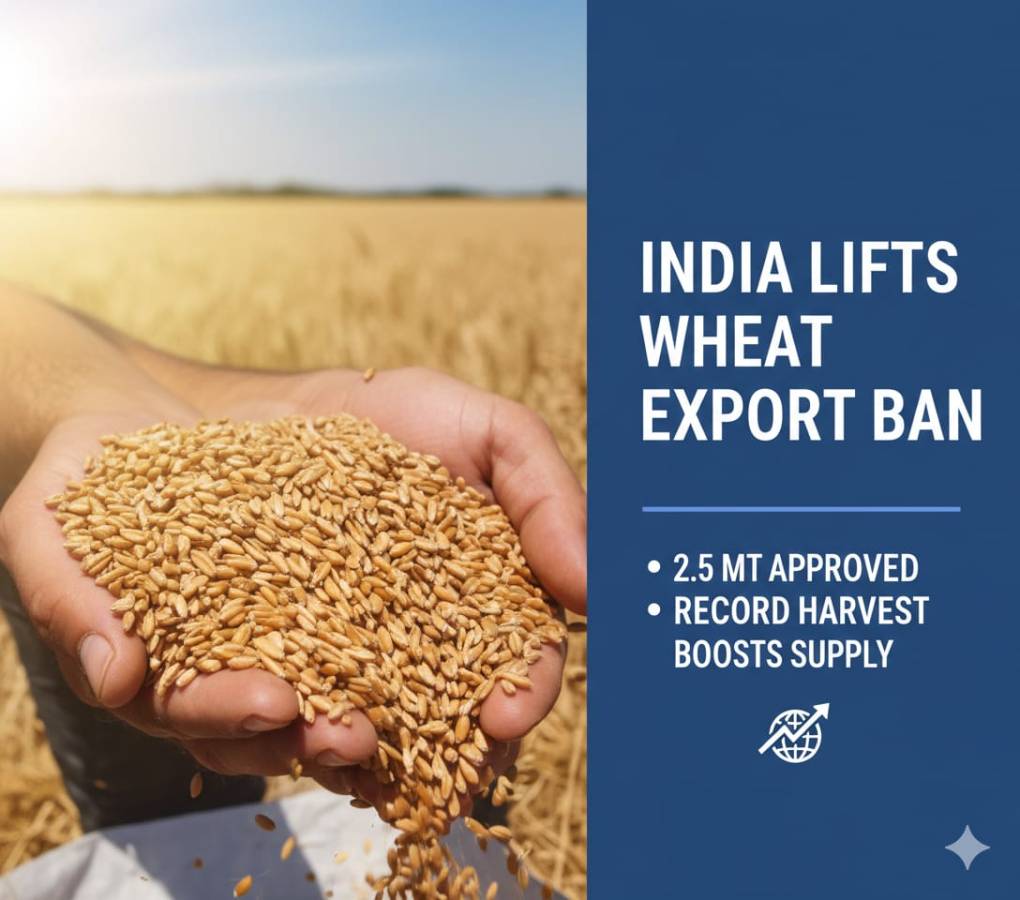
After four cautious years of guarding its granaries, India has reopened its wheat exports — signalling confidence in its stocks, its farmers, and its place in the global food market.
Nearly four years after imposing restrictions on wheat exports, India has decided to re-enter the global market in a calibrated manner. On February 13, 2026, the Union Ministry of Consumer Affairs, Food and Public Distribution approved the export of 2.5 million tonnes (mt) of wheat, along with 500,000 tonnes of wheat-based products such as atta, maida and other related products.
The export ban, introduced in May 2022, had come at a time when soaring domestic inflation and a severe heatwave threatened crop output. The government then prioritised food security and price stability. The latest decision reflects improved confidence in domestic supply, driven by strong sowing data, healthy stock levels and positive production projections for the ongoing rabi season.
Strong Stocks and Expanding Acreage
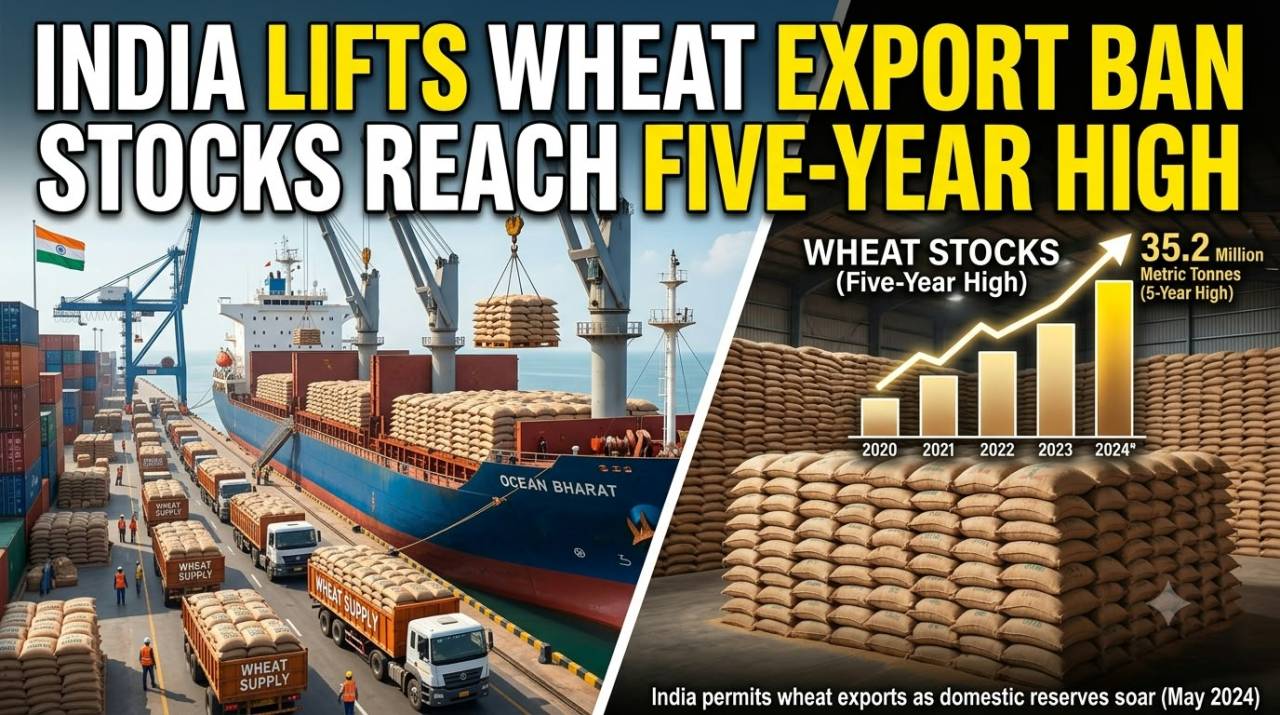
Officials say the policy shift is grounded in data. Wheat stocks in the central pool managed by the Food Corporation of India are projected to reach 18.2 mt by April 1, 2026. The mandatory buffer norm for that date is 7.6 mt, which means reserves are expected to be more than double the required level.
In addition to government stocks, private traders are estimated to be holding around 7.5 mt of wheat — significantly higher than last year. This combination has eased concerns about domestic shortages.
Equally important is the sowing trend. Wheat acreage for the 2025–26 rabi season has reached a record 33.42 million hectares, up from 32.80 million hectares last year. While harvesting will begin only in April, current crop conditions and favourable weather have strengthened expectations of a strong output year.
The government has described the export clearance as a “calibrated” move, designed to maintain food security while preventing excessive downward pressure on farm-gate prices.
Support for Farmers, Caution for Consumers
The timing of the decision is significant for farmers. As the rabi crop begins arriving in mandis over the next two months, there were concerns that abundant supply could push open-market prices below the Minimum Support Price (MSP). By allowing limited exports, the government hopes to create additional demand and avoid distress sales.
At the same time, officials have indicated that domestic inflation will be closely monitored. Wheat remains a staple for millions, and any sharp rise in retail prices would carry political and economic consequences. The capped export quantity reflects an attempt to balance these interests.
A Measured Return to Global Trade
India is the world’s second-largest wheat producer, and its absence from global markets since 2022 has been felt during periods of supply disruption. The Russia-Ukraine conflict, which affected shipments from the Black Sea region, contributed to volatility in international prices.
Although the approved 2.5 mt export quota is modest compared to India’s projected production, it signals a policy shift. Rather than remaining inward-looking, India is cautiously re-engaging with global supply chains.
However, competitiveness remains a challenge. Indian wheat currently faces stiff competition from Australia and suppliers in the Black Sea region. Export success will depend on pricing, logistics and timely allocation of quotas.
Insight & Implications
The Directorate General of Foreign Trade (DGFT) is expected to outline the procedure for allocating export quotas in the coming days. How transparently and efficiently this process unfolds will shape market confidence.
More broadly, the decision reflects a change in tone. In 2022, policy was driven by urgency and uncertainty. In 2026, it is being shaped by data — comfortable buffer stocks, record sowing and stable crop conditions. Yet the harvest is still weeks away, and final production numbers will ultimately determine whether this reopening remains limited or expands further.
For now, India’s message is cautious but clear: domestic food security remains non-negotiable, but with stronger fundamentals in place, the country is prepared to resume its role in the global wheat trade — step by step.



















Leave a Comment