
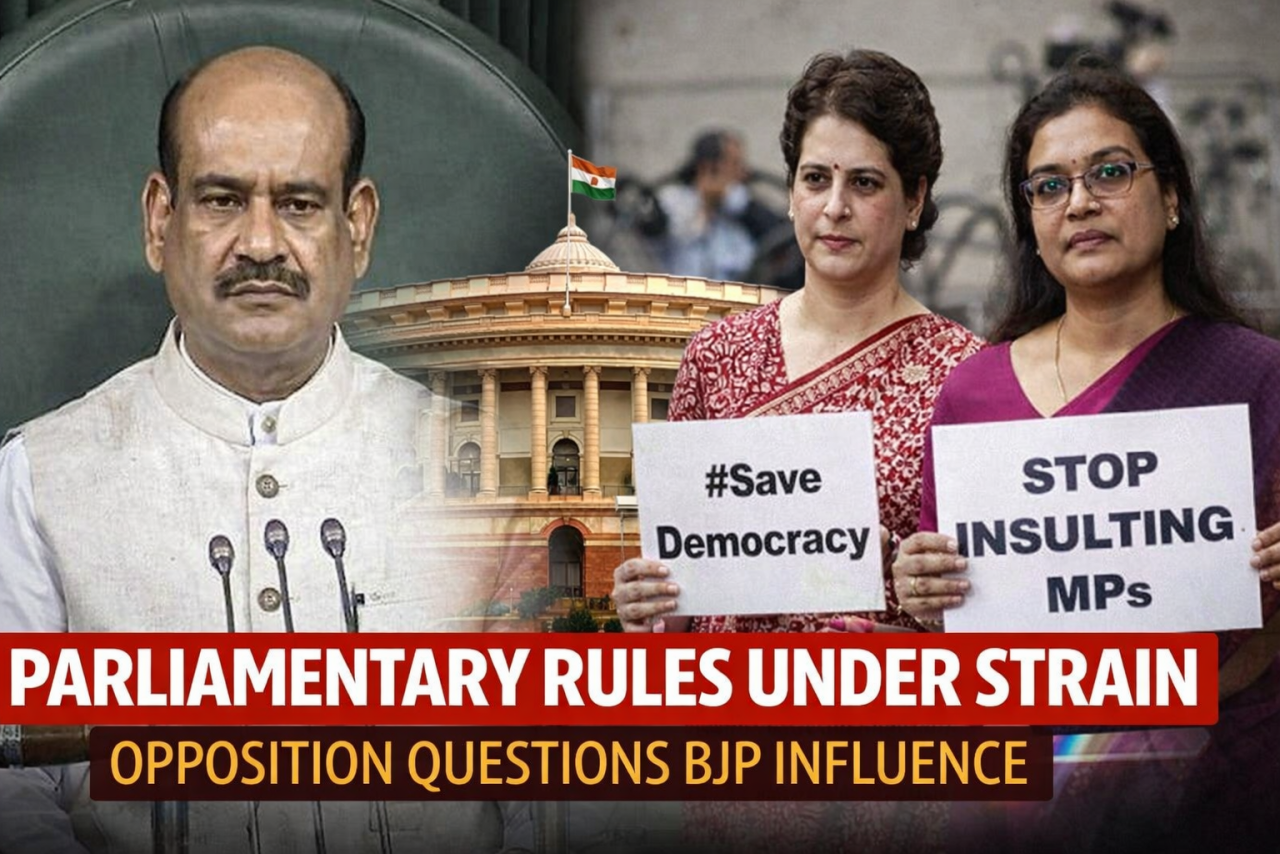
As Parliament sits in session, two separate developments in the Lok Sabha and Rajya Sabha have triggered serious questions about whether established rules and institutional neutrality are being compromised under political pressure.
Two developments from the current session of Parliament—one in the Lok Sabha and the other in the Rajya Sabha—have brought renewed attention to concerns about how parliamentary authority and procedure are being exercised under a dominant executive. While arising from different Houses and involving different actors, both episodes underline a shared issue: whether institutional processes are being subordinated to the political priorities of the ruling party.
The first involves a rare written complaint by six women Members of Parliament from the Congress party to Lok Sabha Speaker Om Birla. The second concerns a formal notice of breach of privilege moved against Union commerce minister Piyush Goyal in the Rajya Sabha. Taken together, the two cases point to mounting unease within the Opposition over what it sees as selective enforcement of rules and a narrowing space for parliamentary accountability.
Speaker’s Conduct Questioned by Women MPs
The Congress MPs—R Sudha, Vasha Eknath Gaikwad, Priyanka Gandhi Vadra, Jyotsna Charandas Mahant, and Geniben Thakor—wrote to the Speaker objecting to comments made in the House that suggested members of the Opposition might have posed a security threat to the Prime Minister during the President’s address.
The Speaker had stated that he had received “reliable information” that certain Congress members could attempt to reach the Prime Minister’s seat and create disruptions. Though no names were mentioned, the Congress MPs argued that the remark implicitly targeted women MPs who were seen standing near the Prime Minister’s bench and amounted to a serious allegation without evidence.
In their letter, the MPs alleged that the Speaker was acting under pressure from the ruling Bharatiya Janata Party (BJP) and that his remarks legitimised a narrative portraying Opposition members as irresponsible or dangerous. They contended that this compromised the Speaker’s constitutional responsibility to function as an impartial custodian of the House.
The letter also drew attention to what the MPs described as unequal disciplinary standards. They pointed to the suspension of eight Opposition MPs from the INDIA bloc while alleging that BJP members were permitted to make objectionable remarks against former Prime Ministers without facing comparable action. This, they said, reinforced the perception that parliamentary authority was being exercised unevenly.
A Lok Sabha Secretariat official rejected the Opposition’s claims, asserting that the Speaker’s actions were aimed at ensuring order and safety in the House. The official maintained that the Speaker’s conduct reflected responsible discharge of duty rather than political bias.
Privilege Notice Over Policy Announcement Outside Parliament
The second episode unfolded in the Rajya Sabha, where DMK MP Tiruchi Siva submitted a notice of breach of privilege against commerce minister Piyush Goyal. The notice accused the minister of showing disregard for Parliament by briefing the media on the India–US trade agreement while Parliament was in session.
Siva argued that established parliamentary convention requires ministers to make policy announcements on the floor of the House before addressing the media, particularly when the legislature is sitting. By announcing the details outside Parliament, he said, the minister had undermined the role of elected representatives and denied them the opportunity for immediate scrutiny and debate.
The notice, submitted under Rule 267, cited authoritative parliamentary texts, including Practice and Procedure of Parliament by M.N. Kaul and S.L. Shakdher, which state that it is improper to announce policy decisions outside Parliament during a session. The notice also recalled a precedent from 1980, when BJP leader L.K. Advani objected to the government announcing decisions outside the House while Parliament was in session.
Rajya Sabha Chairman Jagdeep Dhankhar acknowledged receipt of the notice and said it would be examined. He also noted that the minister had subsequently made a statement in the House. However, the Opposition maintains that a post-facto statement does not negate the initial breach or the precedent it sets.
Institutional Concerns Beyond Party Lines
While the government has defended both the Speaker’s actions and the minister’s conduct, the Opposition argues that these episodes are symptomatic of a broader institutional shift. According to this view, parliamentary mechanisms are increasingly being managed in a way that prioritises executive convenience over legislative scrutiny.
In the Lok Sabha, the concern centres on whether the Speaker’s office is maintaining visible neutrality amid heightened political confrontation. In the Rajya Sabha, the issue is whether ministers are treating Parliament as the primary forum for accountability or merely one of several communication platforms.
Neither episode, by itself, constitutes a constitutional crisis. However, parliamentary democracies rely heavily on conventions, precedents, and trust in institutional roles. When those conventions are perceived to be diluted, the impact is cumulative.
For the Opposition, these developments reinforce the argument that parliamentary space for dissent is shrinking. For the government, the challenge lies in addressing these concerns without appearing dismissive of institutional norms.
As Parliament continues its session, how these issues are resolved—or set aside—will shape not just the tenor of debate in the current term, but also the credibility of parliamentary processes in the years ahead.























Leave a Comment