
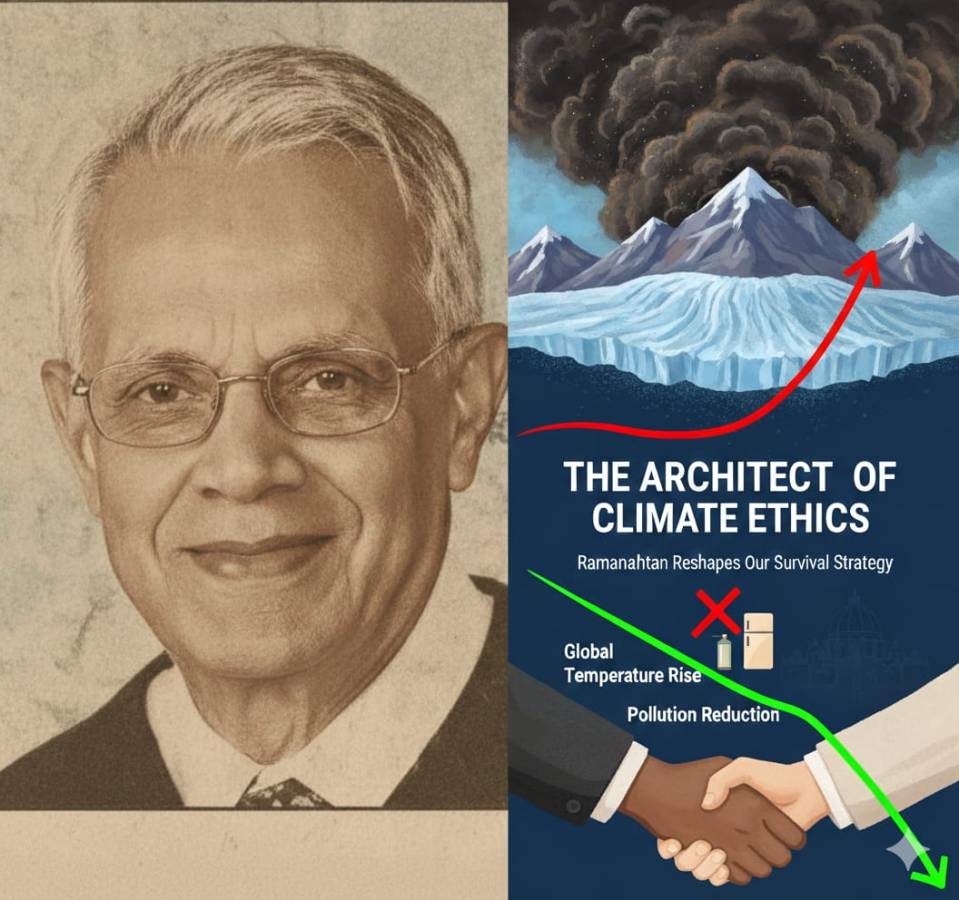
From uncovering hidden heat-trapping gases to redefining climate change as a moral crisis, one scientist’s work quietly changed how the world fights global warming.
When we speak of global warming, the conversation often begins and ends with carbon dioxide (CO₂). However, the story of how the world truly came to understand the complexity of a warming planet cannot be told without mentioning Veerabhadran Ramanathan.
Recently honoured with the 2026 Crafoord Prize in Geosciences, often called the “Nobel of Geosciences”, Ramanathan’s journey, from a refrigerator factory in Secunderabad to advising the Vatican, stands as one of the most consequential stories in modern science.
The CFC Revelation: A Paradigm Shift
In 1975, while working at NASA, Ramanathan made a discovery that shocked the scientific community. Until then, carbon dioxide was widely believed to be the primary driver of the greenhouse effect. Ramanathan proved that chlorofluorocarbons (CFCs), commonly used in aerosols and refrigerators, were also powerful greenhouse gases.
His research revealed a startling fact, “One molecule of CFC can trap up to 10,000 times more heat than a molecule of CO₂.”
This discovery fundamentally changed climate science. It directly influenced the success of the Montreal Protocol, which phased out CFCs to protect the ozone layer. In doing so, the world unknowingly avoided several degrees of additional global warming—an achievement rooted in Ramanathan’s work.
Unveiling the “Atmospheric Brown Clouds”
Ramanathan’s research remained deeply connected to his roots in India. Born in Madurai and educated at Annamalai University and the Indian Institute of Science (IISc), he later focused on South Asia during the Indian Ocean Experiment (INDOEX).
Through this work, he identified Atmospheric Brown Clouds (ABCs)—vast layers of pollution made up of black carbon (soot) and sulfates. His findings highlighted several critical impacts:
- Weakening of the Indian Monsoon
These clouds block sunlight, cooling the Earth’s surface while warming the atmosphere, disrupting monsoon patterns. - Accelerated Glacial Melting
Soot settles on Himalayan glaciers, darkening the ice and increasing heat absorption, which speeds up melting. - Severe Health Consequences
These pollutants contribute to millions of premature deaths every year due to respiratory and cardiovascular diseases.
By focusing on Short-Lived Climate Pollutants (SLCPs) like soot and methane, Ramanathan offered a powerful solution. Unlike CO₂, which remains in the atmosphere for centuries, reducing SLCPs can show climate benefits within weeks—buying valuable time for long-term climate action.
From Data to Divinity: The Moral Imperative
One of the most remarkable aspects of Ramanathan’s career is his move beyond scientific data toward ethical responsibility. As a Distinguished Professor Emeritus at the Scripps Institution of Oceanography, he realised that scientific evidence alone was not enough to drive urgent global action.
He became a key climate advisor to Pope Francis and played a major role in shaping the 2015 encyclical Laudato si’. By framing climate change as a moral and social justice issue, he highlighted a harsh reality:
- The wealthiest 1 billion people produce most global emissions
- The poorest 3 billion people suffer the worst consequences
Through this work, Ramanathan bridged the gap between science, ethics, and global leadership.
The 2026 Crafoord Prize: A Legacy Solidified
The Royal Swedish Academy of Sciences awarded Ramanathan the 8 million Swedish kronor (approximately $900,000) Crafoord Prize in recognition of his decades-long research on super-pollutants.
This honour is more than a personal milestone. It acknowledges that his work has provided a practical blueprint for international environmental treaties and real-world climate solutions.
At 82, Ramanathan remains an active and passionate advocate for the planet. His life’s journey reminds us that the climate crisis is not only a scientific problem but a test of our shared humanity. As he prepares to receive his gold medal in Stockholm this May, his legacy stands as proof that one person’s curiosity can truly help change the world.





















Leave a Comment