
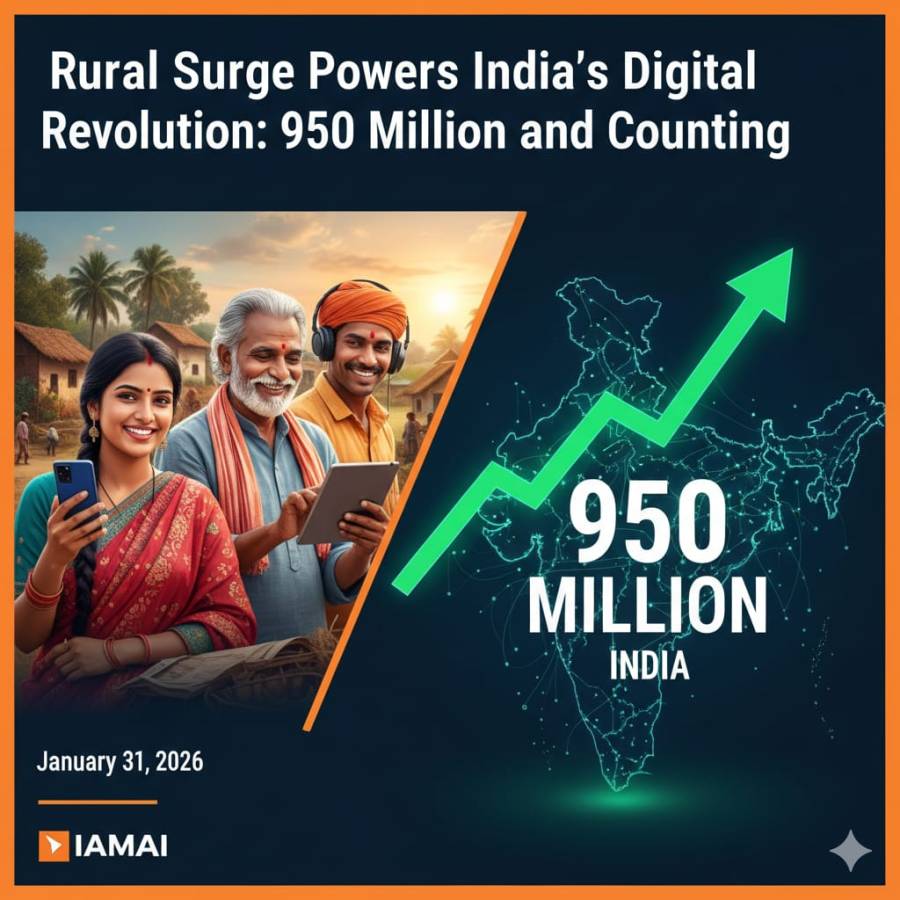
As India crosses 950 million internet users, rural India has quietly taken the lead.
India’s digital journey has quietly crossed a threshold that once felt distant. What began as an ambitious policy vision has now become a lived reality for a majority of the population. According to the Internet in India Report 2025, jointly published by the Internet and Mobile Association of India (IAMAI) and Kantar, the country’s active internet user base has surpassed 950 million. This is not just a numerical milestone; it signals a deeper shift in how Indians access information, consume content, and participate in the digital economy.
The most consequential change lies not in the size of the user base but in its geography. For more than a decade, India’s digital growth story was dominated by Tier-1 cities and urban early adopters. That balance has now decisively tipped. Rural India accounts for nearly 57 percent of all active internet users, translating to roughly 548 million people. Even more telling is the pace of change. Internet adoption in rural areas is expanding almost four times faster than in urban centres, making villages the primary engine of India’s digital expansion.
This is no longer a temporary catch-up phase. Rural users have overtaken urban users in absolute numbers, indicating a structural and likely permanent shift in the country’s digital demographics. Affordable smartphones, low-cost data, and improved network coverage have played a role, but the transformation also reflects how deeply digital tools have embedded themselves into everyday rural life—from communication and entertainment to payments and commerce.
Another striking finding from the report is how quickly artificial intelligence has moved from abstraction to routine use. While much of the global debate around AI remains focused on regulation and ethics, Indian users appear more concerned with utility. Around 44 percent of internet users are already engaging with AI-enabled features in some form. This adoption is not confined to a small, tech-savvy elite. Voice assistants, image-based search, chatbots, and automated filters have made digital platforms more intuitive, reducing dependence on text and formal literacy. In effect, AI is acting as a bridge rather than a barrier, especially for first-time and non-English-speaking users.
Content consumption patterns further underline how the internet experience in India is evolving. Short-form video has emerged as the dominant format, with 588 million users—about 61 percent of the total internet population—consuming such content in 2025. Younger users lead this trend, with more than half of those between 15 and 44 years regularly engaging with video and AI-driven features. What stands out, however, is that rural users now match, and in some cases exceed, urban users in short-video consumption.
This shift has implications far beyond entertainment. It is reshaping the creator economy, turning local storytellers into national voices and blurring the line between regional and mainstream content. Platforms once geared toward metropolitan audiences are being redefined by vernacular languages, hyper-local themes, and creators rooted in small towns and villages.
Taken together, these trends point to a digital ecosystem that is broader, deeper, and more complex than before. India’s 8 percent year-on-year growth in internet users reinforces its status as one of the world’s largest and most dynamic digital markets. For businesses, the opportunity lies in understanding rural users not as late adopters but as central participants with distinct preferences. For policymakers, the challenge is shifting focus from basic access to meaningful engagement.
As the divide between “Digital India” and “Bharat” continues to narrow, the next phase of growth will likely be driven by localized content, voice-first interfaces, and video-centric platforms. The numbers tell a powerful story, but the real transformation is cultural: the internet in India is no longer urban-led or elite-driven. It is rural, mobile, and increasingly intelligent—and it is shaping the country’s future in ways that are only beginning to unfold.
























Leave a Comment