
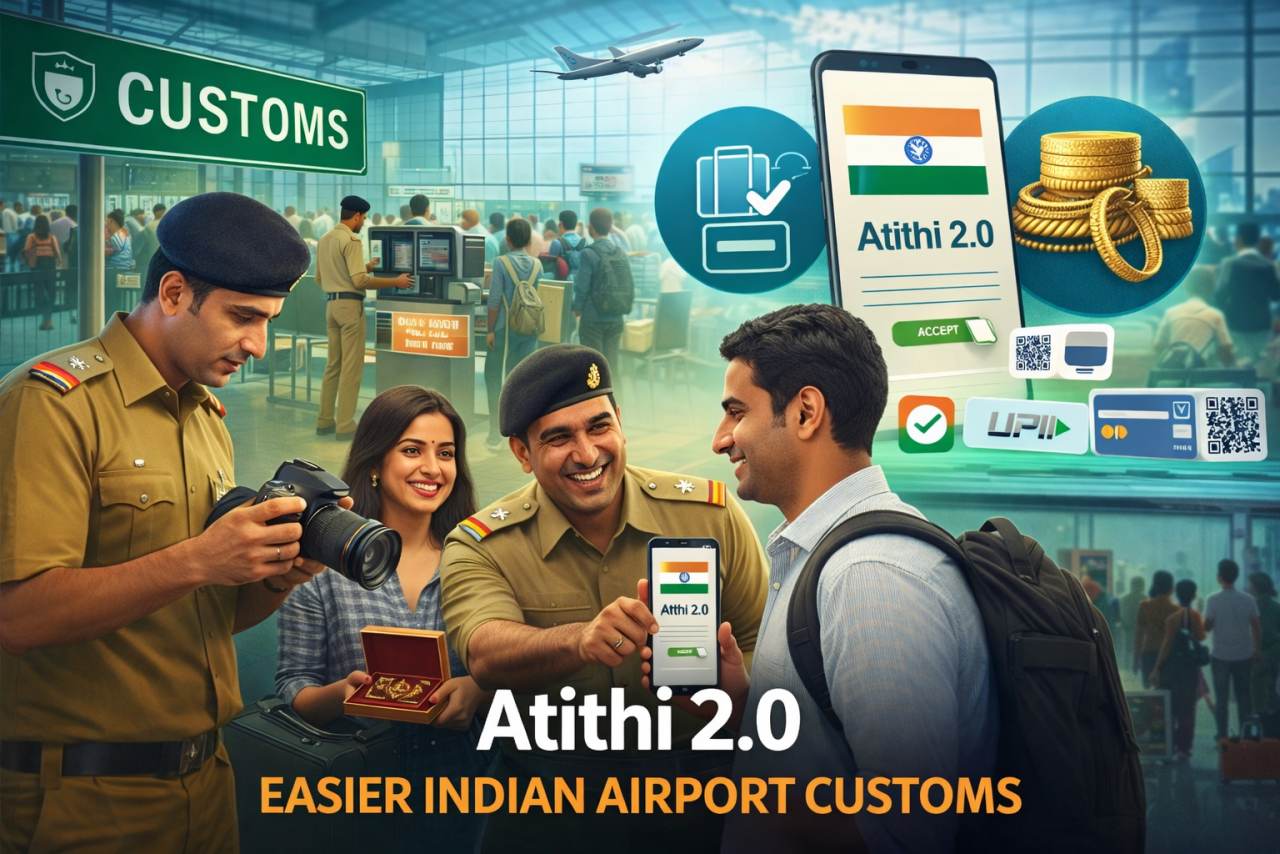
From baggage checks to mobile clicks, Atithi 2.0 brings customs into the digital age.
For decades, India’s airports have carried an unspoken anxiety for returning travellers. The moment the aircraft lands, excitement about home often mixes with worry—Will my jewellery be questioned? Will my camera or laptop invite scrutiny? Will I have to prove ownership of items I carried out myself? These fears, born out of inconsistent enforcement and opaque rules, have shaped countless unpleasant experiences at customs.
The government’s proposed Atithi 2.0 system aims to change this relationship fundamentally—not just by digitising procedures, but by reimagining customs as a facilitator of travel rather than a checkpoint of suspicion.
A shift in mindset, not just a new app
At first glance, Atithi 2.0 looks like another digital initiative: travellers click photos of jewellery or gadgets, upload details before travel, declare items online, and pay any applicable duty via UPI or cards. But the real transformation lies deeper. This system signals a policy shift from discretionary judgment at counters to rule-based, technology-backed clearance.
Historically, customs checks often depended on individual interpretation—especially when it came to jewellery valuation or electronic goods. Atithi 2.0 replaces this ambiguity with automatic duty calculation, removing scope for confusion, delay, or harassment. When numbers are system-generated and payments are digital, discretion gives way to predictability.
Jewellery rules: clarity replaces confusion
One of the most sensitive areas for Indian travellers has always been jewellery. Family gold passed down generations, wedding ornaments, or personal valuables frequently became flashpoints at airports. The revised baggage rules, integrated with Atithi 2.0, simplify this by moving away from outdated value caps and focusing on weight-based allowances.
Under the new framework, eligible returning Indian residents after a stay abroad of over one year can carry duty-free jewellery purely based on weight—up to 40 grams for women and 20 grams for others. This clarity matters. It recognises social realities while aligning enforcement with objective standards, reducing both disputes and delays.
Pre-declaration as empowerment
A key innovation of Atithi 2.0 is pre-arrival filing—allowing travellers to upload details up to 72 hours before landing. This flips the traditional airport experience. Instead of rushing to fill forms or nervously answering questions after a long flight, travellers arrive informed and prepared.
The app also tells passengers in advance whether they are likely to pass through the green or red channel. This transparency transforms customs from a moment of uncertainty into a predictable process—much like online check-in changed air travel.
Faster airports, smarter governance
Beyond individual convenience, Atithi 2.0 has systemic implications. Automated declarations and digital payments reduce paperwork, congestion, and manual workload at airports. Customs officers can focus their attention on genuine risk cases rather than routine travellers, improving both efficiency and security.
The integration of temporary import and export certificates—especially for professionals carrying cameras, laptops, or equipment—also supports India’s growing global workforce, content creators, and business travellers. Travel becomes smoother without compromising regulatory oversight.
Trust as infrastructure
Perhaps the most important outcome of Atithi 2.0 is intangible: restoring trust. When systems are transparent, predictable, and digital, the power imbalance between the state and the citizen narrows. Travellers feel respected rather than suspected. That trust, once rebuilt, becomes a form of national infrastructure—just as vital as terminals or runways.
The proposal to equip customs field officers with body cameras further reinforces accountability. It acknowledges past grievances without defensiveness and signals a willingness to institutionalise transparency.
Aligning with a global India
India today sends millions of citizens abroad for work, education, tourism, and business. Airports are no longer mere entry points; they are the country’s first impression. By aligning customs processes with global best practices, Atithi 2.0 positions India as a confident, modern state that values both compliance and convenience.
The increase in duty-free allowances—from ₹50,000 to ₹75,000 for resident Indians and from ₹15,000 to ₹25,000 for foreign tourists—also reflects a realistic understanding of contemporary travel and purchasing patterns.
Challenges remain
No digital system succeeds on launch alone. Effective implementation will depend on awareness, airport-level training, system stability, and grievance redressal. Rural or less tech-savvy travellers must not be left behind. The promise of Atithi 2.0 will be tested not by its features, but by its everyday use during peak travel seasons.
A quiet but meaningful reform
Atithi 2.0 may not dominate headlines like megaprojects or sweeping tax reforms, but its impact could be deeply felt by millions. By reducing friction at one of the most personal points of state-citizen interaction, it humanises governance.
If implemented well, Atithi 2.0 could mark the moment when returning home stops feeling like an interrogation—and starts feeling, simply, like arrival.

























Leave a Comment