
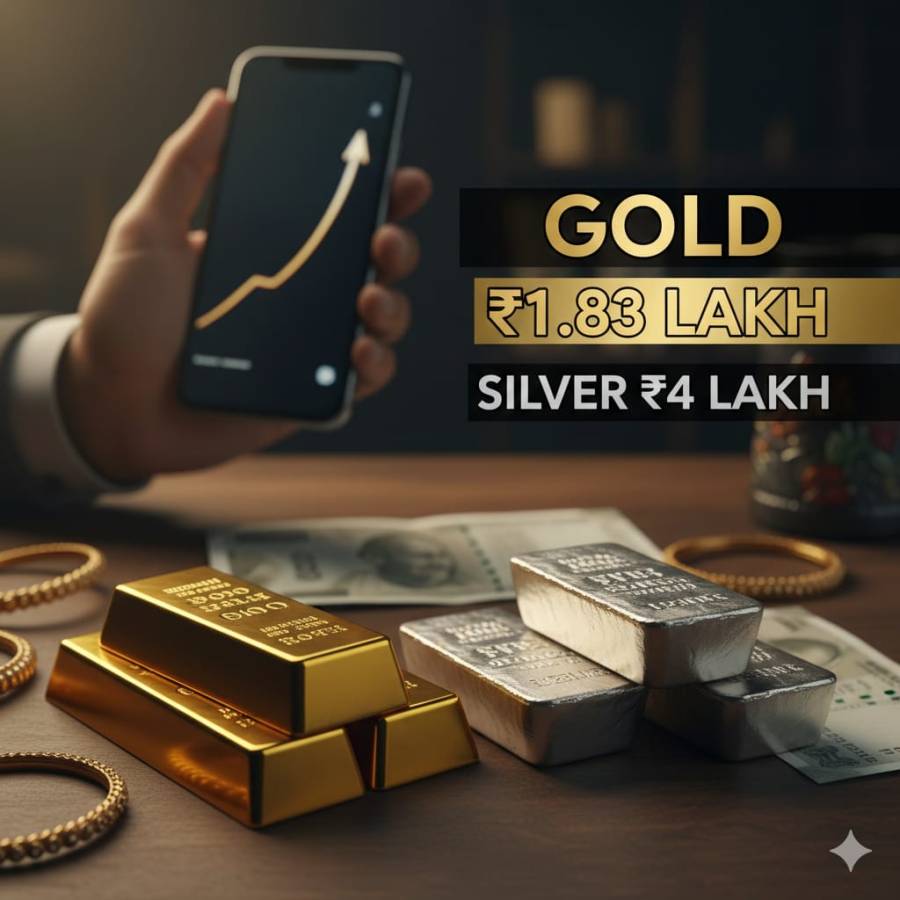
Gold at ₹1.83 lakh and silver at ₹4 lakh aren’t just market milestones—they mark a turning point in how India’s middle class saves, marries, and measures security.
India’s bullion market has entered territory few would have imagined even a year ago. Gold prices have surged to an unprecedented ₹1.83 lakh per 10 grams, while silver has crossed the startling ₹4 lakh per kilogram mark. What might appear as a moment of triumph for investors and traders is, for millions of Indian households, a moment of recalibration—financial, cultural, and emotional.
Gold and silver have never been just commodities in India. They are woven into social customs, marriage rituals, and long-term savings strategies. At today’s prices, however, these traditional assumptions are being quietly but fundamentally challenged.
A Rally Shaped by Global Pressures
The surge in precious metal prices is not the result of domestic speculation alone. According to data and market assessments from the All India Sarafa Association, the rally reflects a convergence of global uncertainties.
Escalating geopolitical tensions, particularly in the Middle East, have revived demand for safe-haven assets. At the same time, the weakening of the US dollar has strengthened precious metals, which historically move in the opposite direction. Adding further momentum is aggressive gold accumulation by central banks across the world, as countries seek to diversify reserves away from conventional currencies.
Together, these forces have created a sustained upward push, leaving domestic buyers with little relief despite periodic corrections.
Gold and the Middle-Class Dilemma
For decades, gold functioned as an informal financial safety net for India’s middle class. Families accumulated jewellery not just for adornment, but as a hedge against uncertainty—assets that could be liquidated during medical emergencies, business downturns, or periods of unemployment.
At current levels, that role is being reconsidered.
A single 10-gram purchase now costs close to four times the monthly starting salary in many urban jobs. As a result, gold is steadily shifting from a savings instrument to a high-value luxury. Regular accumulation, once possible through small monthly purchases, has become financially unviable for many households.
Weddings Under Pressure
Nowhere is this shift more visible than in Indian weddings. Gold jewellery has long been a non-negotiable element of marriage ceremonies, often symbolising security, status, and continuity across generations.
Rising prices are forcing families to rethink long-standing norms. Heavy ornaments are giving way to minimalist designs, while 18-karat gold, once viewed as a compromise, is gaining social acceptance. Lightweight jewellery and selective purchases have become practical necessities rather than stylistic choices.
The cultural symbolism remains intact, but its physical expression is shrinking under economic pressure.
Digital Alternatives Gain Ground
Interestingly, while jewellery demand has softened, investment interest has not disappeared. Instead, it has migrated.
Faced with prohibitive physical prices, many retail investors are turning to gold exchange-traded funds (ETFs) and digital gold platforms. These options allow households to maintain exposure to gold without the burden of large upfront costs, storage concerns, or making charges.
For a new generation of investors, owning gold no longer requires a locker or a jeweller—it only requires a smartphone and a modest monthly allocation.
Silver’s Surprising Transformation
Silver’s rally has been even more dramatic in relative terms. Traditionally considered the “poor man’s gold,” silver has undergone a structural transformation driven by industrial demand.
Its critical role in solar energy systems, electric vehicles, and electronics has elevated silver from a household metal to a strategic industrial asset. This dual identity—both precious and industrial—has increased volatility but also attracted investors seeking alternatives to expensive gold.
For some middle-income households, silver now represents the last accessible entry point into physical precious metals.
To Sell or to Hold?
As prices touch record highs, a difficult question confronts many families: should they sell inherited jewellery and capitalise on the rally?
India is estimated to hold nearly 25,000 tonnes of household gold, making its citizens among the largest private holders in the world. While rising prices have technically increased household net worth, the emotional cost of selling family heirlooms—and the impossibility of replacing them later—complicates the decision.
For most, this is not a straightforward investment call but a deeply personal financial reckoning.
A Quiet Adjustment Underway
What is unfolding is not a rejection of gold or silver, but a recalibration of how they fit into middle-class life. Households are adapting—by buying less, buying differently, or shifting to digital formats—while holding onto the cultural importance of precious metals.
As bullion prices continue to explore uncharted territory, the Indian middle class is learning to navigate a new reality: one where tradition remains valued, but affordability dictates expression. The shine of gold endures—but its weight, both literal and financial, has never felt heavier.
























Leave a Comment