
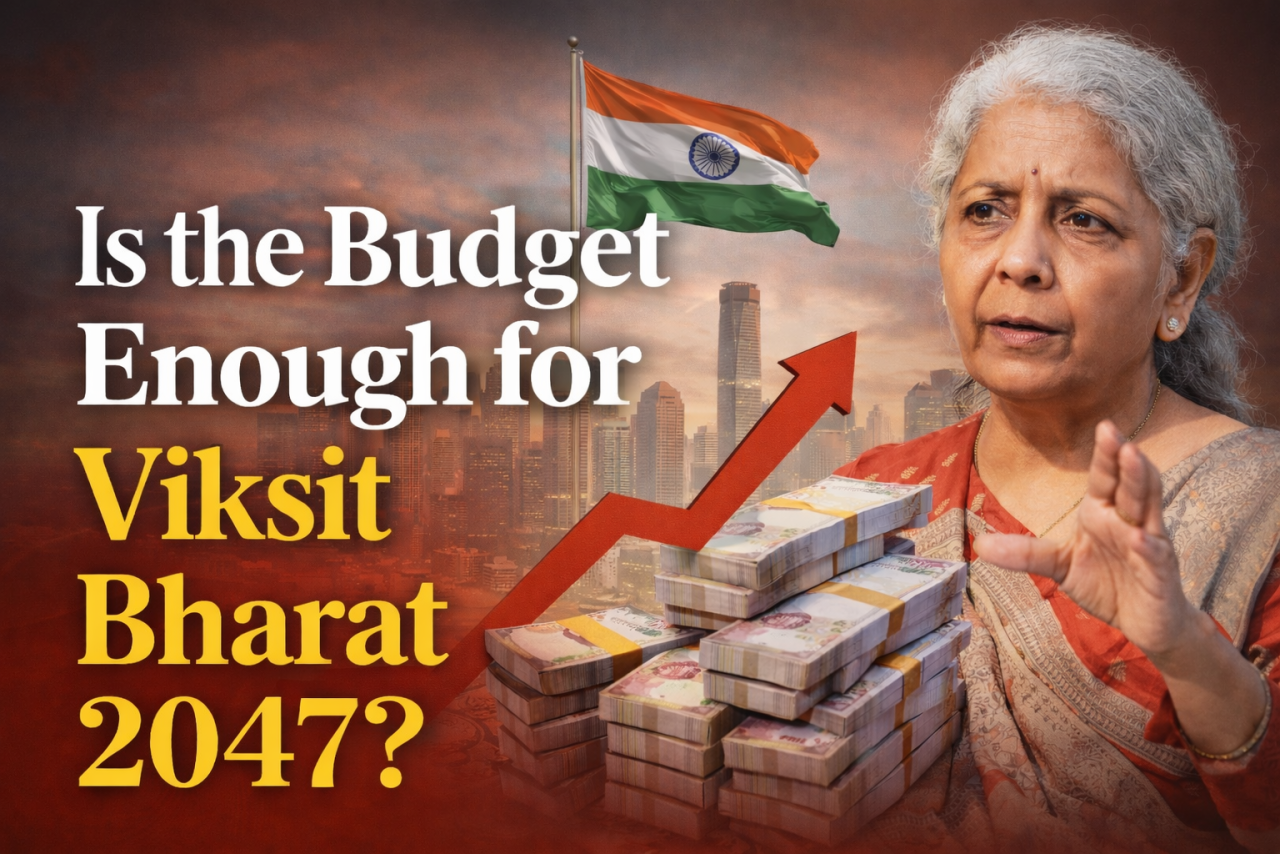
As India charts its course toward Viksit Bharat 2047, the latest Union Budget promises growth and stability—but does it truly lay the foundation for a developed nation, or are we mistaking incremental progress for transformation?
Finance Minister Nirmala Sitharaman’s latest Union Budget arrives wrapped in a familiar promise: steady growth today will lead India to become a Viksit Bharat by 2047. The numbers point to confidence—GDP growth estimates remain optimistic, capital expenditure continues to rise, and fiscal discipline is presented as a strengthNevertheless, a critical reading of the budget brings up an uncomfortable question. Does this budget truly address the structural challenges that stand between India and the ambitious vision of a developed nation, or does it merely extend the comfort of incremental progress?
At first glance, the budget projects stability. Capital expenditure remains a priority, with infrastructure spending once again positioned as the main growth engine. Roads, railways, logistics, and urban development continue to receive attention. This is not insignificant. Infrastructure investment has multiplier effects and creates employment, especially in construction and allied sectors. However, infrastructure-led growth alone cannot carry a country of India’s size and diversity into developed status within two decades. Developed economies are not defined only by highways and rail lines, but by productivity, human capital, innovation, and institutional strength.
One of the most critical gaps in the budget is the limited focus on employment quality. While job creation is frequently mentioned, the budget largely relies on indirect mechanisms—private investment, startups, and infrastructure—to generate employment. India’s employment challenge is not only about numbers, but about the nature of jobs. Informality still dominates the labour market. Millions remain stuck in low-paying, insecure work with little social protection. Without a direct, large-scale push for labour-intensive manufacturing and services, the demographic dividend risks turning into a demographic burden.
Agriculture, which supports nearly half of India’s population, remains another weak link. The budget speaks of technology adoption, digital platforms, and agri-credit, but farmers continue to struggle with price volatility, climate stress, and rising input costs. The absence of a clear, long-term income security framework for farmers raises concerns. A developed India cannot be built on an agrarian base that remains economically fragile and socially distressed.
The budget also places heavy faith in fiscal prudence, aiming to reduce the fiscal deficit gradually. While macroeconomic stability is essential, excessive caution can limit transformative spending. Countries that successfully transitioned to developed status invested heavily in education, healthcare, and research during their growth phase. India’s public spending on health and education, even after incremental increases, remains below global benchmarks. Without significant improvements in school quality, higher education, skill training, and public healthcare, economic growth will struggle to translate into broad-based human development.
Another concern lies in the treatment of inequality. The budget does not meaningfully address widening income and wealth gaps. Tax structures remain largely unchanged, and there is little discussion on strengthening redistributive mechanisms. Growth that disproportionately benefits a narrow segment of society may improve headline numbers but weakens social cohesion. A developed nation is measured not only by its GDP size, but by how evenly opportunity is distributed across regions, genders, and social groups.
On innovation and technology, the budget speaks the right language—AI, digital public infrastructure, green energy, and startups. India has built strong digital rails, and this is a genuine achievement. However, innovation ecosystems require sustained public investment in research and development, not just policy intent. India’s R&D spending remains low as a percentage of GDP. Without deeper investment in science, universities, and indigenous technology, India risks becoming a consumer rather than a creator of advanced technologies.
Climate resilience is another area where ambition falls short of urgency. The budget acknowledges green growth and energy transition, but climate risks to agriculture, coastal regions, and urban centres demand far more aggressive planning and funding. A Viksit Bharat cannot emerge from repeated climate shocks that push millions back into poverty.
Ultimately, this budget reflects continuity rather than transformation. It prioritizes stability, avoids major shocks, and reinforces existing policy directions. That may be sufficient for managing the present, but it is not enough to reshape the future. The journey to Viksit Bharat 2047 requires bold structural reforms, deeper social investment, and a willingness to confront uncomfortable realities—joblessness, inequality, agrarian distress, and human capital gaps.
The budget may keep India on a growth path, but growth alone is not development. If 2047 is to mark not just independence in years but independence in capability, dignity, and opportunity, future budgets will need to be more courageous than comfortable.
























Leave a Comment