
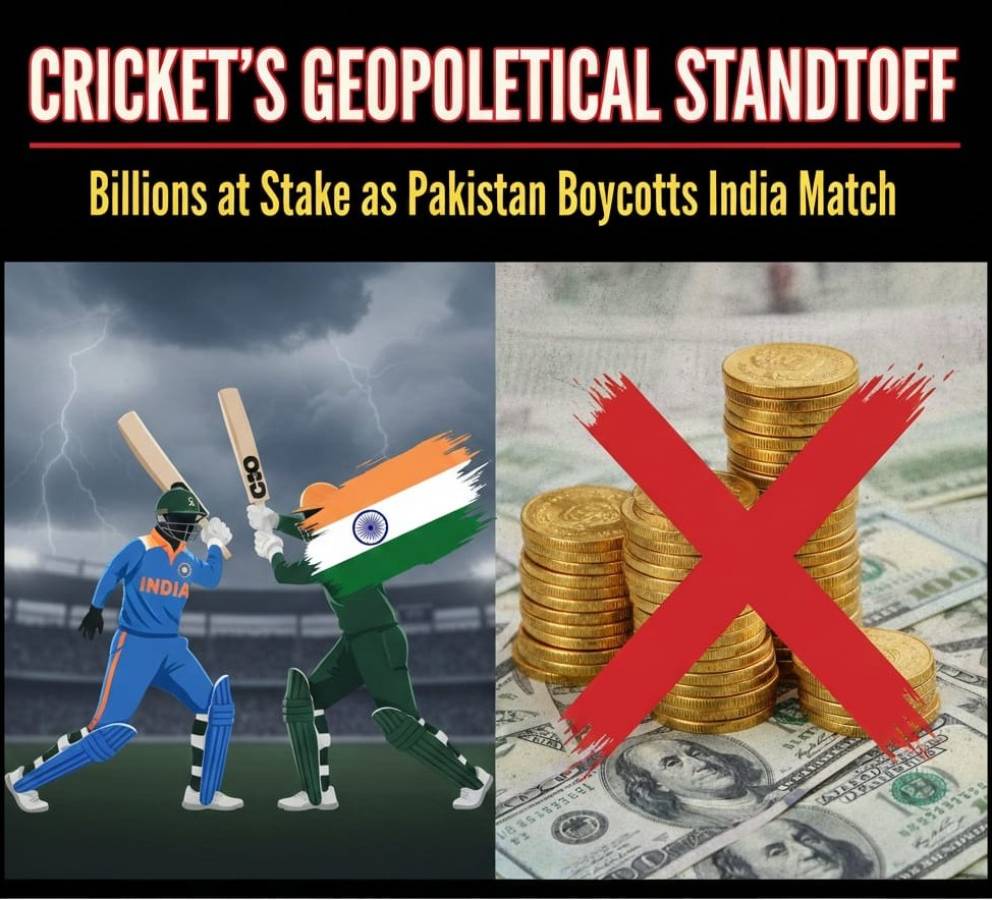
When politics steps onto the pitch, even cricket’s biggest rivalry can push the global game to the edge of collapse.
The world of international cricket has once again found itself entangled in a complex web of political tension and administrative maneuvering. Following a series of controversial decisions regarding match venues and player releases, the Pakistan Cricket Board (PCB) has formally communicated to the International Cricket Council (ICC) that its national team will not take the field for its scheduled league match against India in the upcoming T20 World Cup. This move, which comes as a directive from the Pakistani government, has sent shockwaves through the sporting world, triggering a flurry of informal backchannel talks as officials scramble to prevent a total collapse of the tournament’s commercial and competitive integrity.
The roots of the current crisis are multi-layered, involving not just India and Pakistan, but also the Bangladesh Cricket Board (BCB). The situation escalated when the BCB refused to play its matches in India, a stance that reportedly began after an Indian Premier League (IPL) franchise was ordered by the Indian board to release one of its Bangladeshi players. This refusal by Bangladesh created a precedent of "selective participation" that Pakistan has now adopted, albeit under different circumstances. Critics have labeled Pakistan’s current stance as a "theatre of the absurd," pointing out the logical inconsistencies in their policy. For instance, just days before this announcement, the Pakistani junior team played against India in the U-19 World Cup in Bulawayo, Zimbabwe. The decision to allow juniors to compete in a neutral venue while barring the senior team from doing the same has raised questions about the consistency of the PCB’s logic.
At the heart of the matter is the intense rivalry between India and Pakistan, which is frequently exacerbated by regional security issues. Recent military tensions, sparked by terror attacks in Pahalgam, have further soured relations, leading to a situation where sporting fixtures are used as leverage in broader diplomatic disputes. The ICC has previously allowed India to play its Champions Trophy matches in the UAE rather than in Pakistan, the host country, citing security concerns. However, the failure to extend similar courtesies or find a standardized resolution for all member nations has left the governing body open to accusations of inconsistency.
The financial stakes of this boycott are staggering. The India-Pakistan clash is the undisputed crown jewel of the ICC’s commercial portfolio. In the current 2024-27 media rights cycle, the ICC secured a $3 billion deal from the Indian market alone. Industry estimates suggest that a single T20 World Cup match between the two neighbors can be valued at approximately $100 million. Beyond the league stage, there is the looming question of what happens if both teams qualify for the knockout rounds. If Pakistan maintains its boycott, it risks not only forfeiting league points but also potentially missing out on massive revenue shares and facing severe sanctions that could cripple its domestic cricketing economy.
In response to the boycott call, the ICC has maintained a public stance of sportsmanship, asserting that all qualified teams are expected to compete on equal terms as per the event schedule. While the ICC has the option to call an emergency board meeting to take collective action, it has so far opted for a softer approach, engaging in "backchannel talks" to find a mutually acceptable resolution. Influential member boards, including those of England and Australia, have privately expressed their displeasure with the PCB's unilateral decision, fearing the long-term precedent it sets for the sport.
Within Pakistan, the decision appears to be driven by high-level political figures. PCB Chairman Mohsin Naqvi, who also serves as Pakistan’s Interior Minister, is at the helm of this strategy. This dual role underscores the reality that cricket in the region is rarely just a game. Pakistani players, currently preparing in Colombo for their tournament opener, have expressed that the decision is out of their hands. Skipper Salman Agha noted that the team must follow the directives of their government, regardless of their personal desire to play.
As the tournament draws closer, the ICC faces a race against time. If a resolution is not reached, the governing body may be forced to take drastic measures, such as replacing Pakistan in the tournament or seeking legal means to recover commercial losses. For now, the cricketing world waits to see if diplomacy can triumph over the "theatre of the absurd," or if one of the sport's greatest rivalries will be lost to the shadows of political grandstanding.



















Leave a Comment