
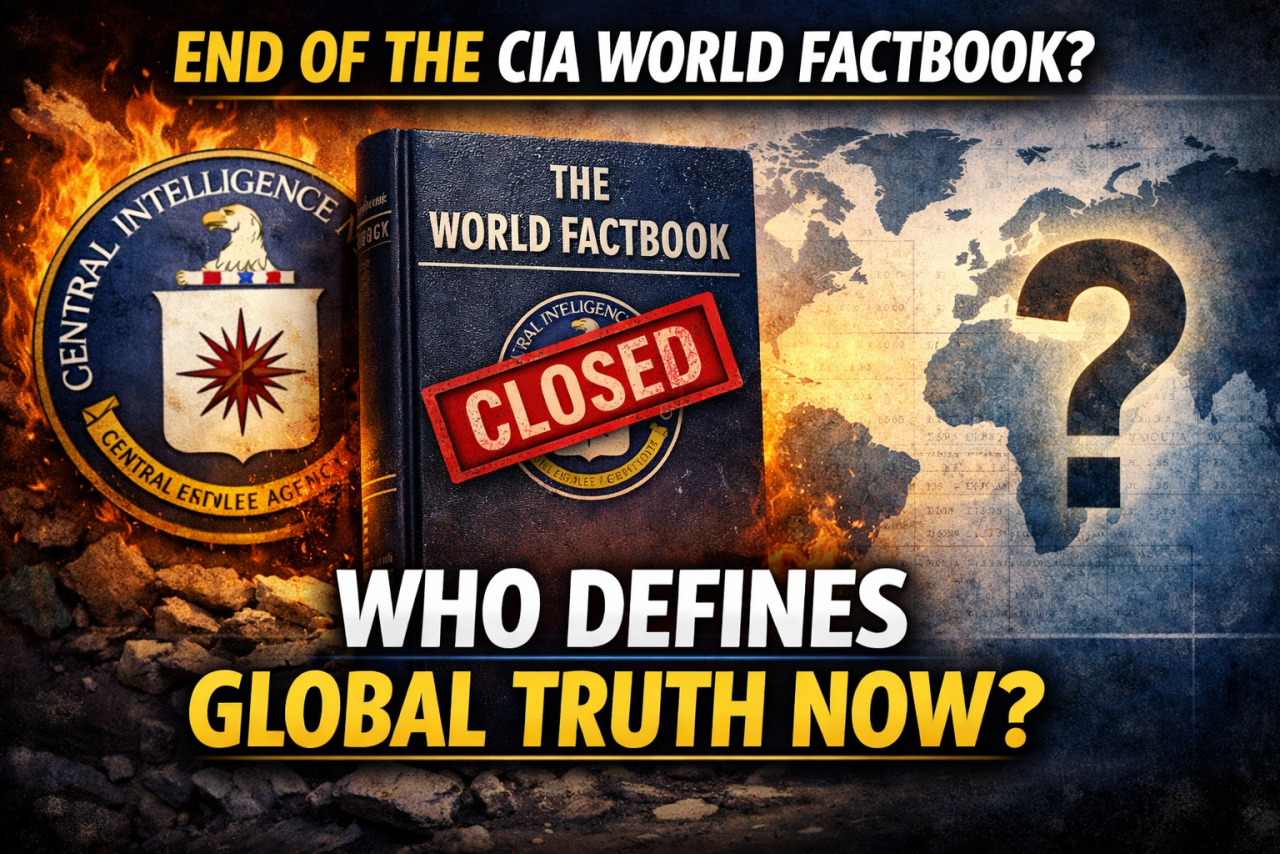
For more than 60 years, one database helped the world understand itself. Its closure raises a bigger question about who now defines global facts.
For more than six decades, the CIA World Factbook stood as one of the most trusted and widely used sources of country-level information in the world. Students, researchers, journalists, policymakers, and even casual readers relied on it for clear, standardized data on geography, population, economy, government systems, and military capabilities. Now, that long-running chapter has come to an end, as the Central Intelligence Agency has officially shut down the World Factbook, closing a global reference legacy that began in the early years of the Cold War.
The World Factbook was first created in 1962 as a classified internal document known as The National Basic Intelligence Factbook. Its original purpose was practical and urgent to give U.S. intelligence officers quick access to essential facts about foreign countries. At a time when global tensions were high and information was scattered across multiple agencies, the Factbook served as a concise and reliable briefing tool. Over time, its usefulness became evident beyond intelligence circles, leading to gradual declassification and wider distribution.
By the early 1970s, an unclassified version was made available to other government departments, and in 1981 it officially became known as The World Factbook. The biggest transformation came in the late 1990s, when the CIA launched an online version. This move dramatically expanded its reach, turning what was once a restricted intelligence aid into a globally accessible public resource. The website attracted millions of users each year and became especially popular in classrooms, newsrooms, and research institutions around the world.
What set the World Factbook apart was its consistency and credibility. In an age of competing data sources and political narratives, it offered standardized country profiles that were updated regularly and presented without commentary or opinion. Users could compare nations across the same categories, making it easier to understand global trends and differences. The Factbook also gained attention for its extensive image library, which included thousands of copyright-free photographs, many taken by CIA personnel during official travel.
The CIA’s decision to close the World Factbook was announced without a detailed public explanation. However, it appears to be part of a broader shift within the U.S. intelligence community toward narrowing priorities and reducing activities that do not directly support core intelligence and national security missions. Reports of staffing reductions and budget tightening at major intelligence agencies suggest that public-facing educational tools are increasingly seen as non-essential in a time of changing geopolitical demands.
In its final statement, the CIA acknowledged the evolution of the World Factbook from a classified paper manual to a widely used digital reference. While the database will no longer be updated, existing archived versions are expected to remain accessible for the time being. Still, the absence of future updates marks a significant loss for users who depended on the Factbook for current and reliable global data.
The closure of the World Factbook also highlights a broader issue in today’s information landscape. As governments retreat from maintaining open, authoritative data platforms, users are left to navigate a crowded mix of private databases, commercial services, and unverified online sources. The Factbook had long served as a common point of reference, helping to ground discussions in shared facts at a time when misinformation has become increasingly widespread.
Although the World Factbook is no longer being maintained, its impact remains substantial. For over 60 years, it helped shape how people around the world understood countries beyond their borders. Its role in promoting global awareness and data literacy cannot be easily replaced. As the CIA itself noted in its farewell message, curiosity about the world does not end with the closure of a single resource. Yet for many, the end of the World Factbook marks the quiet disappearance of a trusted guide that once made the complexities of the world easier to understand.

















Leave a Comment