
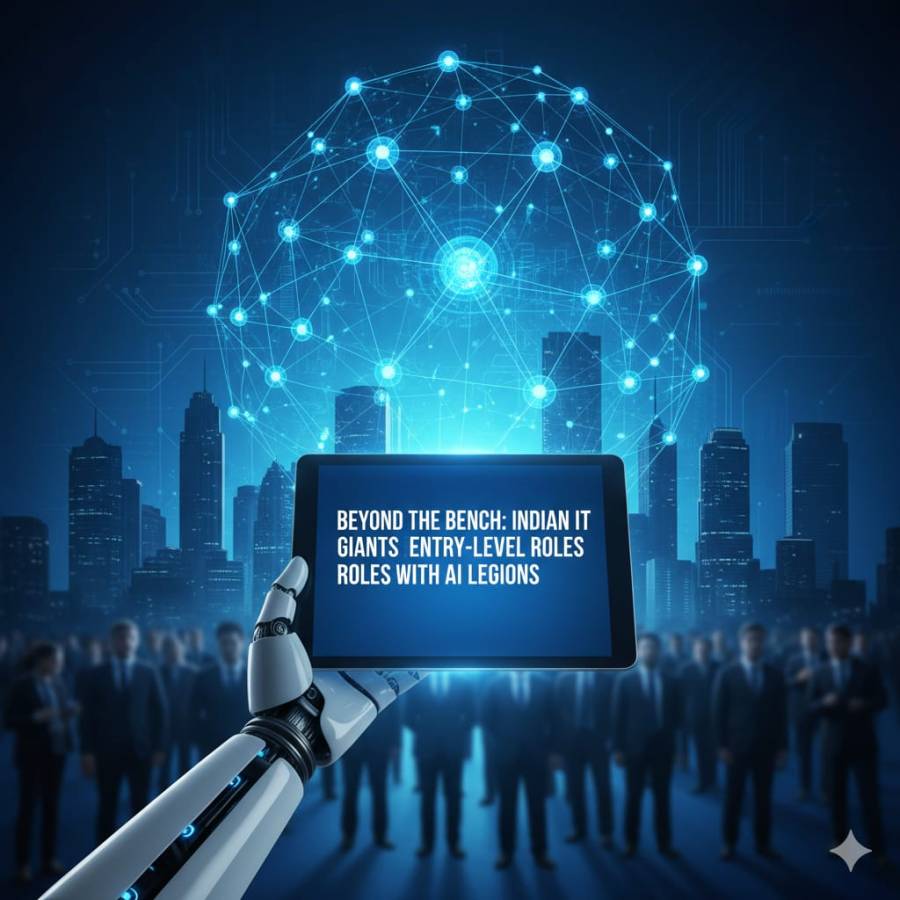
As India’s biggest IT firms deploy AI agents at scale, the country’s long-standing tech employment model is beginning to change.
For a long time, the strength of India’s IT industry lay in its ability to scale human talent. Large teams, predictable delivery, and steady hiring formed the backbone of a sector that became one of the country’s biggest private employers. That advantage is now being tested as the industry quietly begins to change how software work gets done.
India’s largest IT firms such as Cognizant, Infosys, HCL Technologies, and Wipro are gradually moving away from workforce-led expansion and investing instead in artificial intelligence systems that can perform many routine development tasks. Inside these companies, the idea of a “digital workforce” is no longer experimental. It is becoming central to how projects are staffed and delivered.
This shift, which gathered pace in early 2026, is already reshaping the hiring outlook for fresh graduates and mid-level engineers. The competition among IT firms is no longer only about who employs the most people, but about who can deploy AI tools most effectively while keeping costs down and delivery timelines tight.
Wipro’s recent partnership with San Francisco-based Factory offers a glimpse into this new approach. Announced in late January, the collaboration focuses on deploying AI agents for software development work. These are not limited automation scripts, but systems designed to handle entire workflows, from writing and testing code to maintaining features. According to Wipro’s Chief Technology Officer Sandhya Arun, the company has moved beyond small pilots and into large-scale use of AI in production environments.
For clients, this promises faster delivery and lower costs. For employees and job seekers, it raises uncomfortable questions. Tasks that once formed the foundation of entry-level IT jobs—testing, basic coding, routine fixes—are increasingly being handled by machines. The traditional ladder into the industry is beginning to narrow.
Other major players are following similar paths. Infosys has partnered with Cursor to integrate AI-based software engineers into its delivery pipeline. Cognizant has teamed up with Palo Alto-based Typeface to deploy AI agents for marketing and creative advisory work. HCLTech, meanwhile, has acquired Belgian startup Wobby to strengthen its data analytics capabilities using AI. Taken together, these moves suggest a broad industry shift rather than isolated experiments.
The logic behind this transition is largely economic. Infosys CEO Salil Parekh has pointed out that client expectations around pricing and efficiency have changed. When AI tools are combined with legacy system modernization, deals become more attractive for global enterprises under pressure to cut costs. AI-driven delivery allows IT firms to protect margins even as traditional pricing models come under strain.
Yet the numbers also highlight a deeper tension. HCLTech reported $246 million in advanced AI-related revenue in the second half of 2025 alone, a figure that points to growing demand. At the same time, analysts remain cautious about what this means for the long-term structure of the industry. BMO Capital Markets has warned that while AI agents may add to growth in the near term, they challenge a business model built on managing very large teams.
The concern is that the long-standing link between revenue growth and headcount growth is beginning to weaken. In the past, a 10 percent increase in revenue usually required a similar rise in staffing. With AI systems taking on more task-oriented roles, firms can now scale output without expanding their workforce at the same pace—and in some cases, without expanding it at all.
The effects are most visible at the entry level. For decades, Indian IT firms were the largest recruiters of engineering graduates. Today, with AI systems capable of writing code, debugging applications, and analysing data, the demand for junior developers is shrinking. Training benches are shorter, and onboarding cycles are more selective.
Industry observers increasingly describe the future workforce as “top-heavy.” A smaller group of highly skilled architects, system designers, and strategists will remain essential, while a growing layer of AI systems handles much of the execution work. The space once occupied by large numbers of junior and mid-level engineers is steadily being compressed.
Cognizant’s workforce illustrates the scale of the challenge. The company employs nearly 350,000 people, about two-thirds of them in India. As AI agents are deployed across software development, marketing, and advisory services, the pressure to sustain such large physical headcounts is likely to grow.
The Indian IT sector now finds itself at a turning point. AI-led software production is no longer a distant possibility; it is becoming part of everyday operations. While companies continue to report strong growth and successful deployments, the broader implications for India’s labour market are still unfolding.
For the next generation of engineers, the path forward will look different from that of their predecessors. Basic coding and routine tasks will matter less. What will matter more is the ability to work alongside AI systems—guiding them, supervising them, and understanding their limits. In this emerging model, the value of human employees will be defined not by how much code they write, but by how well they manage the machines that write it for them.

























Leave a Comment