
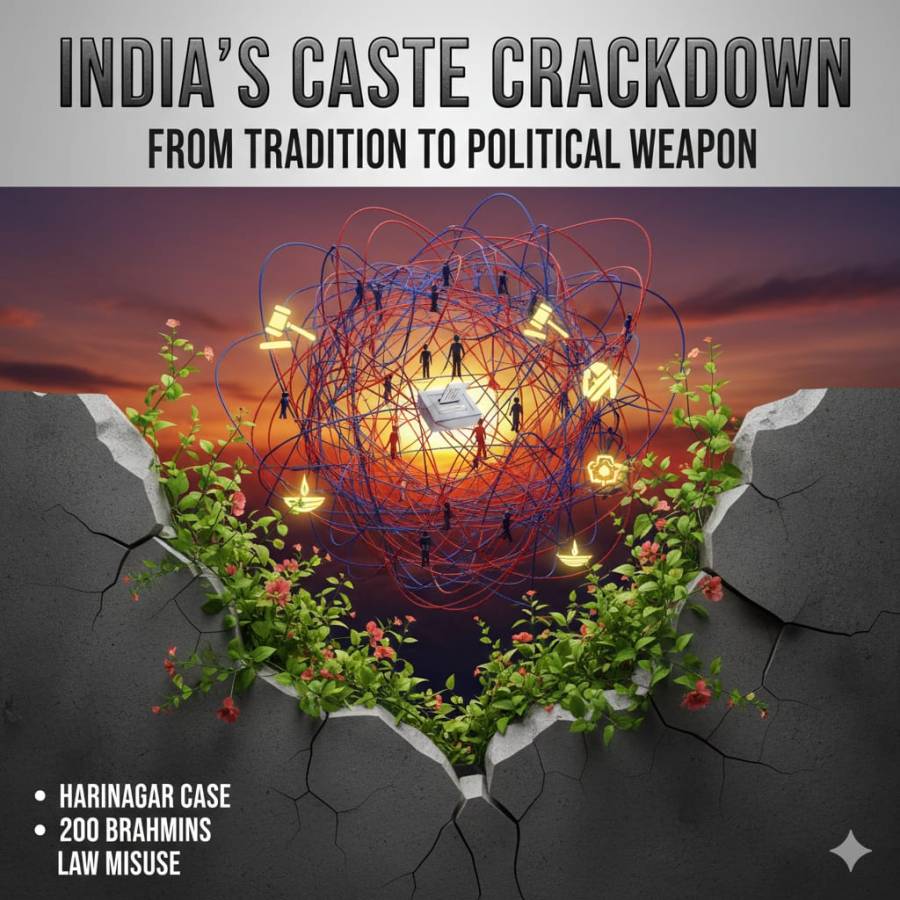
In Harinagar, a local dispute turned into FIRs against nearly 200 Brahmins under a law meant to protect the vulnerable. The episode reveals how caste in modern India has shifted from social identity to political currency.
Mohan Bhagwat’s recent remarks in Mumbai have reopened an uncomfortable conversation about caste in contemporary India. While the traditional foundations of caste have weakened, its influence has not. Caste no longer rigidly decides what people do for a living, but it continues to shape how power is negotiated, distributed, and contested in public life.
The occupational logic that once defined caste has steadily eroded. Urbanisation, education, migration, and economic mobility have blurred boundaries that once dictated professions and social roles. In many parts of India, especially in cities, caste no longer determines whether someone becomes a teacher, an engineer, or an entrepreneur. Yet this social shift has not translated into a diminished role for caste itself. Instead, caste has adapted to a new environment.
What has changed most significantly is the source of caste’s power. No longer sustained primarily by religious sanction or hereditary labour, caste today draws its strength from politics. Electoral arithmetic, vote-bank calculations, and the strategic use of law have replaced scripture and custom. In this new form, caste functions less as a social order and more as a political instrument, one that offers predictability and leverage in an increasingly competitive electoral landscape.
Historically, caste organised society through hierarchy and control over labour. In present-day India, it operates as a tool of mobilisation. As Bhagwat pointed out, appealing to caste identity often proves more effective for political actors than arguing ideology or governance outcomes. Caste loyalties offer ready-made constituencies and reliable returns at the ballot box. Over time, this has turned caste into a form of political currency, encouraging leaders to preserve and sharpen divisions rather than allow them to fade.
This transformation becomes especially visible in the uneasy intersection of social justice laws and political practice. The Scheduled Castes and the Scheduled Tribes (Prevention of Atrocities) Act was enacted to protect historically marginalised communities from violence, humiliation, and systemic discrimination. In a country where caste-based atrocities continue to occur, the moral and legal necessity of such protection remains unquestionable.
At the same time, there is growing evidence that these protections are sometimes drawn into local power struggles and personal disputes. The Harinagar incident illustrates this troubling shift. What began as a local conflict escalated into the filing of FIRs against nearly 200 individuals from the Brahmin community under the SC/ST Act. The scale of the action itself raises difficult questions. Laws designed to address specific acts of cruelty were applied in a manner that treated an entire community as a collective accused.
When criminal cases name hundreds of individuals in a single sweep, concerns about intent and proportionality become unavoidable. Criminal law is meant to establish individual guilt, not impose collective liability. In Harinagar, the severity of the statute appeared to function as a pressure mechanism rather than a calibrated instrument of justice. The consequences were immediate. Cases under the SC/ST Act carry serious legal and social repercussions, including arrest provisions and lasting reputational harm. Even when such cases fail in court, the process itself becomes a punishment.
Beyond the immediate fallout, cases like Harinagar point to a broader national concern. When social justice laws are perceived as tools for settling scores, their moral legitimacy weakens. Public trust erodes, judicial scepticism grows, and genuine victims risk being viewed with suspicion. The original purpose of such legislation—to protect the vulnerable—begins to blur, undermined by its visible misuse.
The persistence of caste identity appears even more striking when set against the collapse of its occupational foundation. For centuries, caste dictated profession and social function. Today, those linkages have largely disappeared. Individuals from all backgrounds are visible across technology, administration, business, and the professions. Bhagwat’s observation that caste has lost its traditional occupational basis is broadly accurate, particularly in urban and semi-urban India.
Yet economic mobility has not translated into political or psychological liberation from caste. The political system continues to reward collective identity over individual merit. Access to reservations, party tickets, and local influence often flows through caste networks. In such a structure, citizens are encouraged to organise along caste lines not because those identities shape everyday life, but because they shape access to state power.
The challenge before India is not to deny historical injustice, but to address it without creating new forms of unfairness. Protecting victims of caste-based violence must remain non-negotiable. At the same time, safeguards are needed to prevent laws from being used in ways that damage social trust and legal credibility. Internal reform within institutions, including a move away from treating caste itself as a qualification, can help refocus attention on merit and shared civic identity.
Caste in India today is no longer primarily about temples, occupations, or ritual hierarchy. It has evolved into a sophisticated mechanism of power. The Harinagar episode serves as a warning of what happens when social justice laws are deployed as political weapons. Moving forward requires a careful balance between historical redress and present-day fairness, ensuring that the pursuit of justice does not harden into a new form of injustice.























Leave a Comment