
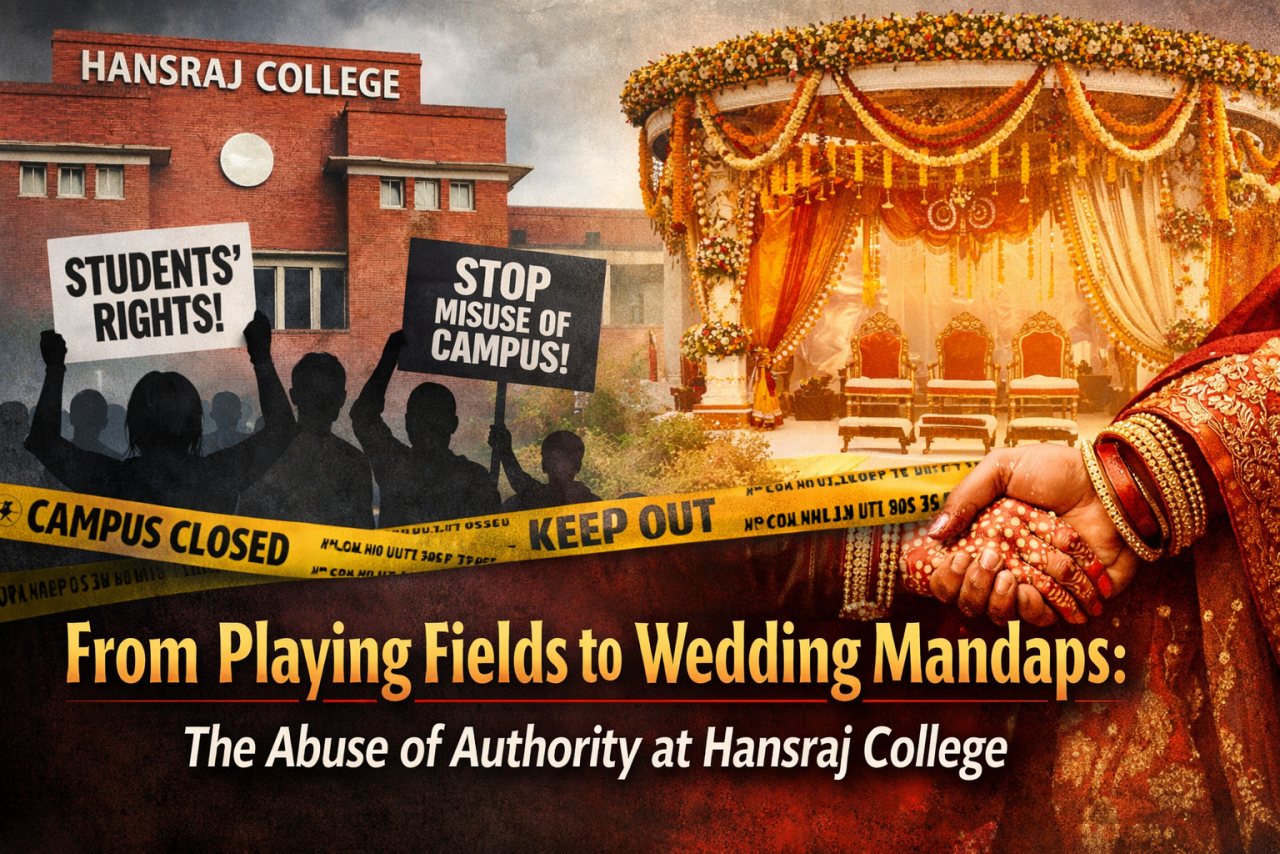
The use of Hansraj College’s sports ground for a private wedding has triggered protests and raised serious questions about accountability in public institutions.
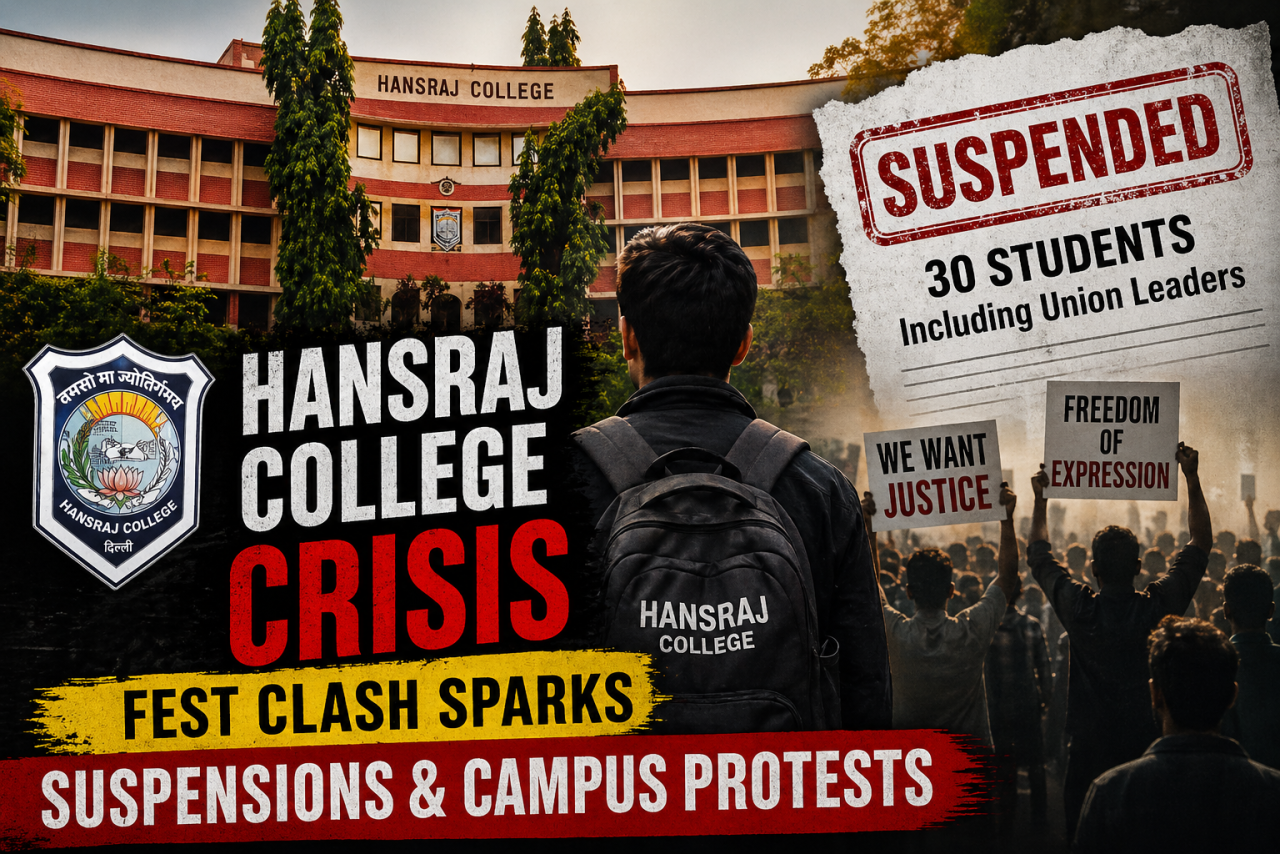
Hansraj College, one of Delhi University’s most respected institutions, is facing an uncomfortable question: who really owns a public college campus? The recent decision to allow a private wedding on its sports grounds has sparked student protests and exposed a deeper problem of administrative entitlement that goes far beyond a single event.
At the centre of the controversy is the use of the college’s sports ground for the wedding of the principal’s son on February 10. What should have been a neutral academic and athletic space was transformed into a private celebration venue, complete with decorations and restricted access. For students, this was not just a matter of inconvenience; it was a direct encroachment on their rights and a violation of the basic idea of public education.
The immediate trigger for student anger was the abrupt cancellation of “Khelo Hansraj,” an annual sports tournament scheduled to run through most of February. No formal explanation was given. Students only learned the real reason when they arrived on campus and saw the ground barricaded and decorated for a wedding. Nearly 50 students staged a protest, arguing that their academic and extracurricular activities had been sacrificed without notice or consent.
The contradiction is hard to miss. Students are routinely asked to vacate the campus by early evening, and permission for student-led events is often delayed or denied on grounds of discipline, safety, or scheduling constraints. Yet the same administration found no issue in granting overnight access to college grounds for a private family function. Rules that appear inflexible for students suddenly became negotiable when authority was involved.
Even more troubling is the issue of the boys’ hostel. Last year, students were asked to vacate the hostel after the administration declared it unfit due to infrastructural concerns. Since then, students report seeing no meaningful repair or reconstruction work. However, during the wedding preparations, the same building was allegedly being decorated to accommodate guests. If the hostel is unsafe for students to live in, how can it be deemed suitable for visitors? This inconsistency has deepened student mistrust and raised serious questions about the sincerity of the administration’s stated concern for safety.
Transparency has been notably absent throughout the episode. There was no prior communication explaining the cancellation of the sports tournament or the temporary takeover of the grounds. Students were left to connect the dots themselves. The Delhi University Students’ Union (DUSU) has criticised the decision, pointing out the clear double standard: student activities face constant scrutiny, while private use of public infrastructure appears to receive swift approval.
This incident is not an isolated lapse in judgment; it reflects a broader culture where institutional authority is treated as personal ownership. Public colleges are funded by taxpayers and exist primarily for the academic, physical, and social development of students. When administrators repurpose these spaces for private events, it undermines the very principle of public accountability.
Following the protest, the college administration reportedly issued a letter assuring students of more transparent use of fest budgets and stating that wedding guests would not be housed in the hostel. While this may ease immediate tensions, it does little to address the core issue. The problem is not just where guests slept or which budget line was used; it is the assumption that such decisions can be taken without student consultation or institutional oversight.
The Hansraj episode should serve as a warning to policymakers and regulators. If administrators are allowed to blur the line between public duty and private privilege, campuses risk becoming extensions of personal authority rather than spaces of learning and fairness. Clear policies are needed to prohibit the use of academic and athletic infrastructure for personal events of those in power, regardless of rank or position.
Colleges are not banquet halls, and principals are not proprietors. They are custodians of public trust. When that trust is compromised, the damage goes beyond one cancelled tournament or one wedding celebration. It erodes faith in the institution itself.
Hansraj College has long stood for academic excellence and student development. Preserving that legacy now requires more than damage control. It demands a reaffirmation that public educational spaces exist for students, not for the private convenience of those who govern them.























Leave a Comment