
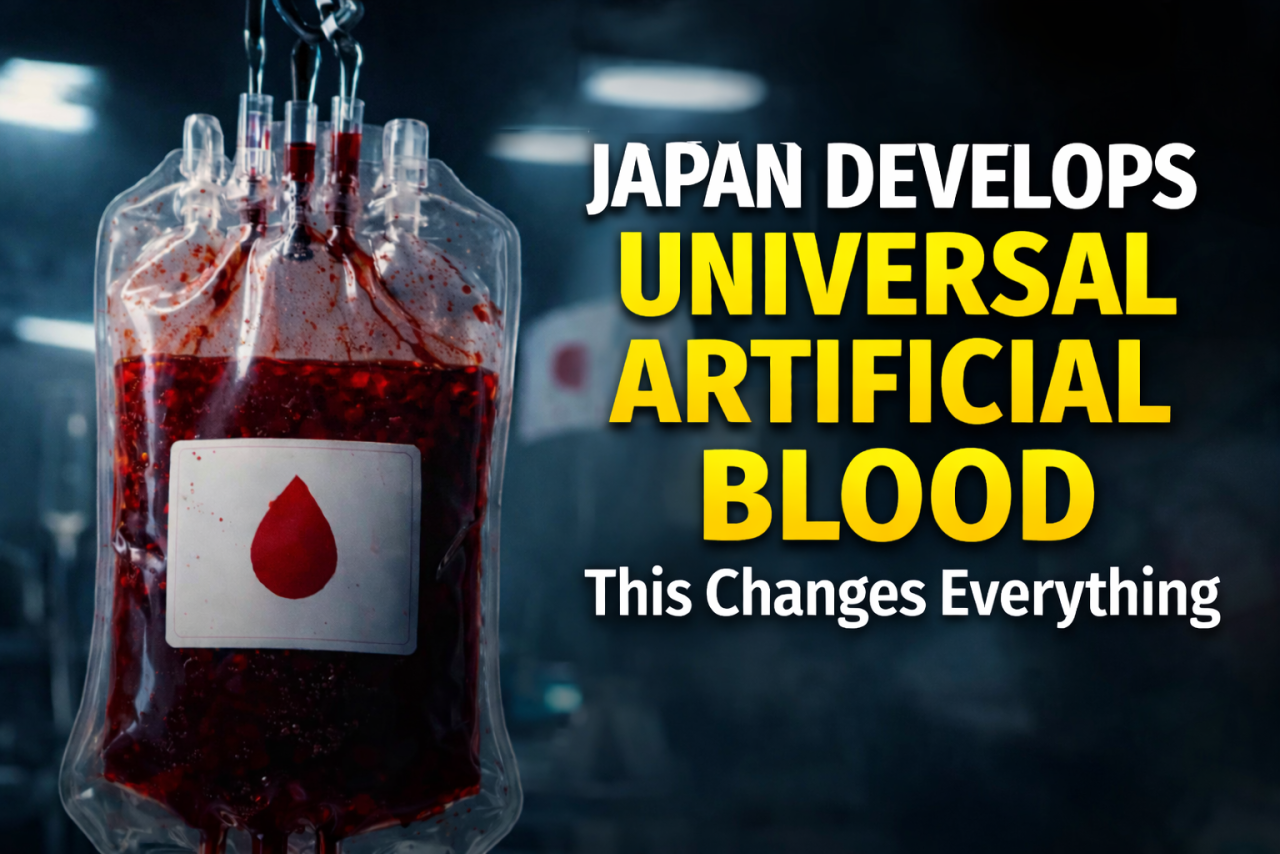
When seconds decide survival, Japan’s universal artificial blood could remove one of emergency medicine’s biggest barriers — the wait for a matching donor.
Japan is moving closer to introducing a universal artificial blood substitute that could significantly alter emergency and trauma care. Researchers led by Professor Hiromi Sakai at Nara Medical University are developing a synthetic product designed to carry oxygen through the bloodstream without the need for blood type matching — one of the biggest constraints in transfusion medicine today.
The development comes at a time when many countries are grappling with recurring blood shortages. Traditional donated blood has a limited shelf life, requires refrigeration, and must be carefully matched to a patient’s ABO blood group. In emergencies, this process can take valuable time. In remote regions and disaster zones, maintaining cold storage and adequate supply becomes even more difficult.
The Japanese research team has focused on creating artificial red blood cell substitutes using hemoglobin — the protein responsible for transporting oxygen in human blood. Instead of circulating freely, the hemoglobin is encapsulated within tiny lipid-based membranes known as liposomes. These microscopic structures are designed to mimic the outer layer of natural red blood cells, improving stability and reducing potential side effects that earlier generations of artificial oxygen carriers faced.
In addition to oxygen transport, researchers are also exploring artificial platelet substitutes to assist with clotting. Severe blood loss not only deprives organs of oxygen but also impairs the body’s ability to stop bleeding. By targeting both oxygen delivery and clot support, the project aims to address the two most urgent needs in trauma care.
One of the most notable features of the artificial blood under development is its universal compatibility. Because it does not carry surface antigens that define blood types, it can potentially be administered to any patient without prior matching. This could eliminate delays in critical situations such as road accidents, battlefield injuries, or large-scale disasters where rapid response determines survival.
Storage stability is another key advantage. Donated red blood cells typically last about 42 days under refrigeration. Platelets have an even shorter lifespan. The artificial substitute being tested in Japan is designed to remain stable for extended periods and does not require the same stringent cold-chain conditions. This makes it particularly useful for emergency stockpiles and rural healthcare facilities with limited infrastructure.
The research builds on decades of global efforts to create safe artificial blood. Previous trials in countries including the United States and the United Kingdom showed promise but were hampered by complications such as elevated blood pressure and oxidative stress. Advances in nanotechnology and lipid encapsulation have since improved the safety profile of hemoglobin-based oxygen carriers, renewing scientific interest.
Human clinical trials are currently underway in Japan to evaluate safety and performance. Early phase studies are focused on determining how the body responds to the artificial product and whether it can effectively maintain oxygen levels in controlled settings. Broader approval will depend on the outcome of these trials and long-term safety data.
Experts caution that artificial blood is not intended to completely replace donated blood. Whole blood contains white cells, immune components, clotting factors, and plasma proteins that perform complex biological functions beyond oxygen transport. The current objective is to provide a reliable alternative in situations where immediate oxygen delivery is critical and conventional transfusion is not readily available.
Japan’s push also reflects demographic realities. With an aging population and a shrinking pool of eligible donors, maintaining stable blood supplies is becoming more challenging. Similar trends are visible in several developed nations. A shelf-stable, universally compatible substitute could ease pressure on blood banks and serve as a strategic reserve during public health emergencies.
Beyond civilian healthcare, the implications extend to military medicine and humanitarian operations. In conflict zones or disaster-hit areas where infrastructure is damaged, transporting and storing blood safely can be a logistical challenge. A temperature-stable alternative that can be rapidly deployed would strengthen emergency preparedness.
While regulatory approval may still be some distance away, the progress reported so far indicates that artificial blood research has entered a more advanced phase than in previous decades. If ongoing trials confirm its safety and effectiveness, Japan’s universal artificial blood could become a critical tool in modern medicine — addressing shortages, accelerating emergency care, and improving survival in high-risk situations.
For healthcare systems facing rising demand and uncertain supply, that possibility carries global significance.

























Leave a Comment