
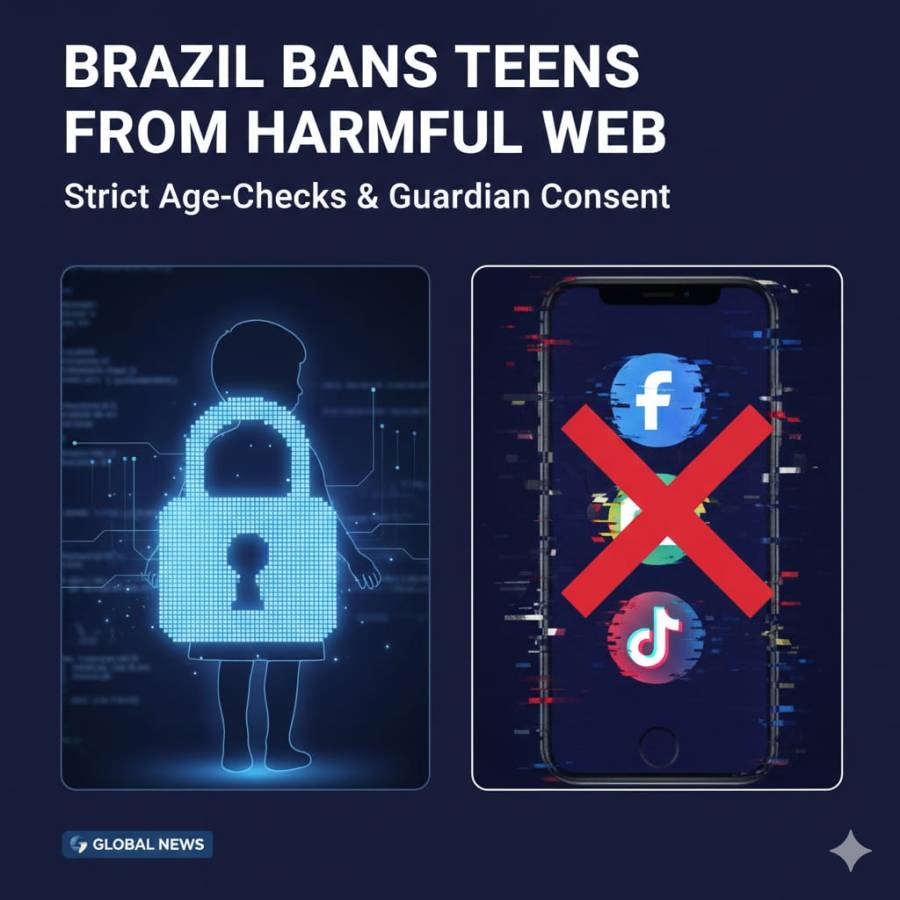
Brazil is moving to make the internet safer for its children—by placing responsibility not just on parents, but on the platforms themselves.
The government of Brazil is developing a comprehensive regulatory framework aimed at significantly restricting children’s and teenagers’ access to potentially harmful online content. According to a draft decree reviewed by Bloomberg News, the administration of President Luiz Inácio Lula da Silva plans to introduce strict age-verification requirements for app stores and digital platforms. This step places Brazil among a growing number of countries seeking to reduce the risks associated with early and unregulated internet exposure.
Under the proposed rules, digital service providers will be legally required to implement robust age-verification systems. The objective is to prevent minors from accessing content categories considered inappropriate for their developmental stage. The draft decree specifies that websites and platforms hosting advertisements or material related to gambling, pornography, alcoholic beverages, dating services, weapons, and escort services must verify users’ ages before granting access.
By mandating verification at the platform level, the government intends to shift part of the responsibility for online safety from parents alone to digital service providers. The approach reflects a broader regulatory philosophy in which platforms are expected to play a more active role in safeguarding young users.
The draft also states that social media profiles for children under the age of 16 must be registered under the name of a legal guardian. This requirement aims to ensure that a responsible adult remains accountable for the minor’s digital presence and that platforms maintain a verifiable link to parental consent. The decree builds on a new law scheduled to take effect in March, which requires companies to restrict access to content deemed illegal or psychologically and socially harmful to minors.
Although the decree is still being finalized and remains subject to internal government discussions, officials familiar with the matter indicate that it is expected to be issued by the end of February. The timeline reflects growing urgency within the government to address concerns about toxic online environments and their impact on youth mental health and safety.
Brazil’s initiative mirrors legislative trends seen in other parts of the world. Australia, for example, recently introduced measures barring young teenagers from accessing social media platforms such as Facebook, Instagram, and TikTok. While Brazil’s proposal does not impose a complete ban on teenage social media use, it represents a substantial expansion of regulatory oversight.
Spain has also proposed restrictions targeting teenage social media access, and at least ten other European countries, along with the European Union, are debating or implementing stricter controls on digital platforms for young users. Increasingly, policymakers argue that self-declared age systems—where users simply enter a birthdate without verification—are inadequate for protecting vulnerable populations.
The Brazilian draft decree explicitly prohibits platforms from relying solely on self-declared ages. It also includes provisions for the government to develop an independent age-verification system that websites can adopt. This move is intended to create a standardized and reliable mechanism for confirming users’ ages.
Privacy concerns remain central to the debate. Critics of age-verification laws, particularly in Australia, have warned about the risks associated with collecting sensitive identification data. In response, Brazil’s proposal includes safeguards designed to limit data usage strictly to age authentication purposes. According to the draft, the rules will prohibit the tracking of users’ identities, browsing histories, or personal requests during the verification process. Verification records must be managed in accordance with high data protection standards to prevent misuse or surveillance.
If implemented as planned, the decree will mark a significant shift in Brazil’s digital governance strategy. It signals a move from limited oversight toward active state intervention in protecting minors online. By the end of the first quarter, Brazil could join a group of nations attempting to balance digital freedom with stronger safeguards for the next generation.



























Leave a Comment