
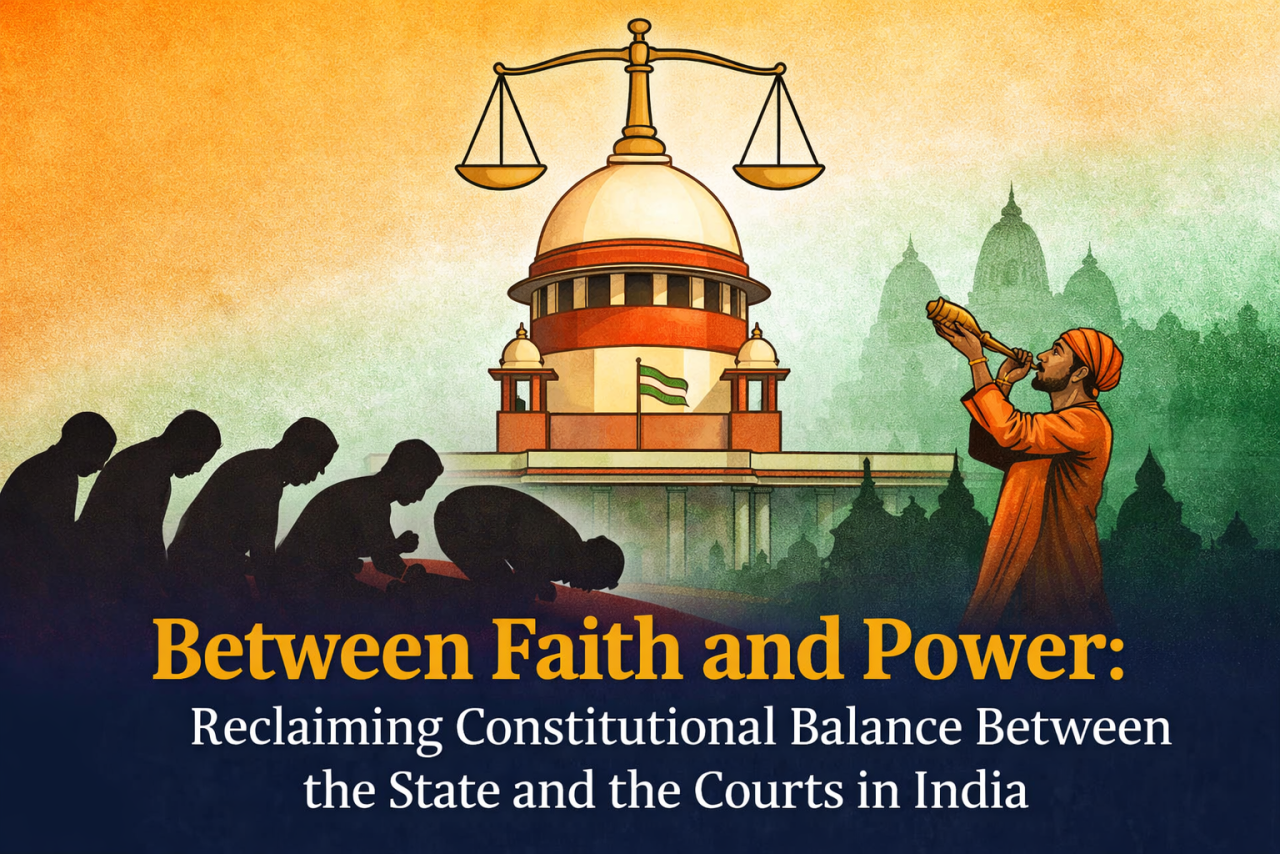
When faith meets state power, the real test is not of religion — but of the Constitution. In today’s India, the balance between religious freedom, executive authority and judicial oversight is being quietly redefined, raising urgent questions about equality, due process and the rule of law.
The relationship between religion, the State, and the judiciary in India has never been simple. It is shaped by constitutional vision, political practice, and the realities of governing a deeply diverse society. Recent developments in Uttar Pradesh have once again brought this delicate balance into public debate. Reports of police action related to namaz offered in private spaces, along with administrative measures following protests, raise broader constitutional questions that extend beyond immediate law-and-order considerations.
India’s Constitution does not establish a theocratic state. Nor does it mandate a rigid separation between religion and governance. Instead, it adopts a model often described as principled distance. Article 25 guarantees every individual the freedom to profess, practice, and propagate religion, subject to public order, morality, and health. This qualification is significant. The State has authority to regulate religious practices where legitimate public concerns arise. But such regulation must meet clear constitutional standards.
The invocation of “public order” cannot rest on abstract or speculative grounds. Courts have consistently held that restrictions on fundamental rights must be reasonable, proportionate, and supported by evidence. When individuals are detained or prevented from religious practice, the legal threshold must be demonstrable and specific. Otherwise, constitutional guarantees risk becoming conditional on administrative discretion.
Judicial intervention has often clarified these limits. In Ismail Faruqui v. Union of India, the Supreme Court examined the scope of religious freedom and articulated the “essential practices” doctrine, holding that not every practice associated with a religion is immune from state regulation. At the same time, the judgment reaffirmed that religious freedoms remain constitutionally protected unless restrictions are justified on valid legal grounds.
More recently, in In Re: Directions in the Matter of Demolition of Structures, the Supreme Court emphasized that executive actions such as demolitions must strictly follow due process. Demolition cannot become a substitute for criminal punishment, nor can it bypass statutory safeguards. The ruling reaffirmed that the rule of law requires procedures to be followed regardless of the identity of those affected.
These judicial pronouncements point to a broader constitutional principle: equality before the law. Articles 14 and 15 guarantee non-discrimination and equal protection. Administrative decisions must be guided by conduct and legal standards, not by identity or perception. In a society where religious expression frequently occupies public space — through festivals, processions, or gatherings — consistent application of the law becomes essential to maintaining institutional credibility.
Selective or uneven enforcement, even when perceived rather than proven, can erode trust. The rule of law depends not only on legality but also on fairness. State action must be predictable, proportionate, and transparent. Where executive authority appears expansive or arbitrary, courts become the final safeguard. Yet judicial review is inherently reactive and often delayed. A healthy constitutional order requires the executive itself to internalize constitutional discipline rather than rely on post facto correction.
India’s secularism is distinct from Western models. Unlike the French doctrine of strict separation or the American non-establishment principle, Indian secularism permits state engagement with religion for purposes of reform, regulation, and social justice. The State manages certain religious institutions, regulates endowments, and has historically intervened to eliminate discriminatory practices. However, such engagement must be anchored in neutrality. The constitutional promise is not indifference to religion, but even-handedness in dealing with it.
The debate over the essential practices test further illustrates the judiciary’s complex role. Critics argue that courts should avoid theological determinations. Supporters contend that judicial scrutiny prevents misuse of religious claims to shield unlawful conduct. Whatever the merits of this debate, the underlying principle remains consistent: any restriction on religious freedom must satisfy standards of legality, necessity, and proportionality.
Recent controversies also highlight concerns about administrative penalties, such as property action or other sanctions following allegations of unlawful conduct connected to religious gatherings. The Supreme Court has repeatedly underscored that such measures must rest on explicit statutory authority and comply with procedural safeguards. Article 21’s protection of life and personal liberty includes protection against arbitrary state action. These safeguards apply uniformly to all citizens.
Ultimately, the question is one of institutional trust. Courts derive authority from public confidence in their independence and impartiality. The executive derives legitimacy from adherence to constitutional limits. Religion, in India’s plural social fabric, is not merely a private matter but an element of collective identity. The State’s role, therefore, must be measured and even-handed.
India’s constitutional framework is resilient, but it is not self-executing. Its durability depends on restraint in the exercise of power and vigilance in the protection of rights. Religious freedom is not absolute, yet it cannot be reduced to administrative convenience. The Constitution envisions a balance — a State that neither privileges nor suppresses faith, courts that enforce accountability without fear or favour, and citizens who exercise liberty responsibly.
The true strength of Indian democracy lies in preserving this balance — not in the absence of disagreement, but in the consistent and impartial application of the law to every citizen, without exception.























Leave a Comment