
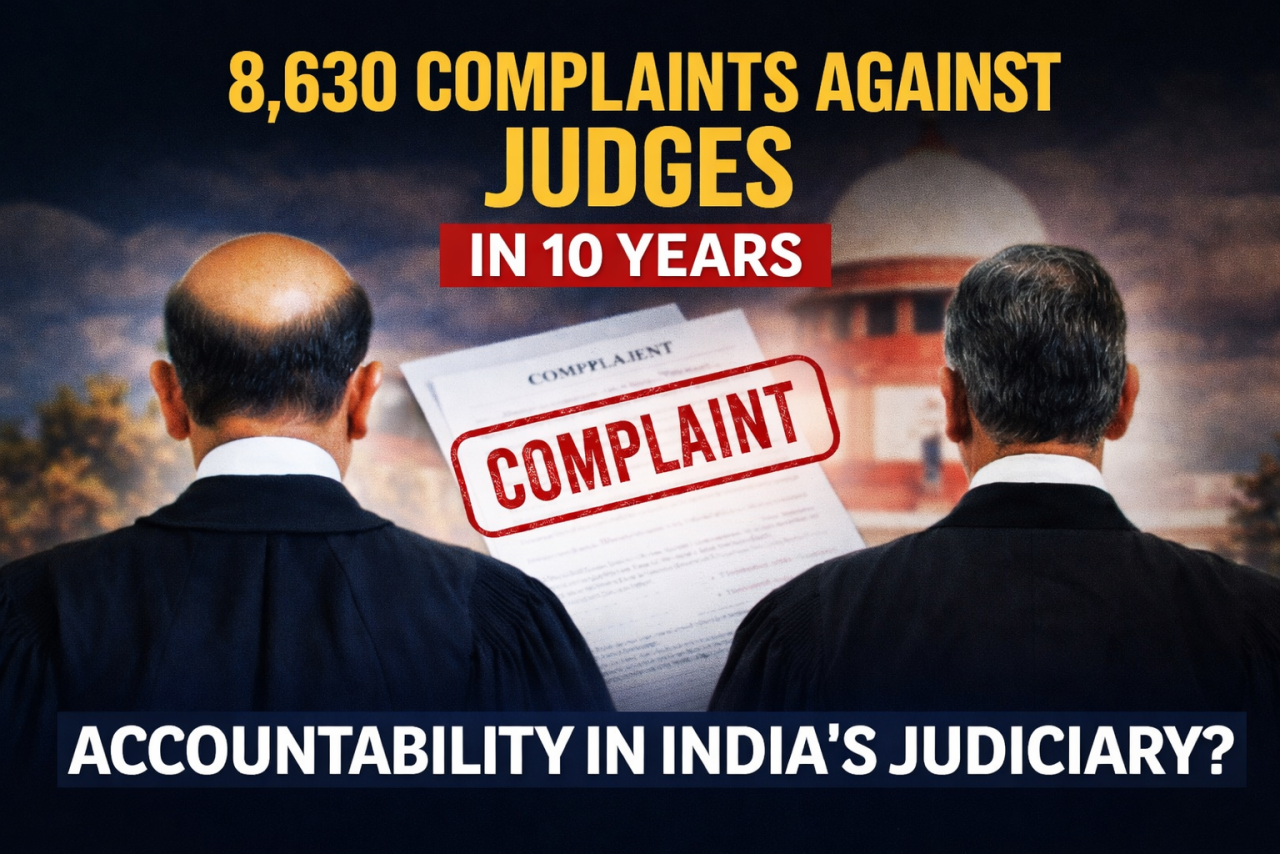
In ten years, 8,630 complaints have been filed against sitting judges in India — but what do these numbers really reveal about accountability, transparency, and trust in the country’s higher judiciary?
The Union government has informed Parliament that 8,630 complaints were received against sitting judges over the past ten years. The information was shared by Union Law Minister Arjun Ram Meghwal in a written reply in the Lok Sabha. The data, provided by the office of the Chief Justice of India (CJI), covers complaints against judges of the Supreme Court and the high courts.
According to the reply, the complaints were dealt with under the judiciary’s “in-house mechanism.” However, the government did not provide details about the nature of these complaints or the action taken on them. This lack of clarity has raised important questions about transparency, accountability, and public trust in the judicial system.
The data shows yearly variations in the number of complaints. There were 729 complaints in 2016, 682 in 2017, and 717 in 2018. The number rose sharply to 1,037 in 2019. It fell to 518 in 2020, likely due to disruptions caused by the Covid-19 pandemic, when courts were functioning in a limited manner. After that, the numbers again increased: 686 in 2021, 1,012 in 2022, 977 in 2023, 1,170 in 2024, and 1,102 in 2025. The recent rise suggests that either more complaints are being filed or that reporting mechanisms have become more accessible.
Complaints against judges of high courts are received by the chief justices of the respective high courts. Complaints against judges of the Supreme Court and against chief justices of high courts are received by the CJI. These complaints are handled internally by the judiciary under a system known as the in-house procedure. This system was developed by the Supreme Court in the late 1990s to examine allegations of misconduct without formal impeachment proceedings.
The Constitution of India provides strong protection to judges to ensure judicial independence. Judges of the higher judiciary can be removed only through impeachment by Parliament, a process that requires a special majority in both Houses. This high threshold was designed to protect judges from political pressure. However, because impeachment is rare and difficult, the in-house mechanism plays an important role in addressing complaints that do not reach the level of impeachment.
The main concern raised in Parliament was whether records are maintained regarding complaints involving serious allegations such as corruption, sexual misconduct, or other forms of improper conduct. The government’s reply did not specify the types of complaints received or the action taken in each case. It also did not clarify whether there is a separate system for systematic recording, monitoring, and ensuring accountability in matters involving judges.
The absence of detailed information creates uncertainty. Without knowing how many complaints were dismissed, how many were found to have substance, and what disciplinary steps were taken, it is difficult for the public to assess whether the system is working effectively. Transparency is a key element of accountability. At the same time, excessive public disclosure may affect the reputation of judges if complaints are later found to be false or motivated.
India’s higher judiciary consists of more than 800 judges across the Supreme Court and various high courts. When seen against this large number, 8,630 complaints over ten years may not necessarily indicate widespread misconduct. It may also reflect increased public awareness and willingness to report grievances. In many cases, complaints against judges may relate to dissatisfaction with court orders rather than actual misconduct. The judicial system makes a clear distinction between a legal error, which can be corrected through appeals, and personal misconduct, which requires disciplinary action.
Internationally, many countries have judicial conduct commissions that function independently and publish annual reports detailing the number and type of complaints received and the outcomes. In India, the in-house mechanism is internal and does not routinely publish detailed findings. This has led to calls from some legal experts and civil society groups for greater openness.
The issue highlights a delicate balance. Judicial independence is essential for democracy. Judges must be free to decide cases without fear of retaliation. At the same time, independence does not mean immunity from scrutiny. A system that ensures fair investigation of complaints while protecting judges from false allegations is necessary to maintain confidence in the judiciary.
The rising number of complaints in recent years suggests that this matter cannot be ignored. The government’s response in Parliament has provided important data, but it has also revealed gaps in public information. A clearer framework for reporting outcomes, without compromising confidentiality where required, could strengthen trust in the judicial system.
In a country where courts play a central role in protecting constitutional rights and resolving disputes, public confidence is vital. Accountability and independence are not opposing ideas. They must work together. The figures presented in Parliament are not just statistics. They reflect the need for continuous review of how institutions function and how they respond to concerns raised by citizens.


























Leave a Comment