
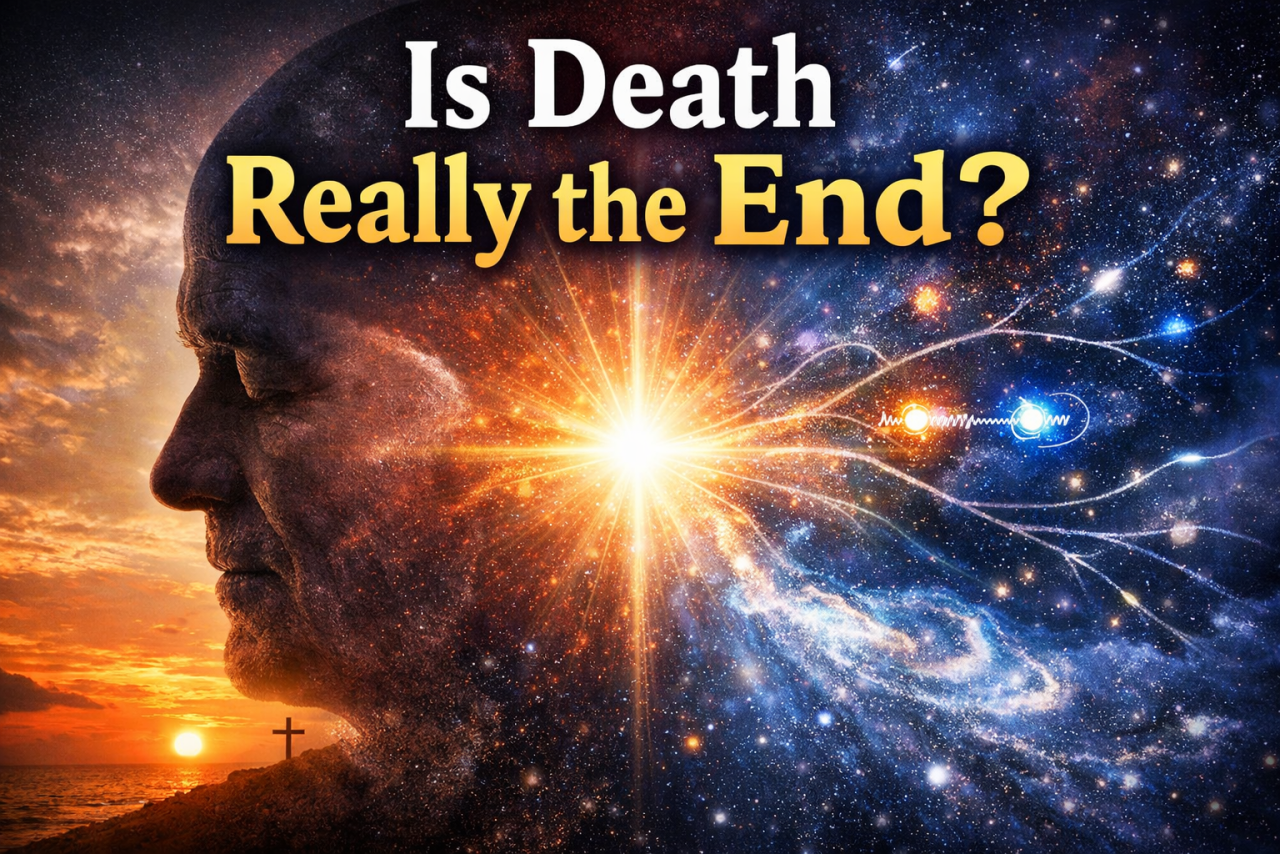
A new look at life, time, and consciousness through modern physics
Death has always felt absolute.
A last breath. A still body. A room that suddenly feels heavier than before. For generations, we have accepted death as the final full stop of existence. Biology tells us the heart stops. The brain shuts down. The body returns to the elements.
Case closed.
But modern physics has quietly reopened the file.
As scientists dig deeper into the fabric of reality, they are finding a universe far stranger than common sense ever imagined. At the smallest level, the world is not made of solid, fixed objects. It is built from energy, probabilities, and information. Matter behaves less like brick and more like a wave of possibilities.
One of the foundations of this strange world is the Copenhagen Interpretation. It suggests that tiny particles do not take on a definite state until they are observed. Before observation, they exist in many possible states at once. Reality, in this view, is not completely settled until it is measured.
This idea leads to an uncomfortable question. If consciousness plays a role in shaping reality, can consciousness truly disappear?
Dr. Robert Lanza, through his theory of Biocentrism, argues that life and awareness are not side effects of the universe. They may be central to it. According to this view, the brain does not create consciousness the way a factory makes goods. It may function more like a receiver that tunes into something deeper.
If that is so, then death might not destroy consciousness. It might simply end the body’s ability to receive it.
Physics already gives us one solid rule: energy cannot be destroyed. It only changes form. If our most basic nature is tied to energy and information, then perhaps what we call death is transformation rather than erasure.
The mystery deepens with the Many-Worlds Interpretation, proposed by Hugh Everett III. This theory suggests that every possible outcome of a quantum event actually happens, but in different branches of reality. The universe may constantly split into parallel versions.
In one version of events, a person survives an accident. In another, they do not. Observers in one branch experience loss. But in another branch, experience continues.
It sounds dramatic. Yet mathematically, it is one serious way to interpret quantum equations.
Even time, the backbone of our fear of death, may not behave the way we think. We see time as a straight line: birth, life, death. But Albert Einstein once wrote that the distinction between past, present, and future is a stubborn illusion.
The Block Universe model suggests that all moments exist at once. Your childhood, this very second, and your final day may all be fixed points in the structure of space-time. From that perspective, you do not vanish. You occupy a different coordinate.
You are not erased. You are positioned.
Then there is quantum entanglement, the phenomenon Einstein described as “spooky action at a distance.” Two particles can remain linked across enormous distances. Change one, and the other responds instantly.
Some researchers believe consciousness could involve quantum processes inside the brain. The Orch-OR theory suggests that tiny structures in brain cells may operate at the quantum level. If consciousness has such a foundation, its underlying information might not simply disappear when the body stops functioning.
None of this proves that death is an illusion. Science has not declared that we survive in some hidden dimension. What it has done is challenge the old certainty that death equals total nothingness.
Think of a sunset. It appears that the sun is sinking into darkness. Yet we know the Earth is turning. The disappearance is only from our viewpoint.
Death may be similar. What looks like an ending may be a shift beyond our frame of reference.
Rather than shrinking life, this possibility expands it. If consciousness is woven into the fabric of the universe, then each human life is more than a brief biological episode. It is a focused expression of something larger.
Perhaps we are the universe becoming aware of itself, for a while.
When the body can no longer hold that awareness, something may change. The form may dissolve. The underlying energy may remain.
Science continues to explore these questions with caution. But one thing is clear: the universe is not as simple as it once seemed.
And if reality itself is deeper than we imagined, then death may not be a hard stop.
It may be a transition we do not yet fully understand.


















Leave a Comment