
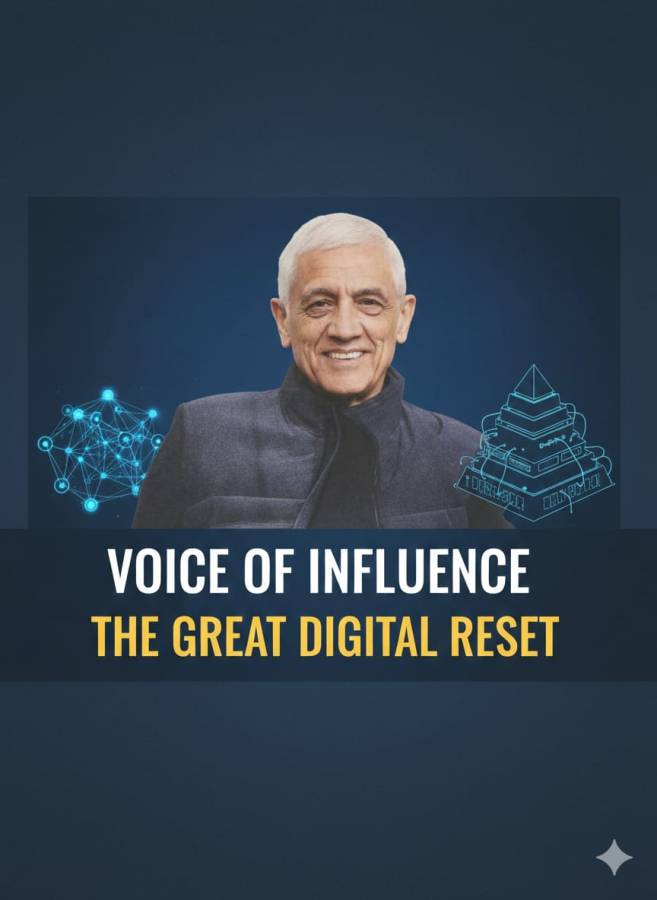
India’s IT boom, once the backbone of its middle class, is on the brink of collapse—Vinod Khosla warns the clock is ticking faster than we think.
For nearly three decades, India’s economic ascent has been powered by glowing screens. From the glass towers of Bengaluru to the sprawling corporate parks of Gurugram, the IT and outsourcing industry did more than create jobs. It created aspiration. It shaped the middle class. It built a national confidence that India could compete with the world on intellect alone.
But according to Silicon Valley veteran Vinod Khosla, that era is approaching a hard stop.
Khosla, co-founder of Sun Microsystems and one of the most influential investors in artificial intelligence, has issued a blunt forecast: within five years, much of today’s IT and outsourcing services could become obsolete. Not slower. Not marginally smaller. Obsolete.
To many, it sounds dramatic. To those watching the speed at which artificial intelligence systems are advancing, it sounds plausible.
The End of Labor Arbitrage
India’s IT boom was built on a simple economic principle: labor arbitrage. Western companies could reduce costs by outsourcing coding, customer support, accounting, and backend processing to India, where skilled professionals were available at lower wages.
It worked brilliantly. Millions found employment. Entire cities transformed. A generation of engineers became the backbone of the global digital economy.
But artificial intelligence does not seek lower wages. It seeks zero wages.
Modern AI systems are no longer limited to repetitive tasks. They write code, analyze medical scans, draft legal briefs, and manage customer interactions with increasing sophistication. What once required teams of junior developers can now be handled by intelligent software tools operating at machine speed and machine scale.
When the cost of digital intelligence approaches zero, the foundation of outsourcing begins to crack.
From Assistance to Autonomy
The disruption will not stop at entry-level roles. Khosla argues that over the next decade or so, most knowledge-based professions could see deep automation. This includes areas long considered insulated from disruption: law, medicine, research, and consulting.
The implications are profound.
If AI systems can diagnose diseases with near-perfect accuracy and deliver guidance at minimal cost, healthcare could become universally accessible. If legal advice becomes automated, justice may no longer depend on affordability.
Yet the same technology that democratizes expertise also displaces it.
For a country like India, which produces millions of graduates every year with ambitions in engineering, medicine, and management, this presents a generational challenge. The career ladder many prepared to climb may no longer exist in its current form.
India’s Strategic Crossroads
The question is not whether automation will accelerate. It will. The real question is whether India will remain a service provider in a world that increasingly needs fewer human services.
Khosla’s warning is not simply about job losses. It is about economic positioning.
For decades, India exported talent. It rented its intellectual capacity to global corporations. That model thrived when human expertise was scarce and expensive. In a world where digital systems can replicate expertise at scale, renting brains becomes less valuable than building products.
The future may belong not to those who execute tasks efficiently, but to those who design platforms, invent technologies, and own intellectual property.
In other words, India must pivot from being the world’s back office to becoming a creator of original technological solutions.
The Human Equation
Despite his stark projections, Khosla is not pessimistic about humanity. He envisions a world where the cost of essential services collapses, raising the minimum standard of living. If machines handle the heavy cognitive lifting, society could redirect human energy toward creativity, entrepreneurship, and social innovation.
But this transition will not be automatic. It demands bold policy thinking.
If machines generate wealth at unprecedented scale, systems of redistribution, education reform, and skill transformation must evolve just as quickly. Otherwise, technological progress may widen inequality rather than reduce it.
The IT boom once acted as India’s safety net. It absorbed talent. It created stability. It promised upward mobility. That net is thinning.
The Five-Year Window
The urgency in Khosla’s message lies in the timeline. Five years is not a distant horizon. It is one business cycle. One political term. One graduating batch.
India still possesses its greatest asset: a vast pool of young, ambitious minds. The challenge is to redirect that energy from servicing global demand to shaping it.
The Great Digital Reset is not merely about technology replacing workers. It is about redefining value in a world where intelligence itself becomes abundant.
The countdown has begun.
Whether India mourns the fading outsourcing dream or builds the next technological revolution will define the country’s economic story for the next fifty years.





















Leave a Comment