
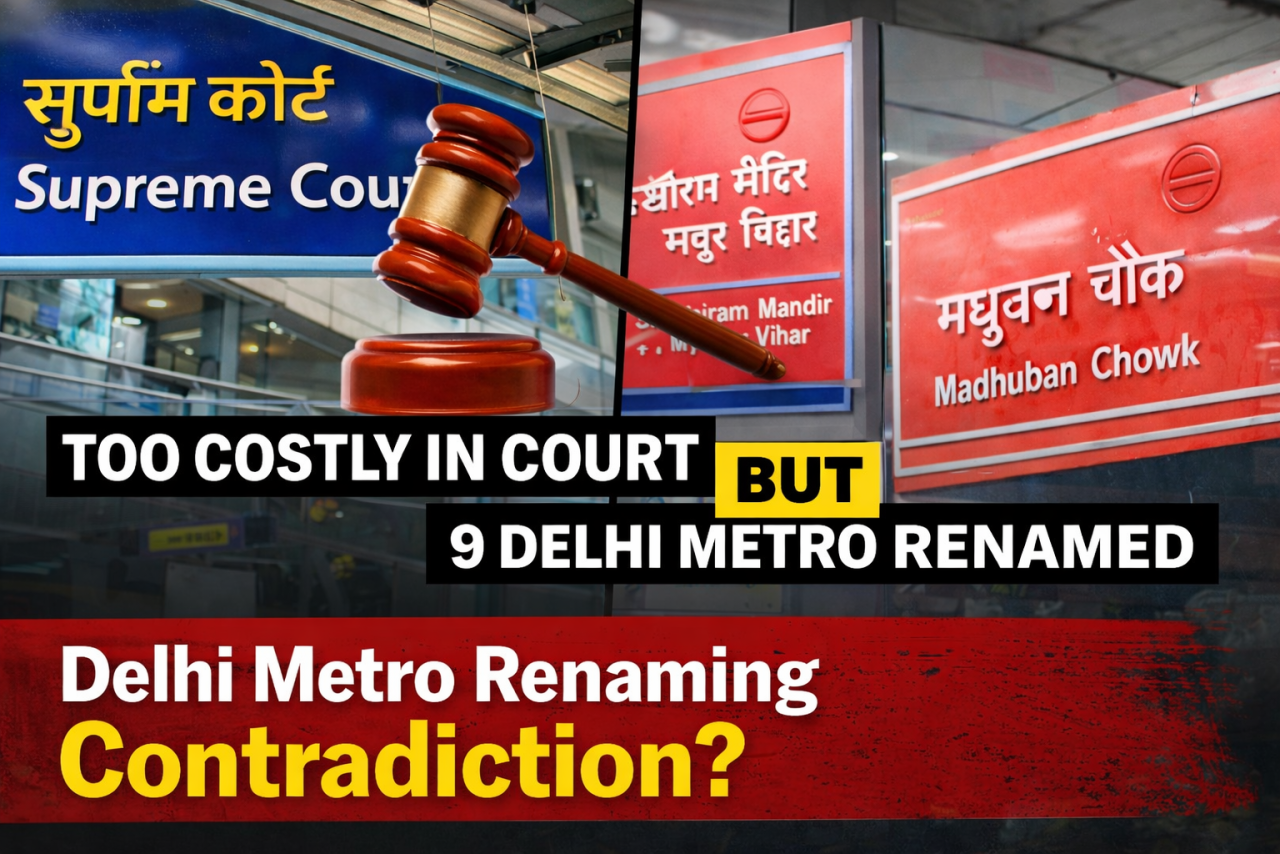
First it was “too costly” in court. Now, nine Delhi Metro stations have fresh names approved. When the price of change is cited as a legal shield but policy moves ahead anyway, the real question isn’t about signboards — it’s about consistency.
Delhi’s Metro map is changing — again. But this time, the debate is not just about identity or local pride. It is about consistency.
Recently, the Delhi government approved the renaming of two Metro stations and modification of seven others. The decision, taken at a meeting led by Chief Minister Rekha Gupta, was cleared by the State Names Authority (SNA). Officials said the changes reflect local identity, historical relevance and public sentiment.
Yet, only weeks ago, the Delhi Metro Rail Corporation (DMRC) told the court that renaming a station is not a simple exercise. Responding to a Public Interest Litigation concerning the Hindi name of the station linked to the Supreme Court of India, the corporation argued that such changes involve substantial cost and logistical challenges.
The contrast is striking.
What Has Changed?
According to official details, the following two stations have been renamed:
- Pitampura → Madhuban Chowk
- North Pitampura → Haiderpur Village
Additionally, seven stations have received modified names, including Uttari Pitampura–Prashant Vihar, Jagatpur–Wazirabad, Nanak Pyau–Derawal Nagar, Khanpur–Vayusainabad, Nanaksar–Sonia Vihar, Shri Ram Mandir Mayur Vihar, and Mangolpur Kalan–West Enclave.
Authorities stated that the names were finalised after considering cultural significance, historical context, and feedback from local representatives. Signage for operational updates has reportedly been revised.
On the surface, this appears to be a routine administrative update. Cities evolve. Names change. Identities shift.
But the legal backdrop complicates the picture.
The Courtroom Argument
In its response to the PIL regarding the Hindi naming of the Supreme Court Metro station, DMRC reportedly submitted that changing a station name triggers a chain of expenses. It involves replacing physical boards across platforms and entry gates, updating route maps inside trains, altering digital displays, reprogramming automated announcements, revising ticketing software, modifying mobile applications, and even reprinting informational material.
The corporation’s stand was clear: such changes are not merely symbolic; they carry financial and operational implications. Frequent renaming, it implied, could strain resources and create commuter confusion.
The argument rested on practicality and fiscal prudence.
Which raises the obvious question — if renaming is expensive and disruptive, how has the approval of nine station name changes now become administratively feasible?
Policy Shift or Procedural Difference?
There are possible explanations.
Metro station naming typically involves coordination between the state government and DMRC. The recent changes appear to stem from a broader policy review conducted by the State Names Authority. The PIL case, on the other hand, may involve a specific linguistic or legal contention rather than a comprehensive naming exercise.
It is also possible that the scale and justification differ. Government-backed renaming following due process may be treated differently from court-directed changes arising from litigation.
Yet, from a public perception standpoint, the distinction is less technical and more symbolic.
When a public authority argues cost constraints in court but proceeds with multiple renamings shortly thereafter, questions naturally emerge about consistency.
Identity vs Infrastructure
Chief Minister Rekha Gupta emphasised that Metro stations are not merely transit nodes; they reflect the identity and cultural fabric of the areas they serve. In a city as layered as Delhi, names carry meaning — historical, religious, social and political.
Urban naming is rarely neutral. It can be a tool for recognition, representation, and sometimes, recalibration of memory.
At the same time, Delhi’s Metro network is one of India’s largest and most heavily used transit systems. Millions rely on it daily. Stability and clarity in station names reduce confusion and maintain operational smoothness.
The tension, therefore, lies between two legitimate considerations:
- The cultural and symbolic importance of names
- The financial and logistical realities of changing them
A Larger Governance Question
Beyond the specifics of this episode, the situation reflects a broader governance dilemma.
Should public infrastructure names remain fixed for long-term clarity, except in extraordinary circumstances? Or should they adapt periodically to reflect evolving local identities?
More importantly, when cost is cited as a reason to resist change in one forum, transparency becomes essential if similar changes are approved elsewhere.
Public institutions operate not only on administrative logic but also on public trust. Consistency strengthens that trust. Apparent contradiction weakens it.
Final Take
Delhi’s commuters will likely adjust to the updated names in time. Maps will be revised. Announcements will be reprogrammed. Signboards will settle into familiarity.
But the debate sparked by this episode may linger longer than the operational changes themselves.
Was the earlier courtroom resistance purely contextual? Has policy evolved? Or does the contradiction point to a deeper tension between legal defence and administrative discretion?
For now, one thing is clear: in Delhi’s dynamic political and urban landscape, even a Metro station name can become a mirror reflecting larger questions about governance, cost, culture and coherence.
And that makes this more than a naming exercise. It makes it a test of institutional consistency.





























Leave a Comment