
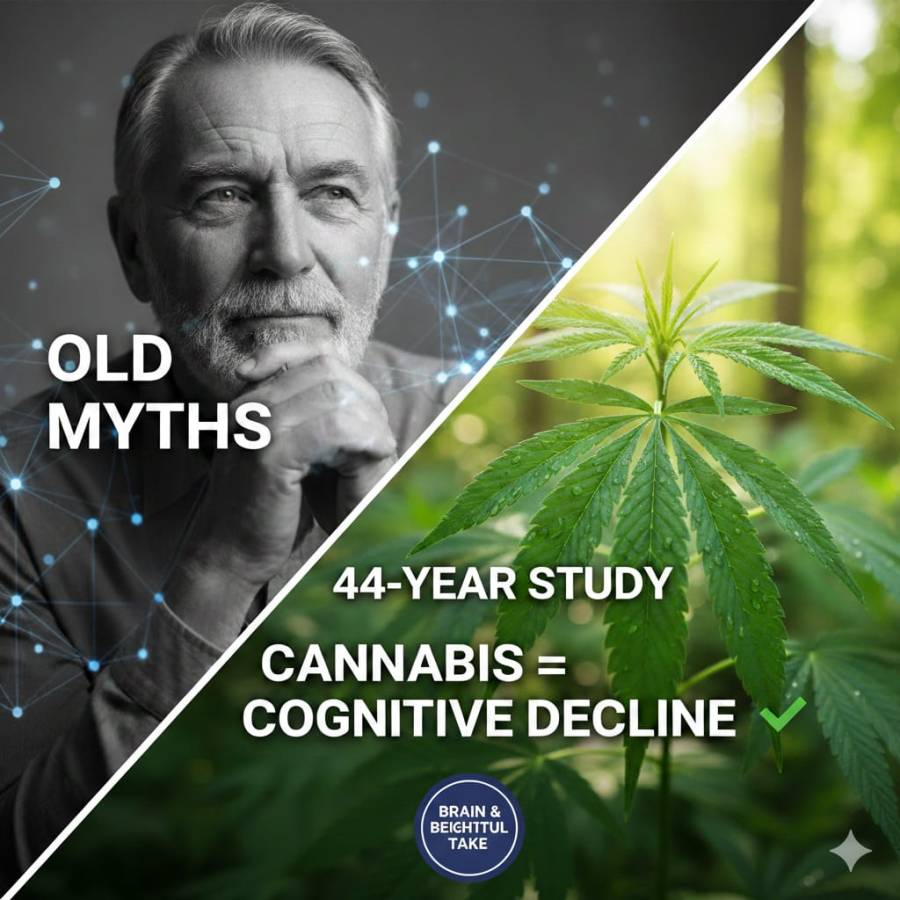
For decades, we were told cannabis would cloud the mind for life — but a groundbreaking 44-year study now challenges that belief and reshapes the debate on brain health and aging.
For decades, public health warnings have cautioned that long-term cannabis use would inevitably lead to a permanent "mental fog" or a faster decline in brainpower as we age. However, a massive longitudinal study spanning nearly half a century is now turning these assumptions upside down. According to research recently published in the journal Brain and Behavior, using cannabis over a long period does not appear to accelerate cognitive decline in later life.
Tracking a Generation for 44 Years
This extensive study, conducted in Denmark, followed more than 5,000 men from their early adulthood into their mid-sixties. What makes this research particularly robust is its unique "before and after" approach. Researchers recorded the participants' intelligence scores at the age of 20 and then returned to conduct follow-up assessments when the same men reached age 64.
By comparing these two data points across 44 years, the team could see exactly how much—or how little—the participants' cognitive abilities changed over nearly five decades. The results were unexpected. There was no evidence that those who used cannabis experienced a faster drop in IQ or mental sharpness compared to those who never used it.
A Surprising Twist in IQ Scores
Perhaps the most startling discovery was that those with a history of cannabis use actually showed a marginally smaller decrease in IQ points over time. Specifically, the cannabis-using group saw about 1.3 points less of a decline than their non-using counterparts.
While this does not necessarily mean cannabis "improves" the brain, it directly contradicts the long-standing stereotype that the substance inevitably impairs long-term mental acuity. It suggests that the relationship between the drug and the human brain is far more complex than previously thought, effectively questioning the notion of inevitable impairment.
The Role of 'Cognitive Reserve'
Scientists involved in the study were careful to point out that other factors might be at play. One major theory involves cognitive reserve—the brain's ability to improvise and find alternate ways of getting a job done. The data showed that the cannabis users in this specific group often started with higher baseline IQs and higher levels of education.
These factors—education and initial intelligence—are known to build a "resilient" brain that can better withstand the natural effects of aging. Therefore, the researchers believe that the lifestyle and intellectual background of the individuals might be just as important as their substance use history when it comes to long-term brain health.
Frequency and Starting Age
One of the most persistent concerns regarding cannabis is that starting young or using it frequently would cause the most damage to the brain. However, this 44-year tracking project found that neither the frequency of use nor the age at which an individual first started using the substance significantly impacted their intelligence later in life.
Understanding the Limitations
While the findings provide a new perspective, the study does have specific boundaries. The data was limited to men and relied on self-reported information regarding their substance use history. Despite these limitations, the study stands as some of the most powerful and robust longitudinal evidence to date that past cannabis use does not inherently doom the aging brain to a faster decline.
As we move forward, this research encourages a more nuanced conversation about public health. Instead of broad generalizations, scientists are now looking closer at how individual health, education, and social factors interact with lifestyle choices to determine how our brains age.



























Leave a Comment