
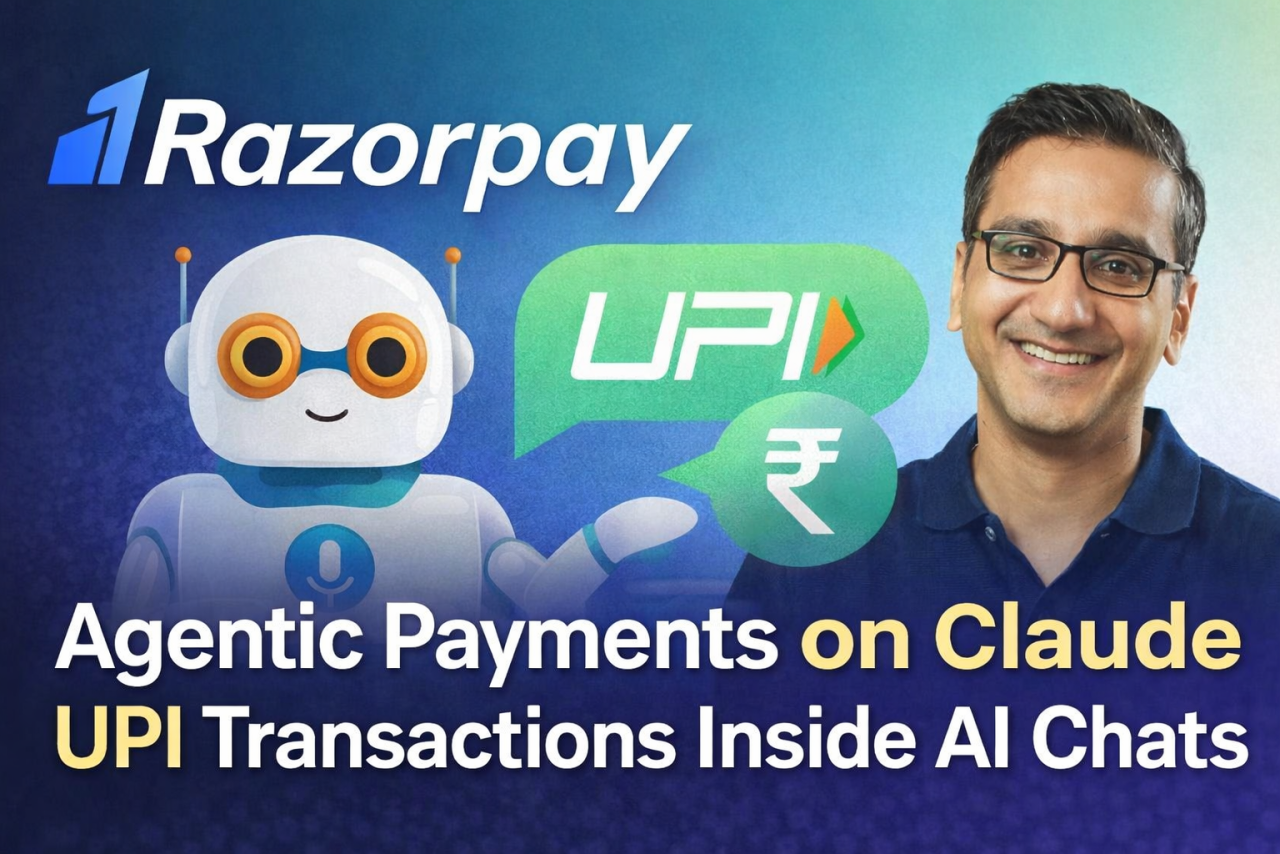
Razorpay has embedded UPI payments into AI chats, turning simple conversations into instant, seamless checkouts.
India’s digital payments ecosystem is taking a decisive step into the era of artificial intelligence. Razorpay has announced the launch of “agentic payments” on Anthropic’s Claude, enabling users to complete transactions directly within AI conversations without switching apps or re-entering payment details.
The announcement was made at the India AI Impact Summit 2026, positioning the Bengaluru-based fintech firm at the forefront of AI-driven commerce in the country.
With this integration, a simple query to an AI assistant, such as “order dinner for two under ₹800,” can now move seamlessly from suggestion to checkout. Users can browse options from platforms like Zomato, Swiggy, or Zepto and complete the payment inside the chat interface itself, eliminating the need to jump across multiple apps.
Commerce Inside Conversations
Razorpay’s new offering combines three key elements: its Agentic Payments feature, India’s UPI infrastructure led by the National Payments Corporation of India (NPCI), and Claude’s conversational intelligence. Together, they enable AI assistants to not just recommend products or services but also execute transactions securely on behalf of users.
Rahul Kothari, Chief Operating Officer at Razorpay, described the move as part of a broader shift in how digital commerce works.
“Commerce is being rearchitected,” he said, noting that AI assistants are rapidly evolving from informational tools into decision-making agents capable of carrying out actions.
The company has already been experimenting with similar integrations with OpenAI’s ChatGPT and Google Gemini in recent months. However, the Claude partnership marks one of the most advanced deployments of real-time AI-powered payments within India’s Unified Payments Interface ecosystem.
How It Works
At the heart of the system is UPI Reserve Pay, which allows users to ring-fence a specific amount from a RuPay credit card, bank account, or pre-sanctioned credit line. This creates a secure payment pool that AI agents can draw from for approved transactions.
Crucially, the system ensures that sensitive payment credentials are not shared with merchants or exposed within the chat interface. Payments are executed only after a single confirmation from the user.
According to Razorpay, UPI’s real-time architecture makes it uniquely suited for agentic commerce. Unlike traditional card systems, which require multiple redirects and authentication layers, UPI enables instant settlement and secure authorisation within a unified framework.
Industry experts see this as a potential turning point for India’s digital economy. With over a billion UPI transactions processed monthly, embedding payments directly into AI-driven conversations could significantly reshape online buying behaviour.
Solving the Trust Gap
While the technology is promising, Razorpay acknowledges that trust remains the biggest challenge.
As checkouts become invisible and AI agents handle more of the transaction flow, users may worry about losing control. Early data from Razorpay’s rollout suggests that consumers are not particularly anxious about AI-initiated payments themselves. Instead, their primary concern is control, including the ability to track spending, revoke access instantly, and set clear limits.
To address this, the company is building real-time tracking tools, instant revocation options, and user-defined spending caps. These safeguards aim to ensure that automation does not come at the cost of transparency.
“The challenge is to maintain user confidence while making the experience frictionless,” Kothari said.
A Larger Shift in Digital Commerce
Razorpay currently holds over 55 percent share of India’s online payment gateway market, and its move into agentic AI payments signals a broader shift in fintech strategy. Instead of competing only on transaction processing, companies are now vying to become embedded layers within AI-driven ecosystems.
For developers, Razorpay is also leveraging its Replit partnership to enable easier integration of monetisation features into AI-powered applications. This opens doors for startups building chat-based shopping, travel booking, ticketing, and subscription services.
As AI assistants become more capable, the line between conversation and commerce is blurring. Ordering food, booking tickets, paying bills, or subscribing to services may soon feel like a natural extension of chatting with a digital assistant.
With this launch, Razorpay is betting that the future of payments in India will not happen on checkout pages but inside conversations.

























Leave a Comment