
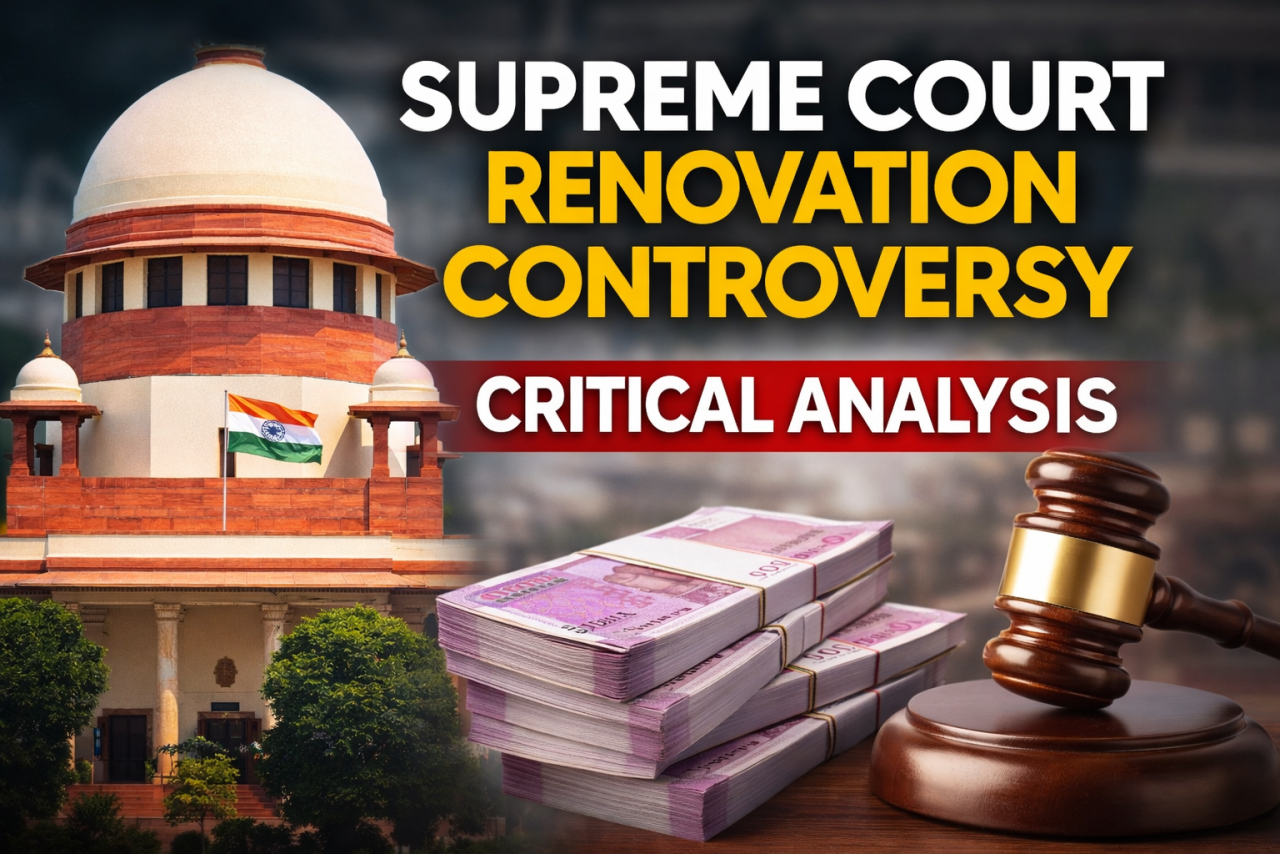
When the guardians of justice face questions over public spending, the debate is no longer about renovation—it is about accountability, optics, and the moral authority of institutions.
The recent controversy over the renovation and expansion of the official residence of the Chief Justice of India (CJI) has triggered a wider debate that goes far beyond the cost of bricks and mortar. At its core, the issue raises difficult questions about public expenditure, institutional accountability, and the delicate balance between judicial independence and public scrutiny.
According to official records placed in the public domain, a substantial amount of public money was sanctioned for the renovation and upgrade of the CJI’s official residence in New Delhi. The expenditure reportedly included structural additions, interior refurbishing, landscaping, and modern amenities. The government clarified that the work followed established procedures and was executed in accordance with approved norms for high constitutional functionaries.
However, the controversy intensified after a petition was filed in the Supreme Court seeking a probe into the expenditure. The petition questioned whether the scale of renovation was justified, whether due process had been followed, and whether public funds were used in a manner consistent with principles of austerity and transparency. The Court dismissed the petition, reportedly observing that the matter did not warrant judicial intervention.
This sequence of events invites a layered analysis.
First, there is the constitutional context. The Chief Justice of India is not an ordinary public official. As head of the Indian judiciary and guardian of the Constitution, the CJI occupies a position of extraordinary institutional importance. Official residences, security arrangements, and administrative facilities are part of the infrastructure necessary for the functioning of such high offices. Historically, governments across political regimes have maintained and upgraded official residences of constitutional authorities, including the President, Prime Minister, and senior judges.
Yet, public discomfort does not arise merely from the existence of such facilities; it arises from perception. In a country where economic inequality remains stark and where judicial backlogs run into millions of pending cases, large expenditures on official residences can appear disconnected from pressing systemic needs. Critics argue that if court infrastructure in many states suffers from shortages of judges, inadequate courtroom facilities, and digital gaps, then high-value residential upgrades may send the wrong message.
Second, there is the question of transparency. While the government has reportedly maintained that all procedures were followed, the larger issue is whether citizens have easy and proactive access to detailed breakdowns of such expenditures. Transparency is not only about legality; it is also about legitimacy. In modern democracies, especially in matters involving public money, disclosure builds trust. When information surfaces only through controversy, suspicion deepens—even if no wrongdoing exists.
Third, the dismissal of the petition by the Supreme Court itself raises a structural concern: who scrutinizes the judiciary when it is the subject of complaint? Unlike the executive and legislature, which face parliamentary oversight, audit mechanisms, and electoral consequences, the higher judiciary enjoys constitutionally protected independence. This independence is indispensable for the rule of law. However, it also creates an accountability gap when questions arise regarding administrative or financial decisions related to the judiciary.
India does have mechanisms such as the Comptroller and Auditor General (CAG) and internal administrative procedures, but these rarely operate in a publicly visible manner when it comes to judicial infrastructure. The Court’s decision to dismiss the plea may have been legally sound, especially if the petition lacked substantive evidence. However, from a public perception standpoint, it reinforces the idea that the judiciary is effectively judging matters concerning itself.
Fourth, the political dimension cannot be ignored. In polarized environments, issues of public expenditure are often weaponized. Some see the controversy as an attempt to undermine the judiciary at a time when it has delivered significant verdicts affecting the executive and legislature. Others see it as a necessary reminder that no institution, however revered, should be insulated from questions about public accountability.
A critical analysis must therefore avoid extremes. It would be simplistic to frame the issue as either a scandal or a non-issue. Instead, the episode underscores the need for clearer institutional norms. The judiciary, like other branches of government, could consider voluntarily publishing detailed annual reports on administrative and infrastructural expenditures. Such proactive transparency would reduce speculation and affirm public trust.
At a deeper level, the controversy reflects the evolving expectations of Indian democracy. Citizens today demand not only constitutional propriety but also moral optics. They expect public officials—especially those tasked with upholding justice—to demonstrate restraint in the use of public resources. Symbolism matters in public life, and the judiciary’s moral authority is one of its greatest assets.
Ultimately, the debate is not about a single residence. It is about how institutions maintain credibility in an age of scrutiny. Judicial independence must remain inviolable. But independence, to endure, must be accompanied by visible accountability and transparent administration. In strengthening these complementary values, the judiciary can ensure that controversies of this nature become opportunities for reform rather than sources of mistrust.

























Leave a Comment