
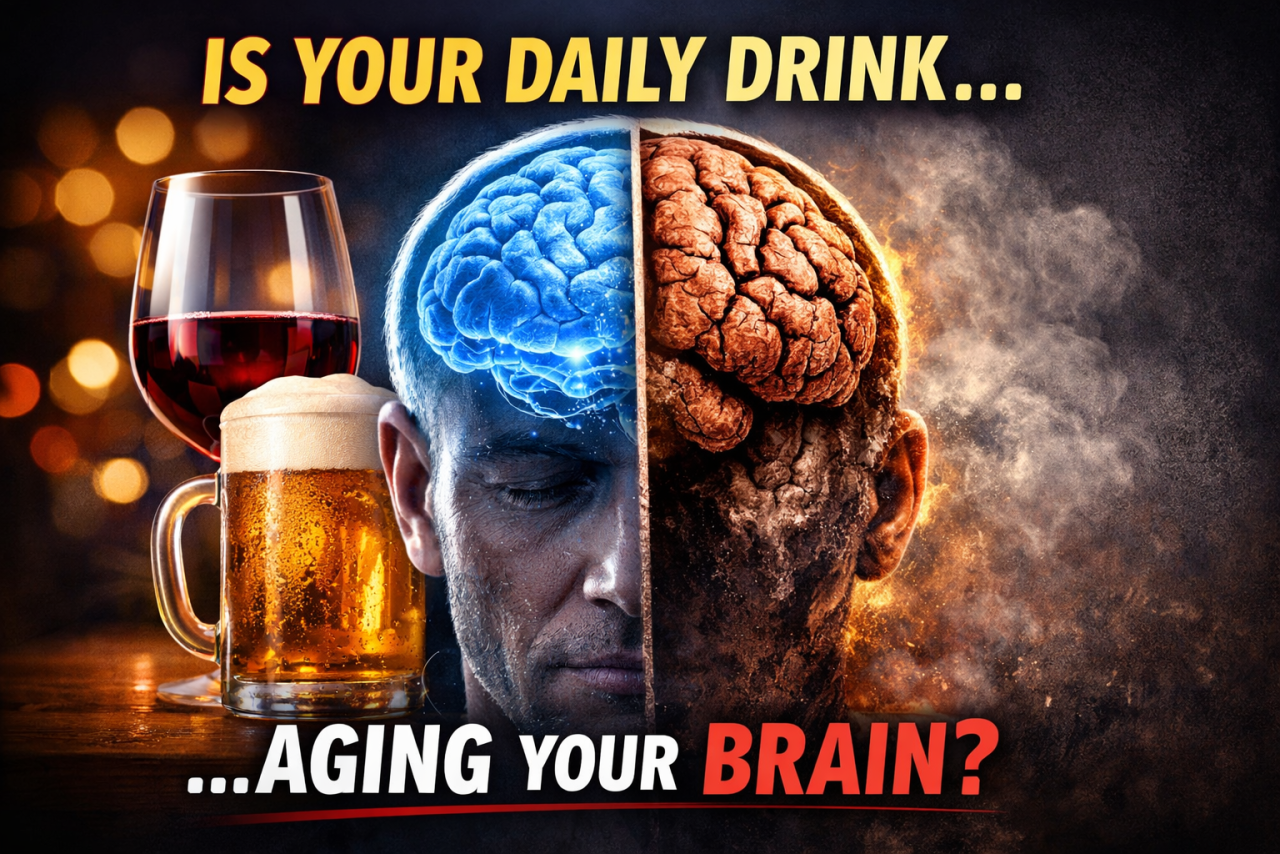
That everyday drink may feel harmless — but new research suggests it could be shrinking your brain, accelerating aging, and slowly dulling the memory and mental sharpness you depend on most.
The evening ritual feels harmless — a glass of wine with dinner, a chilled beer after work, a quiet toast to unwind. It has long been framed as moderation, not excess. But new scientific evidence is challenging that comfort zone, suggesting that even one alcoholic drink a day may quietly reshape the brain in ways that accelerate aging and dull cognitive sharpness.
A major analysis of more than 36,000 adults has found a direct association between light-to-moderate alcohol consumption and reduced brain volume. The scale of the study makes its findings difficult to dismiss. Researchers observed that even the equivalent of one pint of beer or a single glass of wine daily correlated with measurable shrinkage in both gray and white matter.
Gray matter plays a central role in processing information, decision-making, and muscle control. White matter acts as the communication highway, connecting different regions of the brain. When both show structural decline, the implications extend beyond minor forgetfulness. Scientists report that the hippocampus — the region responsible for memory and learning — appears particularly sensitive to alcohol’s effects.
What makes the findings more striking is how rapidly the risk compounds. Moving from one drink to two per day was linked to brain changes comparable to aging by roughly two years. In practical terms, that could mean earlier memory lapses, slower mental processing, and the persistent “brain fog” many people casually attribute to stress or fatigue.
The biological explanation is sobering. Alcohol functions as a neurotoxin. At the microscopic level, it disrupts dendrites — the branch-like extensions of neurons that enable cells to communicate. When these connections weaken, the brain’s internal messaging system becomes less efficient. Over time, that reduced connectivity can affect concentration, recall, and overall cognitive resilience.
Even short-term consumption has immediate physiological effects. Alcohol is a diuretic, meaning it increases fluid loss. While dehydration is often associated with headaches or fatigue, it also impacts neurons. Dehydrated brain cells cannot function at peak performance, which helps explain the temporary lapses in clarity or coordination that follow drinking.
The long-standing belief in a “safe” middle ground of alcohol use is now being reexamined. Earlier research often emphasized potential cardiovascular benefits of moderate drinking. However, advanced brain imaging techniques are uncovering subtler structural changes that older methods may not have detected. The emerging consensus is not that every occasional drink leads to dramatic decline, but that the threshold for harm may be lower than many assume.
Importantly, the relationship appears dose-dependent. Each incremental increase in alcohol intake corresponds with greater structural change. This pattern suggests there may be no entirely risk-free level when it comes to brain health.
Yet the story is not entirely grim. The brain has an extraordinary capacity for repair and adaptation — a property known as neuroplasticity. Evidence indicates that reducing or eliminating alcohol consumption can allow partial recovery of lost brain volume. Neural pathways can strengthen, and cognitive performance may improve over time. While recovery varies based on age, duration of use, and overall health, the possibility of reversal offers hope.
The findings prompt a shift in perspective. Instead of viewing moderate drinking as a benign habit, it may be worth considering its cumulative effect on long-term cognitive health. Small daily choices, repeated over years, shape the structure and function of the brain more than occasional indulgences.
The conversation around alcohol is unlikely to disappear, given its deep cultural roots. But science is steadily adding nuance to what was once a simple narrative. The takeaway is not alarmism — it is awareness. When it comes to protecting memory, clarity, and mental sharpness, the line between moderation and risk may be thinner than we once believed.

























Leave a Comment