
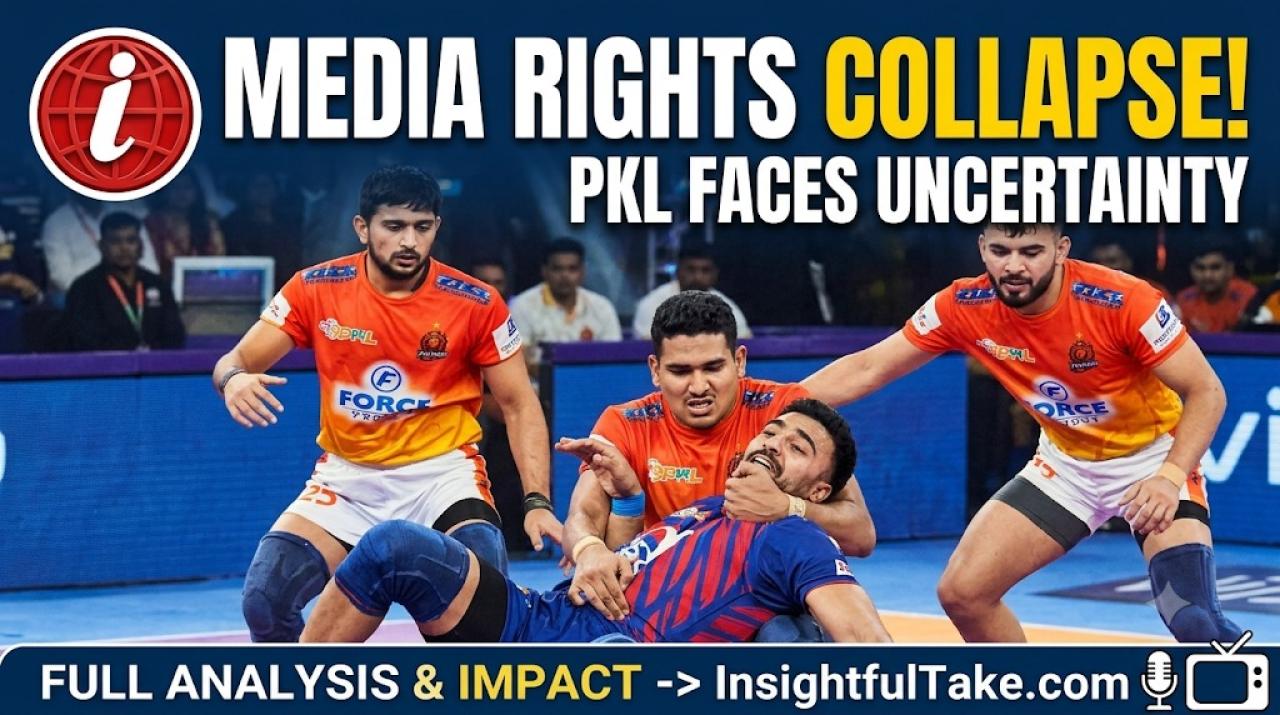
PKL's 2026 shutdown exposes India's fragile sports economy, where cricket thrives on commercial power while other leagues struggle to survive.
The Pro Kabaddi League (PKL), once regarded as one of India's biggest success stories beyond cricket, will not have a season in 2026. For the first time since its launch in 2014, apart from the pandemic-disrupted 2020 season, the league will miss an entire calendar year.
The reason is not a shortage of talent, declining fan interest or a lack of competitive quality. It is a breakdown in media rights negotiations.
Broadcaster JioStar is reportedly seeking a 50% reduction from the previous ₹905 crore media rights deal, which expired after the 2025 season. League owners and franchise stakeholders have been negotiating since May, but the two sides have failed to reach an agreement in time for the 2026 season.
The development raises a larger question about the future of professional sports in India. Why can cricket sustain billion-rupee commercial deals while leagues such as kabaddi, hockey and football remain vulnerable to a single failed negotiation?
The PKL crisis is not simply a scheduling problem. It exposes the commercial imbalance that continues to shape Indian sport.
The PKL Crisis and the Media Rights Deadlock
According to reports, the 12 franchise owners could not finalise a new media rights agreement before the window for organising the 2026 season closed.
JioStar, which also has ownership links through Mashal Sports, reportedly pushed for a substantial reduction in the existing rights fee. Franchise stakeholders, including Telugu Titans' Srinivas Sree Ramaraju, have discussed a possible minimum guarantee and revenue-sharing arrangement similar to earlier agreements.
However, the gap between the broadcaster's expectations and the franchises' commercial requirements remained too wide.
The consequences extend well beyond the league's annual calendar.
Players face uncertainty over contracts, training camps and earnings. Teams must reconsider their preparations, while coaches and support staff are left without a clear competitive schedule. The league's carefully developed structure, including efforts to manage player workloads and reduce injuries, also faces disruption.
Since its launch with eight teams, PKL has expanded to 12 franchises and established itself as a major professional sporting competition. It has also created opportunities for athletes from smaller towns and non-traditional sporting backgrounds to build sustainable careers.
A year without competition threatens that progress.
The problem is not unique to kabaddi. The Hockey India League returned in 2024 after remaining inactive for several years. Other franchise-based competitions have also struggled with high operating costs, limited sponsorship opportunities and broadcasters unwilling to maintain premium valuations after the initial excitement surrounding a new league fades.
Why Cricket Continues to Dominate
Cricket operates in a completely different commercial environment.
The Indian Premier League (IPL) has built a media rights market worth thousands of crores. Broadcasters and digital platforms compete aggressively for its rights because the tournament delivers a massive audience, predictable advertising demand and strong commercial returns.
The IPL benefits from a self-reinforcing business model. High media rights fees support franchises and players, while strong production quality, celebrity involvement and international visibility attract more viewers and sponsors.
Advertisers follow the audience, and the audience continues to grow through the league's established appeal.
Non-cricket sports do not enjoy comparable advantages.
Kabaddi, hockey, badminton, wrestling and football have developed dedicated audiences, but their television and digital reach remains considerably smaller than cricket's. Their ability to attract large sponsorship deals is also limited.
When a broadcaster demands a 50% reduction in media rights fees, these leagues have little negotiating power.
They lack cricket's international broadcasting market, commercial star power and extensive corporate sponsorship network. Even when a competition develops a loyal following, converting that interest into predictable revenue remains difficult.
This creates a fundamental weakness in India's sporting economy. Most non-cricket leagues remain dependent on a small number of commercial agreements. If one major agreement collapses, years of investment in infrastructure, player development and audience building can be put at risk.
The Human Cost of a League Without a Season
The immediate impact of the PKL break will be felt by players.
Professional kabaddi athletes organise their careers around the league's competitive calendar. A missed season means fewer opportunities to earn, compete and maintain their visibility.
For established players, the uncertainty affects contracts and financial planning. For younger athletes, it interrupts an important pathway into professional sport.
The consequences also extend to coaches, trainers, physiotherapists, support staff, scouts and local academies that depend on the professional competition.
PKL has helped transform kabaddi from a largely traditional and regionally followed sport into a commercially visible professional competition. Its absence weakens the ecosystem that developed around that transformation.
There is also a cost to the audience. Fans who had incorporated the league into their annual sporting calendar will have to wait another year, while sponsors and franchise partners must reassess their investments.
The familiar complaint that cricket receives most of India's sporting attention gains another dimension when a successful non-cricket competition cannot secure the commercial backing needed to continue.
India's Sports Business Model Remains Fragile
The deeper problem lies in how professional sports leagues in India generate revenue.
Television and digital media rights have become the principal financial engine for most franchise-based competitions. Sponsorships, ticket sales and merchandise provide additional income, but rarely enough to sustain the operating costs of a major professional league.
This dependence leaves competitions exposed to changing broadcaster priorities and falling commercial valuations.
A league may have strong players, competitive matches and a loyal audience, but those strengths do not automatically translate into a financially sustainable business.
The pandemic in 2020 exposed this weakness across several sporting properties. Competitions were cancelled, postponed or scaled down as organisers struggled to manage financial uncertainty.
PKL's decision to skip a season in a non-pandemic year suggests that the underlying problem remains unresolved.
A professional league cannot build long-term credibility if its existence depends almost entirely on the outcome of one media rights negotiation.
The situation also raises questions about the responsibilities of broadcasters and league owners. A sustainable sporting ecosystem requires both sides to recognise that short-term commercial calculations can damage the long-term value of a competition.
What Needs to Change for Non-Cricket Sports?
There are no quick fixes, but Indian sports leagues need to move towards more diversified revenue models.
Regional broadcasting and digital partnerships could help competitions reach audiences beyond the national television market. Stronger engagement with state associations and grassroots sporting networks could create a more dependable pipeline of players and supporters.
Leagues must also reconsider their operating costs. Expanding teams, increasing match schedules and investing in production quality make sense only when revenue projections support those decisions.
Sponsorship strategies need similar attention. Instead of depending on a handful of national brands, competitions should develop partnerships with regional businesses and companies that have a direct connection with their audiences.
Broadcasters also have a role to play. If they want India to develop a genuine multi-sport culture, competitions outside cricket cannot be treated merely as occasional additions to their content portfolios.
Transparency in media rights negotiations is equally important. When agreements are negotiated behind closed doors, fans and stakeholders rarely understand why a competition has become commercially unviable. Greater clarity about revenue expectations, valuation models and contractual obligations would help identify the actual weaknesses in the system.
Indian Sport Cannot Grow on Cricket Alone
The Pro Kabaddi League's absence in 2026 is more than a temporary break in the sporting calendar. It is a warning about the financial foundations of professional sport in India.
PKL demonstrated that a traditional Indian sport could attract national audiences, corporate investment and professional athletes. Its success offered hope that other disciplines could follow a similar path.
But a league's popularity cannot guarantee its survival when the commercial structure supporting it remains fragile.
Cricket has built an ecosystem in which media rights, sponsorships, franchises and audiences reinforce one another. Other sports are still struggling to establish that balance.
India cannot claim to be a genuine multi-sport nation if professional opportunities outside cricket remain dependent on temporary commercial arrangements.
The challenge is not to reduce cricket's success. It is to create an environment in which kabaddi, hockey, football and other sports can build independent and financially sustainable futures.
Sporting passion creates audiences, but sustainable business models keep leagues alive. Until Indian sports address that difference, cricket will continue to thrive while the country's other sporting successes remain vulnerable to the next media rights negotiation.











Leave a Comment