
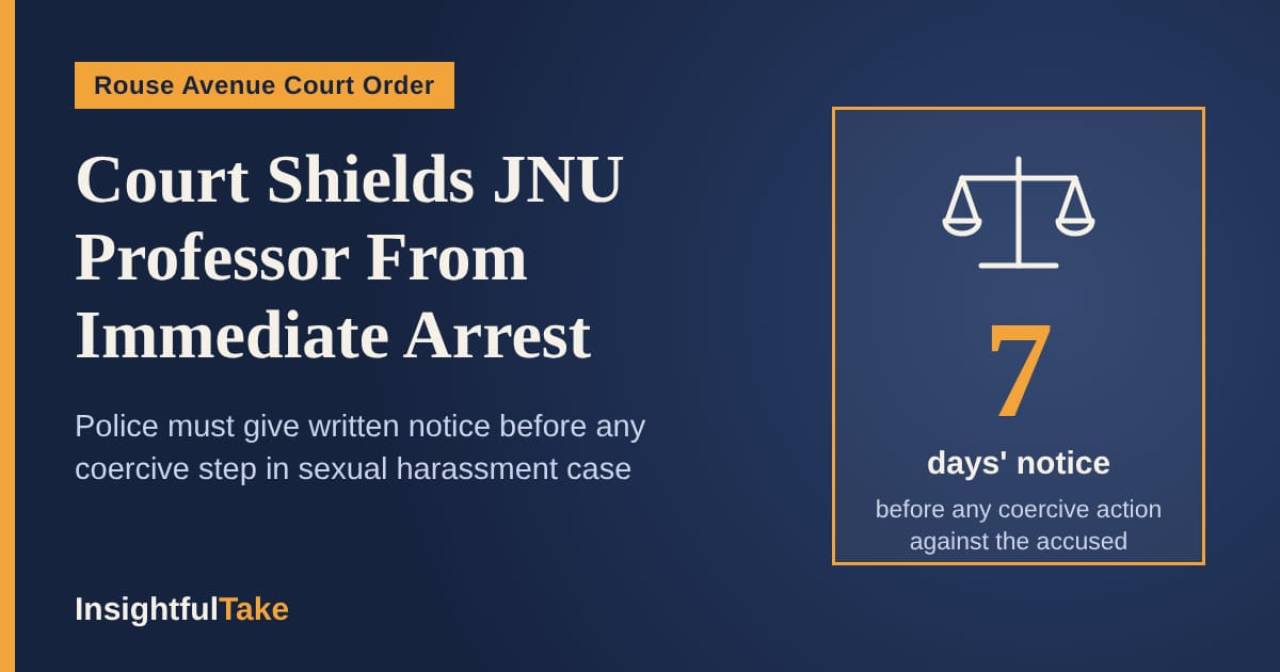
A seven-day notice before arrest, a pending police investigation and a separate legal battle with JNU put the case under judicial scrutiny.
A Delhi court has granted interim protection from arrest to Congress MP and former Jawaharlal Nehru University (JNU) professor Angomcha Bimol Akoijam in a sexual harassment case. The court has directed Delhi Police to give him seven days' written notice before taking any coercive action, including arrest.
The order was passed on Thursday, November 05, 2026, by Special Judge Dig Vinay Singh at the Rouse Avenue Courts while disposing of Akoijam's anticipatory bail application.
The protection does not bring the investigation to a halt. Police can continue examining the allegations and take further legal steps, subject to the conditions laid down by the court.
What the Court Ordered
Akoijam represents the Inner Manipur constituency in the Lok Sabha and was associated with JNU's School of Social Sciences.
During the hearing, public prosecutor Manish Rawat, appearing for Delhi Police, assured the court that if investigators found incriminating material, they would serve a seven-day notice before taking him into custody.
The court recorded this assurance and made it the basis of its order granting interim protection.
The relief means that Akoijam must receive advance written notice before any coercive action is taken against him. It does not amount to a judicial finding on the allegations or a decision on his innocence or guilt.
What Are the Allegations?
According to the police status report, which refers to findings and complaints placed before JNU's Internal Committee (IC), at least 16 students submitted complaints in May this year.
The complaints reportedly alleged sexually suggestive interactions, unwelcome physical contact, inappropriate remarks directed at female students and personal questions during viva examinations.
They also referred to the screening of sexually explicit films in classrooms and alleged irregularities in the conduct of viva examinations.
These allegations are part of the material being examined by investigators. They have not been established through a criminal trial, and the court's order does not validate or reject the claims.
How the Case Unfolded
The case has moved through both the university's disciplinary process and the criminal justice system.
- May 2026: At least 16 students reportedly submitted complaints against Akoijam to JNU's Internal Committee.
- October 9: JNU terminated his services following the internal inquiry.
- October 11: Delhi Police registered an FIR at Vasant Kunj North police station under Sections 75 and 79 of the Bharatiya Nyaya Sanhita (BNS).
- October 15: Akoijam joined the police investigation after receiving a notice. According to the police report, he submitted his curriculum vitae, examination papers and a list of students taught during the relevant semester.
- October 29: His earlier transit anticipatory bail protection granted by a court in Manipur had been extended until this date.
- November 2: The Delhi High Court stayed JNU's termination order after Akoijam challenged the university's decision.
- November 5: The Rouse Avenue Court disposed of his anticipatory bail application and directed Delhi Police to provide seven working days' advance written notice before taking coercive action.
The Delhi High Court's intervention in the employment matter and the Rouse Avenue Court's order in the criminal case are separate judicial developments. Neither determines the final outcome of the sexual harassment allegations.
What the Police Investigation Has Revealed
The police status report indicates that the investigation remains at an early stage.
Investigators told the court that they were examining documents and had not yet received the complete records of JNU's Internal Committee inquiry. These records include the original complaints, statements of the complainants and accounts of independent witnesses.
The availability of these documents is important because investigators need to examine the students' accounts independently and assess the supporting material before deciding on further action.
Reports also indicate that the investigating agency had yet to examine the complainants. The court was informed that the police were seeking the necessary details from the university.
Why the Court's Order Matters
The court's decision highlights the distinction between an ongoing criminal investigation and the legal safeguards available to an accused person.
Akoijam's anticipatory bail application was disposed of after the police gave an assurance regarding advance notice. The court directed that the notice must be served physically and provide seven working days for him to pursue appropriate legal remedies.
He has also been directed to cooperate with the investigation and provide the names of at least two people from his family or office who can receive the notice if he is not available in Delhi. If he fails to cooperate, the investigating officer can approach the court for further directions.
The order does not grant immunity from arrest under all circumstances. Nor does it prevent the police from continuing their investigation.
It is equally important to recognise that the university's internal inquiry and the police investigation serve different purposes. The university's disciplinary proceedings cannot substitute for the criminal investigation, just as an FIR or an internal committee's findings cannot by themselves establish criminal guilt.
The principle of presumption of innocence remains central to the criminal justice process.
What to Watch Next
Three developments will be important in the coming weeks.
First, whether JNU submits the complete records of its Internal Committee inquiry to the police. Second, whether investigators examine the complainants and other witnesses and identify material requiring further action. Third, how the Delhi High Court proceeds with Akoijam's challenge to the university's termination decision, which has been stayed for now.
For the complainants, the priority remains a fair investigation and an opportunity to have their allegations examined without undue delay. For the accused, the legal process must protect the right to a fair hearing and due procedure.
























Leave a Comment