
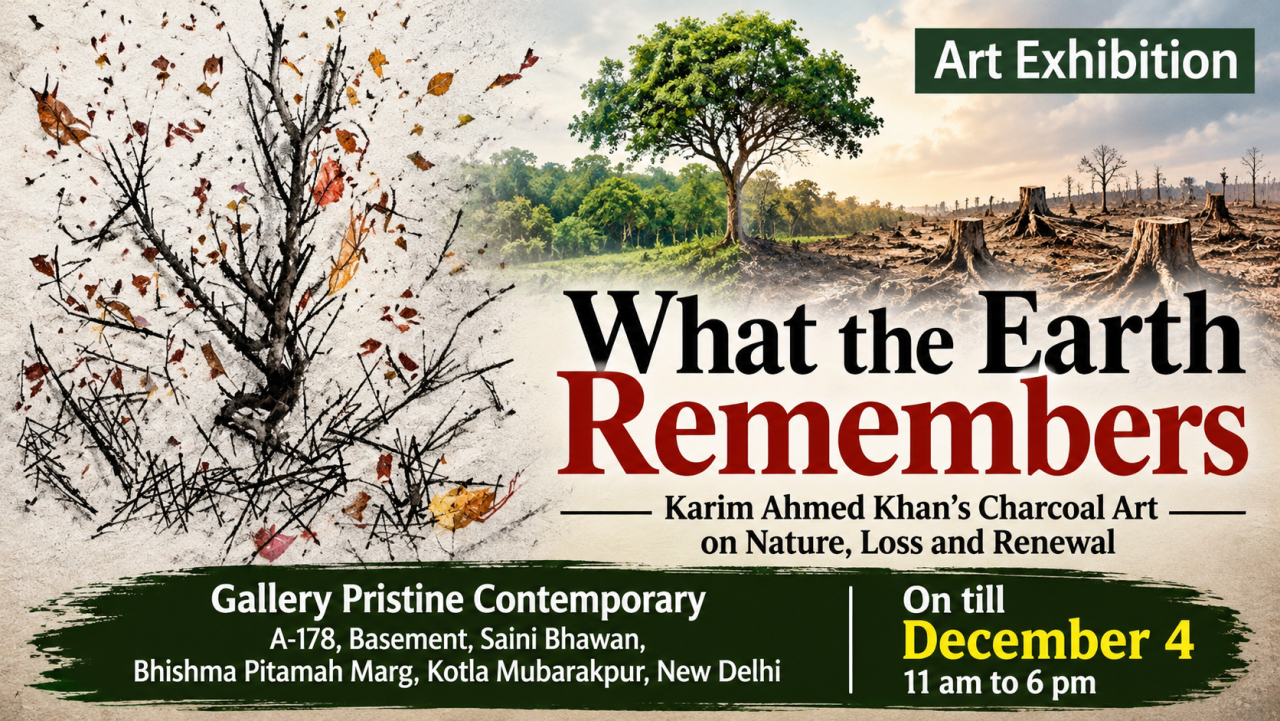
Now on view at Gallery Pristine Contemporary in New Delhi, visual artist Karim Ahmed Khan’s solo exhibition invites visitors to explore the relationship between environmental destruction, nature’s resilience and the possibility of renewal through evocative
What remains after a forest disappears? Can nature recover from the damage inflicted upon it? And how does the earth preserve the memory of landscapes, trees and ecosystems that human activity has gradually erased?
These questions lie at the heart of What the Earth Remembers, a solo exhibition by visual artist Karim Ahmed Khan, currently on view at Gallery Pristine Contemporary, New Delhi. Through detailed charcoal drawings, the artist explores the relationship between destruction and renewal, encouraging visitors to reflect on humanity’s changing relationship with the natural world.
Drawing inspiration from his life in Hunza Valley, Khan brings the experiences and observations of a landscape closely connected with nature into his artistic practice. His works engage with themes of deforestation, climate change, ecological uncertainty and the remarkable ability of nature to regenerate.
Charcoal as a Language of Memory
The choice of charcoal is central to the exhibition's artistic expression. Traditionally associated with drawing, texture and tonal contrasts, charcoal becomes a meaningful medium for exploring the fragile relationship between nature and human intervention.
Its dark, earthy character evokes images of burnt landscapes, fallen trees and disappearing vegetation. At the same time, its expressive possibilities allow the artist to capture the intricate details of natural forms and the possibility of regeneration.
In Khan’s visual vocabulary, charcoal is more than an artistic material. It becomes a reminder of what has been lost and what may still emerge after destruction.
The drawings invite viewers to look beyond the immediate visual experience. Their scattered forms, delicate lines and organic patterns evoke the vulnerability of natural ecosystems while suggesting that destruction does not necessarily mark the end of a story.
Nature has an extraordinary capacity to recover, but that recovery requires time, space and care.
From Hunza Valley to a Universal Environmental Concern
Khan's connection with Hunza Valley provides an important context for understanding his work. Known for its dramatic mountain landscapes and natural beauty, the region offers a compelling setting for reflecting on the relationship between human communities and the environment.
However, the concerns explored in the exhibition extend well beyond any particular geography.
Deforestation, changing climatic conditions and environmental degradation have become global challenges. Forest loss affects biodiversity, disrupts ecological balance and threatens communities that depend directly on natural resources.
Against this backdrop, What the Earth Remembers offers an artistic perspective on issues often discussed through scientific reports, policy debates and environmental campaigns.
Rather than presenting statistics or prescribing solutions, Khan uses visual storytelling to create an emotional connection with the subject. His drawings encourage visitors to pause, observe and reconsider the consequences of human actions.
Art, Resilience and Collective Responsibility
One of the central ideas running through the exhibition is resilience. The natural world is not merely a passive victim of destruction. It possesses an extraordinary ability to regenerate, adapt and reclaim damaged spaces.
Yet this resilience should not become an excuse for human indifference.
The exhibition reflects on the need for collective action and care at a time when environmental uncertainty is becoming increasingly difficult to ignore. Its message is particularly relevant for urban audiences, who experience environmental challenges through shrinking green spaces, rising temperatures, pollution and changing weather patterns.
By bringing environmental concerns into a contemporary art gallery, Khan creates an opportunity for dialogue between artistic expression and public awareness.
The exhibition also demonstrates how art can contribute to conversations that extend beyond conventional boundaries. A drawing can communicate vulnerability, loss and hope in ways that complement scientific and political discussions.
Visit the Exhibition Before December 4
For visitors interested in contemporary art, environmental themes and visual storytelling, What the Earth Remembers offers an opportunity to engage with a subject that affects everyone.
The exhibition is currently open to visitors at Gallery Pristine Contemporary, located at A-178, Basement, Saini Bhawan, Bhishma Pitamah Marg, Kotla Mubarakpur, New Delhi. Art enthusiasts and those interested in environmental issues can visit the gallery between 11 am and 6 pm until December 4.
Exhibition Details
- Exhibition: What the Earth Remembers
- Artist: Karim Ahmed Khan
- Venue: Gallery Pristine Contemporary
- Address: A-178, Basement, Saini Bhawan, Bhishma Pitamah Marg, Kotla Mubarakpur, New Delhi
- Exhibition dates: Currently on view until December 4
- Visiting hours: 11 am to 6 pm
Ultimately, What the Earth Remembers is an invitation to look at nature not simply as a resource to be used, but as a living inheritance that deserves attention and protection.
Through the language of charcoal, Karim Ahmed Khan brings the memory of disappearing landscapes into the gallery, reminding visitors that what humanity destroys may leave traces far longer than it imagines.
Perhaps the most important question the exhibition leaves behind is what we will choose to give back when the earth remembers all that we have taken away.



















Leave a Comment