
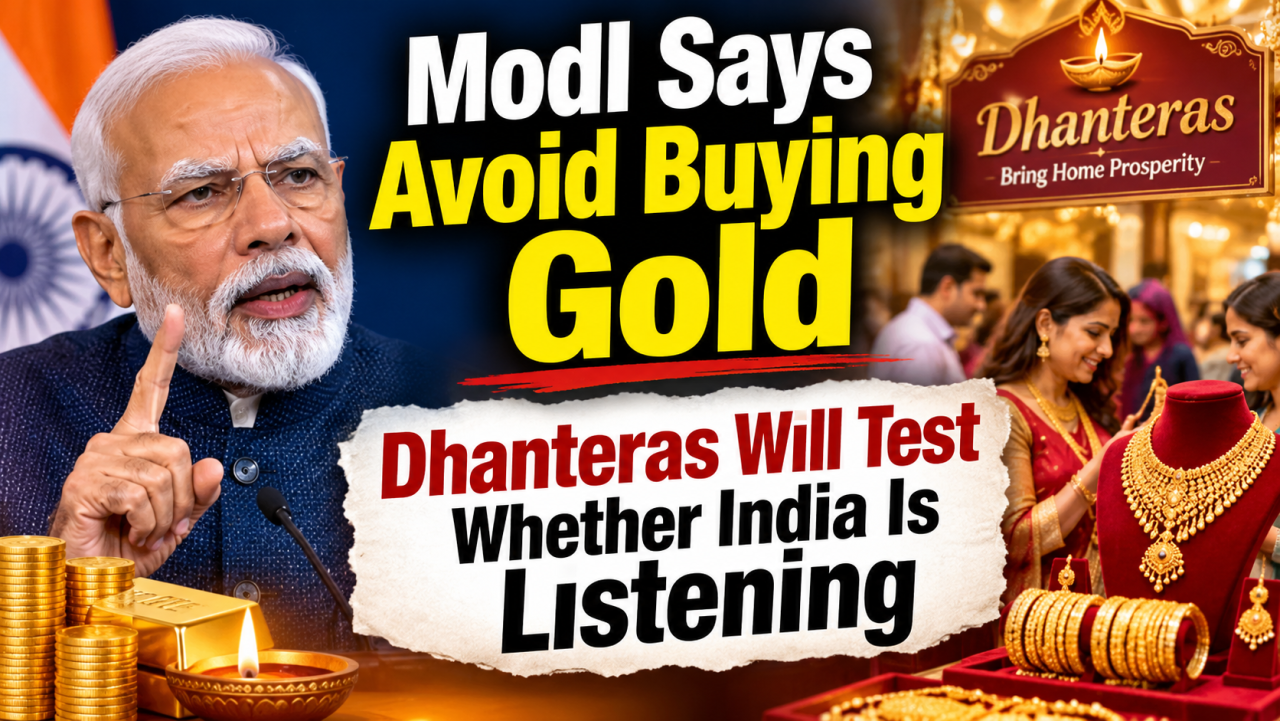
Modi wants restraint on gold purchases, but jewellery brands want festive buyers. Dhanteras will reveal which message Indian consumers choose to follow.
Prime Minister Narendra Modi has asked Indians to avoid unnecessary gold purchases. But as Dhanteras approaches, jewellery advertisements across television, newspapers, digital platforms and social media are sending a familiar message: bring home gold, celebrate prosperity and make the occasion special. The contrast raises an interesting question. Will the Prime Minister's appeal for restraint survive India's biggest traditional gold-buying season, or will festive sentiment and commercial persuasion prove stronger?
For millions of Indian families, buying gold on Dhanteras is not an ordinary shopping decision. It is a tradition associated with prosperity, good fortune and the hope of a better future. A small gold coin, a pair of earrings or a new ornament often carries emotional significance beyond its market price.
That is precisely why this Dhanteras presents an unusual test for the government. The question is no longer simply whether Indians can afford gold at current prices. It is whether they are willing to reconsider a deeply rooted consumption habit in response to a national economic appeal.
When the Prime Minister asks India to hold back
Modi first made a strong appeal on May 10, 2026, asking citizens to avoid non-essential gold purchases for a year, alongside other measures aimed at conserving foreign exchange. His appeal came amid economic pressures arising from the conflict in West Asia, rising energy costs and concerns about India's external financial position.
He renewed the message on September 1, urging people to buy gold only when necessary while promoting Swadeshi and greater self-reliance.
The economic reasoning is understandable. India imports most of the gold it consumes. When domestic demand rises, the country needs to spend more foreign currency on overseas supplies. That adds pressure to the import bill and can complicate efforts to manage the balance of payments.
According to reporting by The Economic Times, India's gold imports reached a record $71.98 billion in FY26, despite a 4.8 per cent decline in import volumes to 721 tonnes. The rising value of imports underlines the financial significance of the country's appetite for gold.
The Economic Times+1
The Prime Minister's appeal, therefore, was not merely about personal spending habits. It was an attempt to connect individual consumption decisions with the country's larger economic priorities.
But asking Indians to reduce gold purchases during an ordinary month is one thing. Asking them to do so during Dhanteras is quite another.
Dhanteras and the power of tradition
Gold occupies a special position in Indian society. It is jewellery, a store of wealth, a family inheritance and, for many households, a form of financial security.
Its importance becomes particularly visible during weddings and festivals. Dhanteras, celebrated during the Diwali period, is traditionally considered an auspicious occasion to purchase precious metals. Families who may postpone other expenses often make an exception for a small gold purchase on this day.
For some, it is a matter of religious belief. For others, it is an annual savings habit. There are also households that purchase gold because they believe it offers protection against financial uncertainty.
This makes the government's message complicated. It is not asking people to abandon an ordinary luxury. It is asking them to reconsider a practice that has been passed down through generations.
However, tradition need not mean unlimited consumption. A family can respect Dhanteras without necessarily buying another expensive ornament. A symbolic purchase, an existing gold exchange or simply observing the festival without buying gold are all possible choices.
The real question is whether consumers will consider these alternatives when the festive marketplace is encouraging them to spend.
Jewellery advertisements are telling a different story
A glance at the jewellery industry's festive marketing offers an interesting contrast with the Prime Minister's appeal.
Brands are continuing to position Dhanteras as an important occasion for buying jewellery. Their campaigns emphasise prosperity, family relationships, gifting, new beginnings and the emotional value of precious ornaments.
The marketing strategy has also adapted to high gold prices. Instead of relying entirely on heavy jewellery, brands are promoting lighter designs, accessible collections, personalised products and alternative categories.
A November 3 report by Exchange4Media highlighted how jewellery companies are recalibrating their Dhanteras campaigns to attract consumers dealing with elevated gold prices. The focus is on making purchases feel more accessible rather than abandoning the festive buying occasion.
exchange4media.com+1
This is commercially understandable. Jewellery businesses employ thousands of people, support artisans and depend heavily on seasonal demand. Dhanteras and the wedding season are important periods for the industry.
But the larger contradiction remains.
While the Prime Minister is asking citizens to avoid unnecessary gold purchases, the industry is working hard to ensure that consumers continue to associate the festival with buying jewellery.
There is no reason for private businesses to suspend advertising simply because the Prime Minister has made an economic appeal. They are operating within the market and responding to consumer demand.
Yet the contrast reveals how difficult it is to translate a national economic message into individual behaviour when powerful commercial incentives point in the opposite direction.
The consumer is caught between patriotism and persuasion
An Indian household considering a gold purchase this Dhanteras faces competing considerations.
On one side is the government's argument that reducing unnecessary imports can help conserve foreign exchange. On the other is the emotional and cultural importance attached to buying gold during an auspicious occasion.
Then comes the commercial message. Advertisements remind consumers that a festival is incomplete without a special purchase. Easy payment options, lighter designs, promotional offers and attractive collections make the decision to buy seem more manageable.
There is also an important distinction between buying gold as an investment and buying it as jewellery. The Prime Minister's appeal concerns unnecessary purchases, not a blanket prohibition on gold ownership.
For households with wedding commitments or genuine financial requirements, the decision may be different from that of someone buying another ornament simply because a festival has arrived.
That distinction deserves attention. Economic patriotism should not become a reason to judge every individual purchase. Nor should the government's appeal be dismissed as irrelevant simply because gold has cultural importance.
The responsibility is shared, but the choices are different.
Will Dhanteras become a test of economic restraint?
The World Gold Council's recent assessment of Indian jewellery demand offers an indication of changing consumer behaviour. Its figures, cited in Exchange4Media's November 3 report, showed a 15 per cent year-on-year decline in jewellery demand by volume even as demand by value increased 34 per cent. This suggests that consumers are purchasing less gold by weight but spending more because of elevated prices.
exchange4media.com
This year's festive season could reveal whether that caution continues or whether traditional demand brings buyers back to jewellery stores.
However, the outcome should not be measured only by the number of people entering showrooms. The quantity of gold purchased, the value of imports and the extent to which consumers substitute fresh purchases with old-gold exchanges will also matter.
There is another question the government must address. If it wants citizens to reduce unnecessary gold consumption, it must explain the economic situation consistently and transparently. People are more likely to respond to a persuasive explanation of national priorities than to an appeal that sounds like a one-sided demand for sacrifice.
The jewellery industry, meanwhile, could also demonstrate social responsibility by encouraging sensible purchases rather than relying exclusively on the emotional pressure of festive consumption.
A festival does not have to become a shopping target
Dhanteras is traditionally associated with prosperity. But prosperity should not be measured only by the amount of gold a family brings home.
A household that avoids unnecessary expenditure, protects its savings and makes informed financial decisions is also celebrating prosperity in a meaningful way.
Modi's appeal has placed an interesting question before the country. Can a society that deeply values gold distinguish between tradition and consumption? Can consumers celebrate Dhanteras without treating a new jewellery purchase as an essential ritual?
The government cannot expect every Indian family to change generations-old habits overnight. Equally, consumers cannot ignore the economic consequences of collective spending simply because a purchase is wrapped in tradition.
This Dhanteras, the real test will not be whether jewellery advertisements disappear or whether showrooms remain busy. They almost certainly will not.
It will be whether Indian consumers can exercise restraint when the marketplace is encouraging them to do exactly the opposite.
The Prime Minister has made his appeal. The jewellery industry has made its pitch. Now the decision rests with the Indian consumer.
Editorial note: The article distinguishes between Modi's appeal against unnecessary gold purchases and a blanket ban on buying gold. It also avoids treating jewellery advertisements as proof that consumers have ignored the appeal.
I can also prepare a sharper, more provocative headline and a Discover-friendly thumbnail concept for this article.














Leave a Comment