
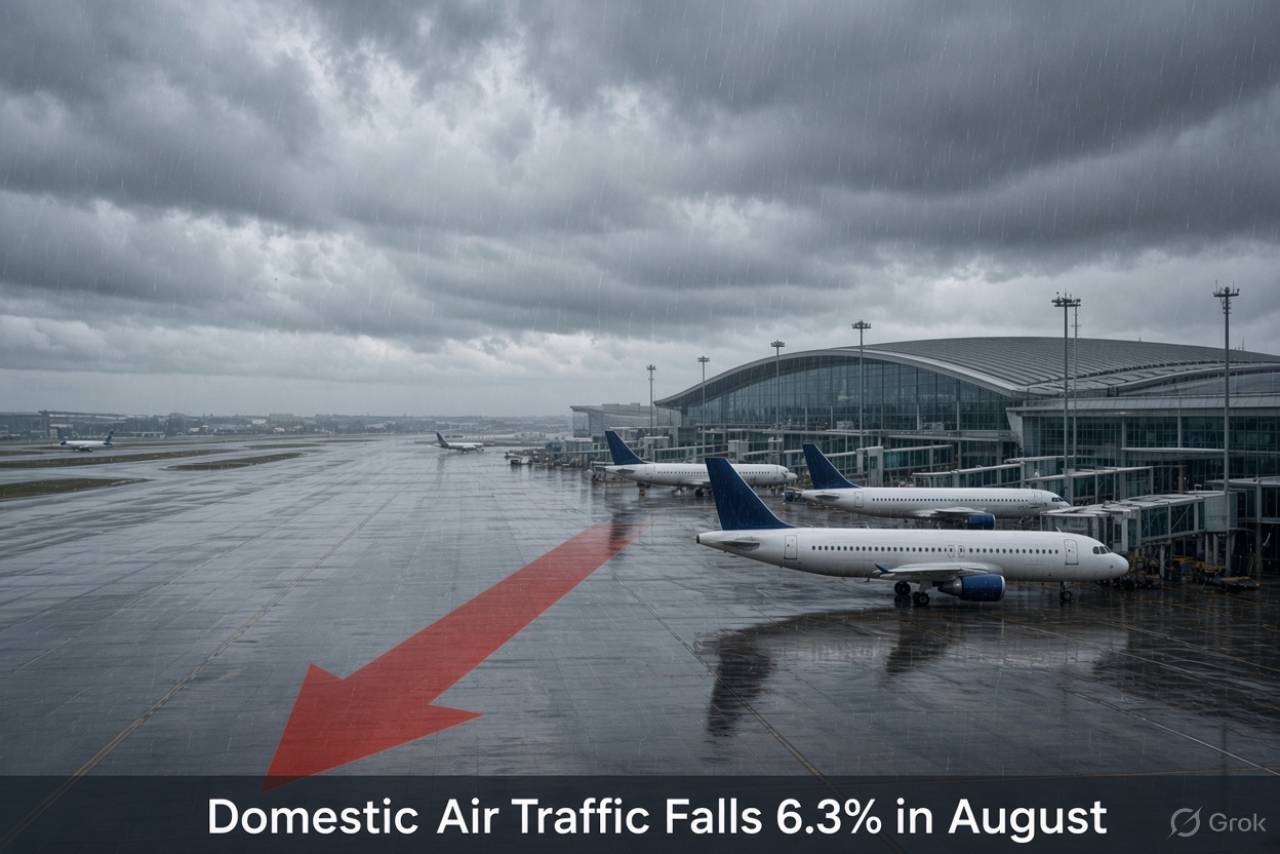
India’s domestic air travel slowed sharply in August as the monsoon and school reopening combined with softer leisure demand to pull passenger traffic lower.
India’s domestic aviation market recorded another monthly decline in August, with passenger traffic falling 6.3 percent year on year as the monsoon, school reopening and softer leisure demand weighed on travel.
According to the latest data from the Directorate General of Civil Aviation (DGCA), scheduled domestic airlines carried around 11.73 million passengers in August, compared with 12.95 million in the same month last year. The decline followed a 4.8 percent year-on-year contraction in July, when domestic traffic stood at about 12 million passengers against 12.6 million a year earlier.
The August numbers mark the second consecutive monthly decline and point to a seasonal slowdown rather than an immediate reversal of the broader expansion seen in Indian aviation.
Load Factors Also Ease
Airline capacity and passenger demand both came under pressure during the month. The system-wide passenger load factor fell from 82.4 percent in July to 79.2 percent in August.
The decline suggests that airlines were operating with a lower proportion of occupied seats as demand softened. Carriers have also been adjusting frequencies on selected routes where passenger volumes and yields have not justified maintaining earlier capacity levels.
Market shares changed moderately during the month. IndiGo’s share declined from 67.4 percent in July to 65 percent in August, while the Air India Group increased its share from 24 percent to 26.7 percent.
Akasa Air remained relatively stable at around 5.5 percent, while SpiceJet’s share stood at about 1.6 percent.
The changes reflect a competitive market in which airlines are continuing to adjust schedules and capacity in response to demand and operating economics.
Monsoon and School Calendar Weigh on Demand
August is traditionally a softer period for domestic leisure travel. The reopening of schools and colleges after the summer break reduces family holiday traffic, while the monsoon can discourage discretionary travel to several popular destinations.
Hill stations and coastal locations, which often benefit from weekend and short-break travel, can also see weaker demand during periods of heavy rainfall.
Many travellers additionally postpone non-essential trips until the festive season begins. Demand typically strengthens around major festivals and holidays, followed by the Christmas and New Year travel period.
These seasonal factors provide important context for the year-on-year decline.
Inbound Tourism Remains Uneven
Inbound tourism also remained relatively subdued during August. Uncertainty in some international markets and elevated airfares on certain international routes continued to affect foreign visitor flows.
At the same time, higher aviation costs have encouraged airlines to exercise greater caution over capacity. Jet-fuel prices, airport charges, aircraft availability and other operating expenses remain important considerations when carriers decide whether to increase or reduce frequencies on individual routes.
The result is a market where airlines are attempting to balance passenger demand with profitability rather than simply adding capacity.
Operational Performance Remains a Concern
The softer passenger numbers did not remove the operational challenges facing the industry.
At the 10 major airports monitored, around 1.39 percent of flights experienced delays of more than two hours.
Among the major carriers, IndiGo recorded an on-time performance of 91.5 percent, followed by Akasa Air at 90.5 percent and Air India Group at 83.9 percent. SpiceJet's figure stood at 71.8 percent.
Passenger complaints remained another area requiring attention. Airlines received 2,132 complaints during August. Baggage-related issues accounted for the largest share at 48.05 percent, followed by flight-related complaints at 26.3 percent and refund-related grievances at 17.3 percent.
Of the total complaints, 2,123 were addressed during the month.
The figures show that passenger experience remains an important challenge even when overall traffic growth slows.
Industry Sees Seasonal Softness
Jay R. Bhatia, director of Tuli Holidays and a member of the Travel Agents Association of India, said the current slowdown should be viewed in the context of seasonal travel patterns.
He pointed to the potential return of visiting-friends-and-relatives traffic as the festive season approaches and maintained that the broader growth prospects for Indian aviation remain positive.
Capacity rationalisation could also play a role in improving airline economics. After a period of aggressive expansion, adjusting frequencies on weaker routes can help carriers avoid operating excess capacity and protect yields.
Festive Season Could Bring Fresh Momentum
The travel calendar is likely to become more favourable for airlines in the coming months.
The festive period generally brings stronger leisure and visiting-friends-and-relatives traffic, while the Christmas and New Year holidays provide another important demand window.
Airlines are expected to adjust schedules and promotional campaigns to capture this seasonal increase in bookings.
The challenge will be balancing additional capacity with service reliability. A sharp increase in demand can put pressure on airports, aircraft utilisation, baggage handling and flight schedules.
At the same time, the rise in Air India Group's market share and the continued presence of newer carriers such as Akasa Air indicate that competition remains active.
A Broader View of India’s Aviation Growth
The August decline needs to be considered against India's broader aviation expansion since the pandemic.
Domestic air travel has grown substantially as passenger demand recovered, incomes increased, airport infrastructure expanded and low-cost carriers widened access to air travel.
That means monthly comparisons can sometimes look sharper when measured against a strong previous-year base.
The more important indicators will be whether demand strengthens during the festive period and how airlines respond through capacity, pricing and route adjustments.
Advance bookings for the coming holiday period will provide a better indication of whether August represented a temporary seasonal dip or the beginning of a more sustained moderation.
What the August Numbers Tell Us
The DGCA's monthly traffic data provide an important window into the health of India's aviation sector. The latest figures point to a combination of seasonal demand weakness, monsoon disruption, softer inbound tourism and deliberate capacity adjustments by airlines.
For carriers, the immediate task is to align capacity with the expected festive-season surge while improving the operational issues that generate passenger complaints.
For travellers, softer demand can sometimes create opportunities for better fares on selected routes, although pricing will vary depending on destination, booking window and available capacity.
The 6.3 percent year-on-year decline in August therefore needs to be read in context. The numbers show a clear short-term slowdown, but they do not by themselves establish a fundamental change in India's longer-term domestic aviation trajectory.
The coming festive season will offer a more meaningful test of passenger demand, airline capacity and the sector's ability to turn India's expanding appetite for air travel into sustainable growth.
India’s domestic aviation market recorded another monthly decline in August, with passenger traffic falling 6.3 percent year on year as the monsoon, school reopening and softer leisure demand weighed on travel.
According to the latest data from the Directorate General of Civil Aviation (DGCA), scheduled domestic airlines carried around 11.73 million passengers in August, compared with 12.95 million in the same month last year. The decline followed a 4.8 percent year-on-year contraction in July, when domestic traffic stood at about 12 million passengers against 12.6 million a year earlier.
The August numbers mark the second consecutive monthly decline and point to a seasonal slowdown rather than an immediate reversal of the broader expansion seen in Indian aviation.
Load Factors Also Ease
Airline capacity and passenger demand both came under pressure during the month. The system-wide passenger load factor fell from 82.4 percent in July to 79.2 percent in August.
The decline suggests that airlines were operating with a lower proportion of occupied seats as demand softened. Carriers have also been adjusting frequencies on selected routes where passenger volumes and yields have not justified maintaining earlier capacity levels.
Market shares changed moderately during the month. IndiGo’s share declined from 67.4 percent in July to 65 percent in August, while the Air India Group increased its share from 24 percent to 26.7 percent.
Akasa Air remained relatively stable at around 5.5 percent, while SpiceJet’s share stood at about 1.6 percent.
The changes reflect a competitive market in which airlines are continuing to adjust schedules and capacity in response to demand and operating economics.
Monsoon and School Calendar Weigh on Demand
August is traditionally a softer period for domestic leisure travel. The reopening of schools and colleges after the summer break reduces family holiday traffic, while the monsoon can discourage discretionary travel to several popular destinations.
Hill stations and coastal locations, which often benefit from weekend and short-break travel, can also see weaker demand during periods of heavy rainfall.
Many travellers additionally postpone non-essential trips until the festive season begins. Demand typically strengthens around major festivals and holidays, followed by the Christmas and New Year travel period.
These seasonal factors provide important context for the year-on-year decline.
Inbound Tourism Remains Uneven
Inbound tourism also remained relatively subdued during August. Uncertainty in some international markets and elevated airfares on certain international routes continued to affect foreign visitor flows.
At the same time, higher aviation costs have encouraged airlines to exercise greater caution over capacity. Jet-fuel prices, airport charges, aircraft availability and other operating expenses remain important considerations when carriers decide whether to increase or reduce frequencies on individual routes.
The result is a market where airlines are attempting to balance passenger demand with profitability rather than simply adding capacity.
Operational Performance Remains a Concern
The softer passenger numbers did not remove the operational challenges facing the industry.
At the 10 major airports monitored, around 1.39 percent of flights experienced delays of more than two hours.
Among the major carriers, IndiGo recorded an on-time performance of 91.5 percent, followed by Akasa Air at 90.5 percent and Air India Group at 83.9 percent. SpiceJet's figure stood at 71.8 percent.
Passenger complaints remained another area requiring attention. Airlines received 2,132 complaints during August. Baggage-related issues accounted for the largest share at 48.05 percent, followed by flight-related complaints at 26.3 percent and refund-related grievances at 17.3 percent.
Of the total complaints, 2,123 were addressed during the month.
The figures show that passenger experience remains an important challenge even when overall traffic growth slows.
Industry Sees Seasonal Softness
Jay R. Bhatia, director of Tuli Holidays and a member of the Travel Agents Association of India, said the current slowdown should be viewed in the context of seasonal travel patterns.
He pointed to the potential return of visiting-friends-and-relatives traffic as the festive season approaches and maintained that the broader growth prospects for Indian aviation remain positive.
Capacity rationalisation could also play a role in improving airline economics. After a period of aggressive expansion, adjusting frequencies on weaker routes can help carriers avoid operating excess capacity and protect yields.
Festive Season Could Bring Fresh Momentum
The travel calendar is likely to become more favourable for airlines in the coming months.
The festive period generally brings stronger leisure and visiting-friends-and-relatives traffic, while the Christmas and New Year holidays provide another important demand window.
Airlines are expected to adjust schedules and promotional campaigns to capture this seasonal increase in bookings.
The challenge will be balancing additional capacity with service reliability. A sharp increase in demand can put pressure on airports, aircraft utilisation, baggage handling and flight schedules.
At the same time, the rise in Air India Group's market share and the continued presence of newer carriers such as Akasa Air indicate that competition remains active.
A Broader View of India’s Aviation Growth
The August decline needs to be considered against India's broader aviation expansion since the pandemic.
Domestic air travel has grown substantially as passenger demand recovered, incomes increased, airport infrastructure expanded and low-cost carriers widened access to air travel.
That means monthly comparisons can sometimes look sharper when measured against a strong previous-year base.
The more important indicators will be whether demand strengthens during the festive period and how airlines respond through capacity, pricing and route adjustments.
Advance bookings for the coming holiday period will provide a better indication of whether August represented a temporary seasonal dip or the beginning of a more sustained moderation.
What the August Numbers Tell Us
The DGCA's monthly traffic data provide an important window into the health of India's aviation sector. The latest figures point to a combination of seasonal demand weakness, monsoon disruption, softer inbound tourism and deliberate capacity adjustments by airlines.
For carriers, the immediate task is to align capacity with the expected festive-season surge while improving the operational issues that generate passenger complaints.
For travellers, softer demand can sometimes create opportunities for better fares on selected routes, although pricing will vary depending on destination, booking window and available capacity.
The 6.3 percent year-on-year decline in August therefore needs to be read in context. The numbers show a clear short-term slowdown, but they do not by themselves establish a fundamental change in India's longer-term domestic aviation trajectory.
The coming festive season will offer a more meaningful test of passenger demand, airline capacity and the sector's ability to turn India's expanding appetite for air travel into sustainable growth.


.jpeg)






















Leave a Comment