
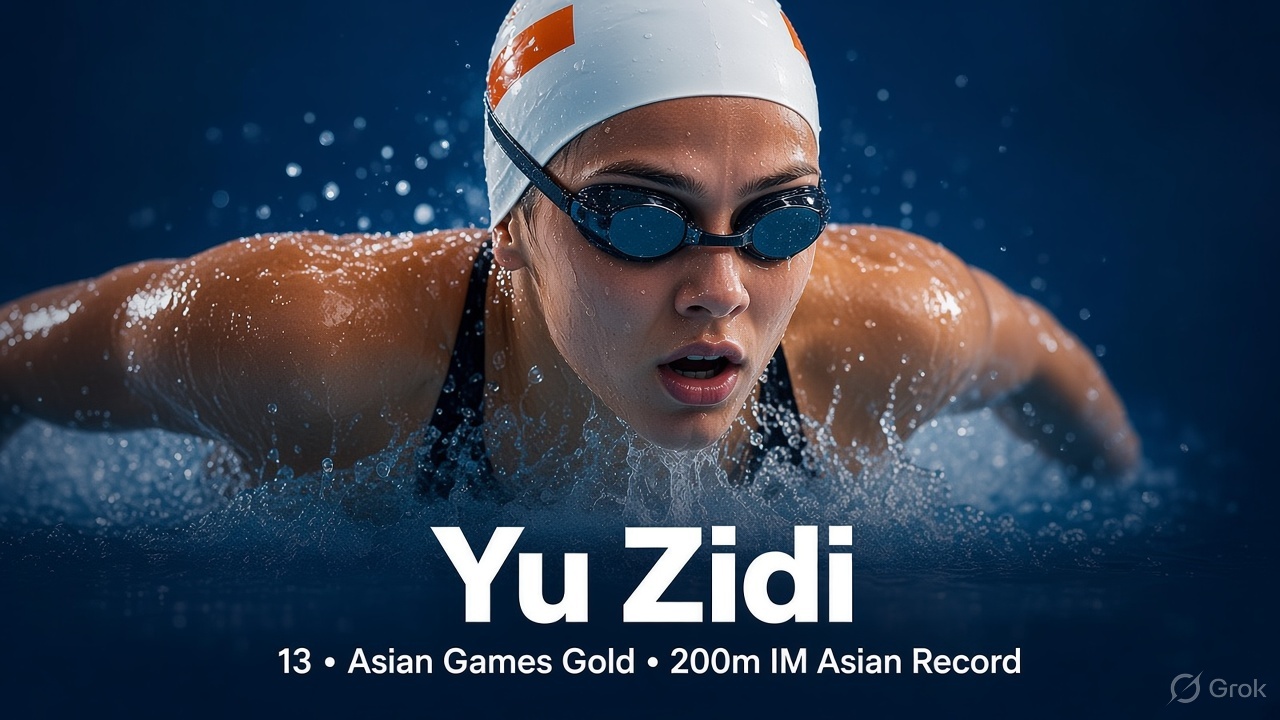
At just 13, Yu Zidi is already breaking Asian records and closing in on the world’s fastest swimmers in the pool.
In the gleaming waters of the Tokyo Aquatics Center during the 2026 Asian Games, a 13-year-old Chinese swimmer delivered a performance that demanded attention from the established names of world swimming.
Yu Zidi, already regarded as one of the sport’s most promising young talents, won gold in the women’s 200-metre individual medley in a time that placed her among the fastest swimmers ever recorded in the event. The victory came only a day after another dominant performance and underlined the remarkable depth of talent emerging from China.
From a Water Park to Competitive Swimming
Born in Baoding, Hebei province, in October 2012, Yu began swimming at the age of six. Her entry into the sport was almost accidental.
A visit to a water park with her father caught the attention of a local swimming coach. What began as a simple summer activity soon developed into structured training.
By the age of nine, Yu had moved to the Hebei Taihua Jinye Swimming Club, where her natural ability in the water was developed into competitive skill. The club also supported her schooling and daily needs, helping her manage academics alongside an increasingly demanding training schedule.
Her rise through the ranks was unusually fast.
A Breakthrough Before Her Teenage Years
Yu made an early impression on the international stage.
At 12, she became the youngest medallist in the history of the World Aquatics Championships when she helped China win bronze in the women’s 4x200-metre freestyle relay in Singapore.
Her individual performances were equally striking. She reached the finals of several events and finished fourth in the 200-metre individual medley, 400-metre individual medley and 200-metre butterfly.
Those events included competition from Canadian swimming star Summer McIntosh, one of the leading young swimmers in the world.
Yu’s results in Singapore established her as a serious international prospect. The Asian Games, however, provided a much larger stage for her individual performances.
Two Gold Medals in Two Days
On the opening day of swimming competition, Yu won gold in the 200-metre butterfly and set a new Asian Games record.
A day later, she returned to the pool for the 200-metre individual medley and produced an even more remarkable performance.
Yu clocked 2:06.10, breaking the Asian record previously held by fellow Chinese swimmer Yu Yiting. The time also put her within four-tenths of a second of McIntosh’s world record of 2:05.70, set in June 2025.
Her performance ranked among the fastest ever recorded in the event and moved her past the previous benchmark associated with Olympic champion Katinka Hosszú.
The decisive moment came during the final 50 metres. Yu entered the freestyle leg slightly behind but produced a powerful closing burst to move ahead and touch the wall first, defeating her more experienced compatriot.
The Race Was Won in the Final 50 Metres
The final reflected a combination of endurance, tactical awareness and finishing speed.
Yu remained within striking distance through the butterfly, backstroke and breaststroke legs. It was in freestyle that she made her decisive move.
Rather than allowing the pressure of the race to affect her, she accelerated through the final length and completed the comeback with authority.
Her comments afterwards were notably measured for an athlete so young. Instead of focusing only on her individual achievement, she credited the collective work of her team and said the second gold medal was even more satisfying than the first.
She also pointed to areas where she could improve, including technical details such as head position and leg drive.
The Summer McIntosh Connection
Yu’s rapid rise has naturally drawn comparisons with Summer McIntosh, another swimmer who began breaking major records while still a teenager.
McIntosh has established herself as one of the leading figures in the medley and butterfly events, winning three gold medals at the Paris Olympics and setting multiple world records.
Yu has openly regarded the Canadian swimmer as an idol and a source of motivation.
Their potential future meetings are therefore likely to attract considerable attention. The 2027 World Championships in Budapest and the 2028 Los Angeles Olympics could provide major stages for the two swimmers to meet in the events where both have established themselves as leading competitors.
For Yu, however, the significance is even more striking because of her age.
At 13, an age when many swimmers are still competing primarily in age-group events, she is already producing performances that place her close to the highest level of senior international swimming.
Questions Around Early Elite Success
Such rapid success also brings difficult questions.
Elite swimming places substantial demands on the body, particularly during periods of growth. Yu’s progress has therefore prompted wider discussion about training loads, long-term athletic development and the pressures that accompany international competition at such a young age.
Those involved in her programme have pointed to careful management and a supportive club environment.
Yu continues to compete across several events, including the 400-metre individual medley during the Asian Games. Her participation across different disciplines highlights the breadth of her ability rather than limiting her development to a single speciality.
A New Chapter in Chinese Swimming
Yu’s emergence also reflects the depth of Chinese swimming.
China has produced Olympic champions and generations of medal-winning swimmers across major international competitions. The country's development system has consistently introduced new athletes to the global stage.
What makes Yu particularly notable is the combination of her age and her times.
Her Asian record performance in the 200-metre individual medley places her within the long history of Chinese excellence in the event. The record she surpassed had previously been associated with Yu Yiting, while the broader Asian record lineage also connects to Ye Shiwen, the Olympic champion who made history at the 2012 London Olympics.
Yu is now beginning to establish her own place in that lineage.
The Road Beyond Aichi-Nagoya
The immediate question is how much more Yu can achieve during the remaining events of the Asian Games.
The larger question concerns the next Olympic cycle.
A 13-year-old swimmer already approaching the world-record level presents a challenge to conventional assumptions about how elite careers develop. Traditionally, swimmers tend to reach their highest levels after years of physical development and senior competition.
Yu is following a very different timeline.
That does not guarantee a straight upward path. Swimming careers are shaped by growth, changing physiology, injuries, training demands, competition and countless other factors. The challenge for Yu and her coaches will be to manage those variables while allowing her talent to develop over the long term.
For now, though, the achievement is already significant.
Yu Zidi has won two Asian Games gold medals at 13, broken a continental record and placed herself within striking distance of one of the most demanding records in women's swimming.
Her performances in Tokyo have done more than add medals to China’s tally. They have brought a remarkably young athlete into the centre of the global swimming conversation.
The next chapter of her career remains unwritten. But the name Yu Zidi is already impossible to overlook.
In the gleaming waters of the Tokyo Aquatics Center during the 2026 Asian Games, a 13-year-old Chinese swimmer delivered a performance that demanded attention from the established names of world swimming.
Yu Zidi, already regarded as one of the sport’s most promising young talents, won gold in the women’s 200-metre individual medley in a time that placed her among the fastest swimmers ever recorded in the event. The victory came only a day after another dominant performance and underlined the remarkable depth of talent emerging from China.
From a Water Park to Competitive Swimming
Born in Baoding, Hebei province, in October 2012, Yu began swimming at the age of six. Her entry into the sport was almost accidental.
A visit to a water park with her father caught the attention of a local swimming coach. What began as a simple summer activity soon developed into structured training.
By the age of nine, Yu had moved to the Hebei Taihua Jinye Swimming Club, where her natural ability in the water was developed into competitive skill. The club also supported her schooling and daily needs, helping her manage academics alongside an increasingly demanding training schedule.
Her rise through the ranks was unusually fast.
A Breakthrough Before Her Teenage Years
Yu made an early impression on the international stage.
At 12, she became the youngest medallist in the history of the World Aquatics Championships when she helped China win bronze in the women’s 4x200-metre freestyle relay in Singapore.
Her individual performances were equally striking. She reached the finals of several events and finished fourth in the 200-metre individual medley, 400-metre individual medley and 200-metre butterfly.
Those events included competition from Canadian swimming star Summer McIntosh, one of the leading young swimmers in the world.
Yu’s results in Singapore established her as a serious international prospect. The Asian Games, however, provided a much larger stage for her individual performances.
Two Gold Medals in Two Days
On the opening day of swimming competition, Yu won gold in the 200-metre butterfly and set a new Asian Games record.
A day later, she returned to the pool for the 200-metre individual medley and produced an even more remarkable performance.
Yu clocked 2:06.10, breaking the Asian record previously held by fellow Chinese swimmer Yu Yiting. The time also put her within four-tenths of a second of McIntosh’s world record of 2:05.70, set in June 2025.
Her performance ranked among the fastest ever recorded in the event and moved her past the previous benchmark associated with Olympic champion Katinka Hosszú.
The decisive moment came during the final 50 metres. Yu entered the freestyle leg slightly behind but produced a powerful closing burst to move ahead and touch the wall first, defeating her more experienced compatriot.
The Race Was Won in the Final 50 Metres
The final reflected a combination of endurance, tactical awareness and finishing speed.
Yu remained within striking distance through the butterfly, backstroke and breaststroke legs. It was in freestyle that she made her decisive move.
Rather than allowing the pressure of the race to affect her, she accelerated through the final length and completed the comeback with authority.
Her comments afterwards were notably measured for an athlete so young. Instead of focusing only on her individual achievement, she credited the collective work of her team and said the second gold medal was even more satisfying than the first.
She also pointed to areas where she could improve, including technical details such as head position and leg drive.
The Summer McIntosh Connection
Yu’s rapid rise has naturally drawn comparisons with Summer McIntosh, another swimmer who began breaking major records while still a teenager.
McIntosh has established herself as one of the leading figures in the medley and butterfly events, winning three gold medals at the Paris Olympics and setting multiple world records.
Yu has openly regarded the Canadian swimmer as an idol and a source of motivation.
Their potential future meetings are therefore likely to attract considerable attention. The 2027 World Championships in Budapest and the 2028 Los Angeles Olympics could provide major stages for the two swimmers to meet in the events where both have established themselves as leading competitors.
For Yu, however, the significance is even more striking because of her age.
At 13, an age when many swimmers are still competing primarily in age-group events, she is already producing performances that place her close to the highest level of senior international swimming.
Questions Around Early Elite Success
Such rapid success also brings difficult questions.
Elite swimming places substantial demands on the body, particularly during periods of growth. Yu’s progress has therefore prompted wider discussion about training loads, long-term athletic development and the pressures that accompany international competition at such a young age.
Those involved in her programme have pointed to careful management and a supportive club environment.
Yu continues to compete across several events, including the 400-metre individual medley during the Asian Games. Her participation across different disciplines highlights the breadth of her ability rather than limiting her development to a single speciality.
A New Chapter in Chinese Swimming
Yu’s emergence also reflects the depth of Chinese swimming.
China has produced Olympic champions and generations of medal-winning swimmers across major international competitions. The country's development system has consistently introduced new athletes to the global stage.
What makes Yu particularly notable is the combination of her age and her times.
Her Asian record performance in the 200-metre individual medley places her within the long history of Chinese excellence in the event. The record she surpassed had previously been associated with Yu Yiting, while the broader Asian record lineage also connects to Ye Shiwen, the Olympic champion who made history at the 2012 London Olympics.
Yu is now beginning to establish her own place in that lineage.
The Road Beyond Aichi-Nagoya
The immediate question is how much more Yu can achieve during the remaining events of the Asian Games.
The larger question concerns the next Olympic cycle.
A 13-year-old swimmer already approaching the world-record level presents a challenge to conventional assumptions about how elite careers develop. Traditionally, swimmers tend to reach their highest levels after years of physical development and senior competition.
Yu is following a very different timeline.
That does not guarantee a straight upward path. Swimming careers are shaped by growth, changing physiology, injuries, training demands, competition and countless other factors. The challenge for Yu and her coaches will be to manage those variables while allowing her talent to develop over the long term.
For now, though, the achievement is already significant.
Yu Zidi has won two Asian Games gold medals at 13, broken a continental record and placed herself within striking distance of one of the most demanding records in women's swimming.
Her performances in Tokyo have done more than add medals to China’s tally. They have brought a remarkably young athlete into the centre of the global swimming conversation.
The next chapter of her career remains unwritten. But the name Yu Zidi is already impossible to overlook.

























Leave a Comment