
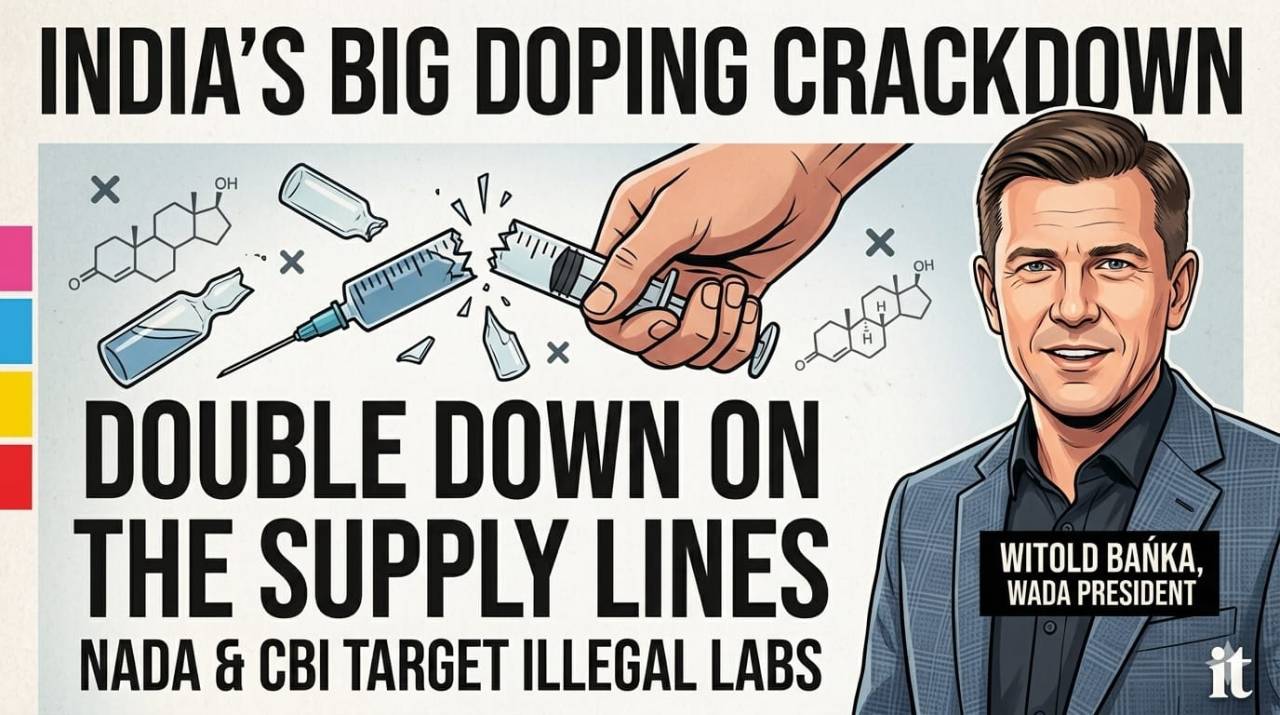
India isn’t just leading in medals—it’s leading in doping. Behind the numbers lies a powerful steroid network threatening the future of Indian sport.
In the high-stakes arena of global sports, India is grappling with a podium finish it desperately wants to vacate. Recent revelations from the World Anti-Doping Agency (WADA) have sent shockwaves through the national sporting fraternity that India has topped the global doping chart for the third consecutive year.
During his high-profile visit to New Delhi in April 2026, WADA President Witold Bańka delivered a stark warning. The issue, he emphasized, goes beyond athletes. According to WADA’s findings, India has emerged as the world’s largest producer of Performance-Enhancing Drugs (PEDs) and steroids, fuelling what he described as a “sophisticated international operation” trafficking these substances across Europe and the Americas.
The Alarming Numbers
The 2024 testing cycle paints a troubling picture. Out of approximately 7,113 samples tested by the National Anti-Doping Agency (NADA), there were 260 Adverse Analytical Findings (AAFs)—a positivity rate of 3.6%, the highest among major sporting nations.
While some argue that higher detection reflects stronger enforcement, Bańka’s assessment is more nuanced. He acknowledged NADA’s active testing regime but warned that the easy availability and large-scale production of banned substances in India creates a dangerous ecosystem—one where athletes, particularly young and vulnerable ones, are often set up for failure.
Shifting the Blame: From Athletes to “The Syndicate”
For years, India’s anti-doping narrative has centered on the “ignorant athlete”—often portrayed as someone who unknowingly consumed a contaminated supplement. That narrative is now evolving toward a more complex reality involving organized criminal networks.
“Athletes are sometimes victims in the whole process... We don’t want athletes in jail—only those who are supplying and destroying careers should face strong consequences.”
— Witold Bańka, WADA President.
This shift is echoed by Union Sports Minister Mansukh Mandaviya, who has announced plans for landmark legislation to criminalize the trafficking and administration of banned substances. Currently, India’s framework largely penalizes athletes through suspensions and bans. The proposed law aims to target the real enablers such as coaches, doctors, agents, and illegal suppliers.
Why This Matters Now
1. The Olympic Dream
India has formally expressed its ambition to host the 2036 Summer Olympics. However, a reputation as a doping hotspot could severely undermine credibility with the International Olympic Committee (IOC), making that goal harder to achieve.
2. A Growing Public Health Crisis
The problem extends far beyond elite sports. The widespread availability of unregulated steroids and PEDs has seeped into local gyms and amateur bodybuilding circuits, exposing young people to serious long-term health risks—from hormonal imbalance to organ damage.
The Strategy for Change
Authorities are now pivoting toward a two-pronged strategy:
Technological Intervention
NADA is promoting tools like the “Know Your Medicine” app, enabling athletes to instantly verify whether a substance is prohibited.
Criminal Investigation
In a significant escalation, WADA and NADA are collaborating with the Central Bureau of Investigation (CBI). By treating doping as organized crime rather than a regulatory violation, the focus shifts to dismantling production units and trafficking networks at their source.
Final Take
India stands at a critical crossroads. It can continue producing world-class athletes while simultaneously housing a vast illicit drug ecosystem—or it can commit to restoring integrity in sport.
WADA’s planned “virtual audit” of NADA’s results management system in late 2026 will serve as a crucial test of India’s resolve.
For sports fans across the country, this moment demands more than passive support. It calls for accountability. Because to truly win on the global stage, India must first clean up the system behind the scenes.
In the high-stakes arena of global sports, India is grappling with a podium finish it desperately wants to vacate. Recent revelations from the World Anti-Doping Agency (WADA) have sent shockwaves through the national sporting fraternity that India has topped the global doping chart for the third consecutive year.
During his high-profile visit to New Delhi in April 2026, WADA President Witold Bańka delivered a stark warning. The issue, he emphasized, goes beyond athletes. According to WADA’s findings, India has emerged as the world’s largest producer of Performance-Enhancing Drugs (PEDs) and steroids, fuelling what he described as a “sophisticated international operation” trafficking these substances across Europe and the Americas.
The Alarming Numbers
The 2024 testing cycle paints a troubling picture. Out of approximately 7,113 samples tested by the National Anti-Doping Agency (NADA), there were 260 Adverse Analytical Findings (AAFs)—a positivity rate of 3.6%, the highest among major sporting nations.
While some argue that higher detection reflects stronger enforcement, Bańka’s assessment is more nuanced. He acknowledged NADA’s active testing regime but warned that the easy availability and large-scale production of banned substances in India creates a dangerous ecosystem—one where athletes, particularly young and vulnerable ones, are often set up for failure.
Shifting the Blame: From Athletes to “The Syndicate”
For years, India’s anti-doping narrative has centered on the “ignorant athlete”—often portrayed as someone who unknowingly consumed a contaminated supplement. That narrative is now evolving toward a more complex reality involving organized criminal networks.
“Athletes are sometimes victims in the whole process... We don’t want athletes in jail—only those who are supplying and destroying careers should face strong consequences.”
— Witold Bańka, WADA President.
This shift is echoed by Union Sports Minister Mansukh Mandaviya, who has announced plans for landmark legislation to criminalize the trafficking and administration of banned substances. Currently, India’s framework largely penalizes athletes through suspensions and bans. The proposed law aims to target the real enablers such as coaches, doctors, agents, and illegal suppliers.
Why This Matters Now
1. The Olympic Dream
India has formally expressed its ambition to host the 2036 Summer Olympics. However, a reputation as a doping hotspot could severely undermine credibility with the International Olympic Committee (IOC), making that goal harder to achieve.
2. A Growing Public Health Crisis
The problem extends far beyond elite sports. The widespread availability of unregulated steroids and PEDs has seeped into local gyms and amateur bodybuilding circuits, exposing young people to serious long-term health risks—from hormonal imbalance to organ damage.
The Strategy for Change
Authorities are now pivoting toward a two-pronged strategy:
Technological Intervention
NADA is promoting tools like the “Know Your Medicine” app, enabling athletes to instantly verify whether a substance is prohibited.
Criminal Investigation
In a significant escalation, WADA and NADA are collaborating with the Central Bureau of Investigation (CBI). By treating doping as organized crime rather than a regulatory violation, the focus shifts to dismantling production units and trafficking networks at their source.
Final Take
India stands at a critical crossroads. It can continue producing world-class athletes while simultaneously housing a vast illicit drug ecosystem—or it can commit to restoring integrity in sport.
WADA’s planned “virtual audit” of NADA’s results management system in late 2026 will serve as a crucial test of India’s resolve.
For sports fans across the country, this moment demands more than passive support. It calls for accountability. Because to truly win on the global stage, India must first clean up the system behind the scenes.






















Leave a Comment