
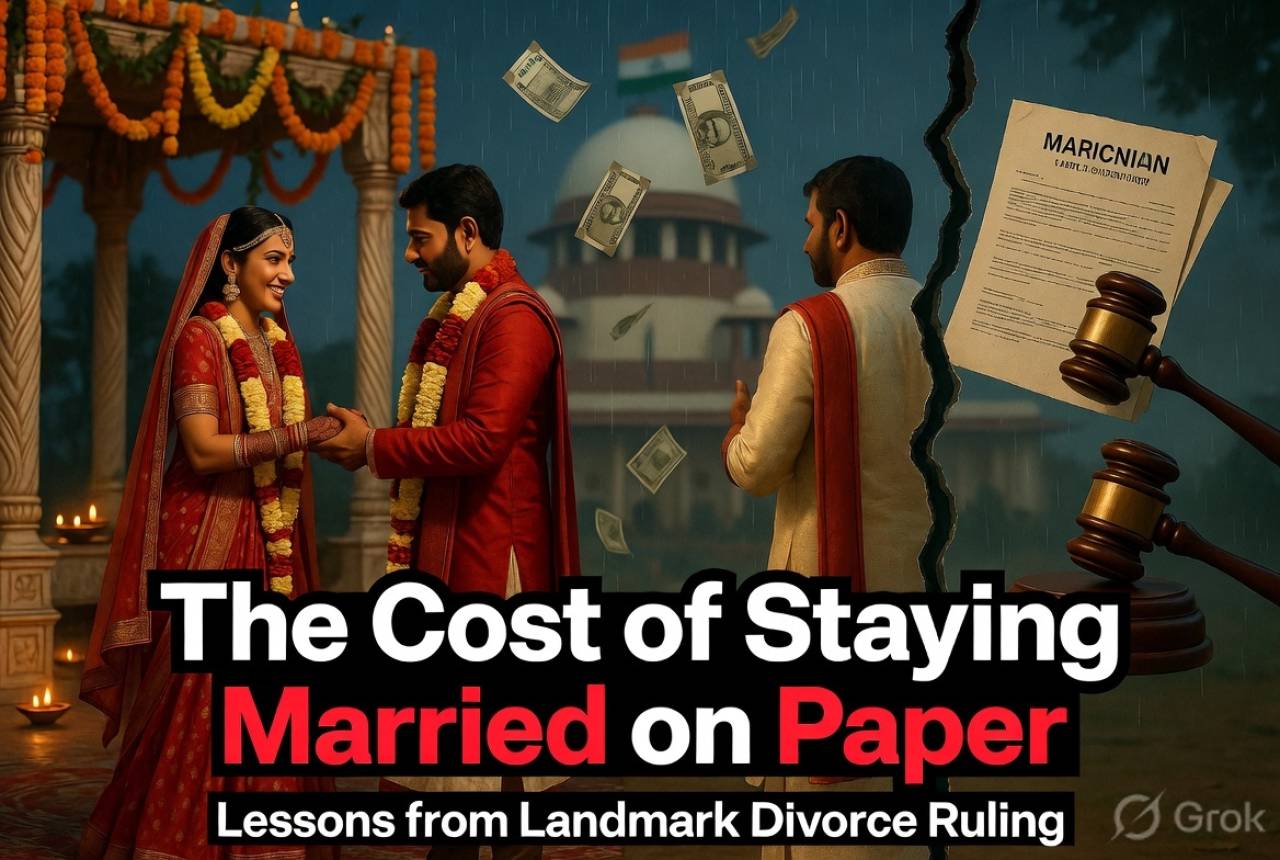
Can a marriage that exists only on paper still serve any purpose? The Supreme Court’s latest ruling suggests that sometimes ending a broken bond is the first step toward justice, healing, and dignity.
The Supreme Court of India recently dissolved a long-dead marriage between an army officer and his dentist wife, utilizing its extraordinary powers under Article 142 of the Constitution to do justice. What made this case highly unusual was not that the marriage had failed, but that the wife actively opposed the immediate decree of divorce. Her opposition did not stem from a desire to reconcile or save the relationship; rather, she wanted the court to delay the dissolution so she could first legally prove in court that her husband had committed adultery under Section 13(1)(i) of the Hindu Marriage Act. She argued that he should not be allowed to "take advantage of his own wrongs."
The apex court, however, chose a more compassionate and pragmatic path. It observed that a marriage existing "only on paper" serves no meaningful purpose and continuing the legal bond any further would merely prolong bitterness, hostility, and endless legal warfare. While the bench did increase her permanent alimony significantly from an agreed ₹32 lakh to ₹50 lakh to ensure absolute financial fairness based on their lifestyles, it prioritized the practical termination of an irretrievably broken relationship over a prolonged legal battle meant to assign moral blame.
This landmark ruling brings to light a deep, shifting conflict within modern society: the clash between punitive justice—the desire to prove a partner’s guilt—and therapeutic justice, which focuses on letting individuals heal and move on with their lives. Historically, our legal and social systems have treated divorce as a battleground of fault. To get a divorce, one traditionally had to prove a specific "wrong" like cruelty, desertion, or adultery. While this framework was designed to protect innocent spouses, it frequently forces estranged couples into decades of hostile litigation, turning what was once a loving partnership into a bitter theater of mutual destruction.
From a broader societal perspective, forcing two individuals to remain legally bound when their emotional and physical connection has completely vanished serves no constructive purpose. When a marriage collapses beyond any hope of repair, keeping it alive on paper does not uphold the sanctity of the sacred institution of marriage. Instead, it breeds continuous resentment, sparks multiple civil and criminal proceedings, and creates an atmosphere of perpetual conflict. This toxic residue does not stay confined to the couple; it spills over to children, extended families, and the community at large, draining emotional energy and judicial resources alike.
The Supreme Court’s decision reminds us that healthy marriages are built on mutual respect, trust, and companionship. When these foundational elements are permanently lost, the legal structure holding them together becomes an empty, suffocating shell. Demanding that a court must first decide who was the "bad partner" before granting an exit often has less to do with rebuilding a life and more to do with personal vindication. While the desire for legal validation of one’s emotional hurt is entirely understandable, the price paid to achieve it is often years of wasted youth, escalating financial drain, and profound emotional exhaustion.
Furthermore, this specific case highlights the evolving role of the judiciary as a pragmatic peacekeeper rather than just an arbiter of blame. By enhancing the wife’s alimony to fifty lakh rupees, the court acknowledged her financial security and ensured she was well-provided for, perfectly balancing economic justice with emotional liberation. It sends a clear, unmistakable message to modern society: financial security and legal finality are far more valuable for an individual's future than a lengthy, bitter campaign to establish moral fault in a courtroom.
As our society progresses, our collective understanding of family, marriage, and individual well-being must also mature. A truly healthy society should not be measured by low divorce rates alone, but by the emotional health, peace, and dignity of its citizens. Recognizing that a marriage is irretrievably broken—and allowing it to end cleanly rather than through prolonged legal warfare—is a step toward a more compassionate social order. It gives individuals a genuine chance to heal, rebuild, and find peace, rather than remaining chained to the ghost of a dead relationship simply to prove a point.
The Supreme Court of India recently dissolved a long-dead marriage between an army officer and his dentist wife, utilizing its extraordinary powers under Article 142 of the Constitution to do justice. What made this case highly unusual was not that the marriage had failed, but that the wife actively opposed the immediate decree of divorce. Her opposition did not stem from a desire to reconcile or save the relationship; rather, she wanted the court to delay the dissolution so she could first legally prove in court that her husband had committed adultery under Section 13(1)(i) of the Hindu Marriage Act. She argued that he should not be allowed to "take advantage of his own wrongs."
The apex court, however, chose a more compassionate and pragmatic path. It observed that a marriage existing "only on paper" serves no meaningful purpose and continuing the legal bond any further would merely prolong bitterness, hostility, and endless legal warfare. While the bench did increase her permanent alimony significantly from an agreed ₹32 lakh to ₹50 lakh to ensure absolute financial fairness based on their lifestyles, it prioritized the practical termination of an irretrievably broken relationship over a prolonged legal battle meant to assign moral blame.
This landmark ruling brings to light a deep, shifting conflict within modern society: the clash between punitive justice—the desire to prove a partner’s guilt—and therapeutic justice, which focuses on letting individuals heal and move on with their lives. Historically, our legal and social systems have treated divorce as a battleground of fault. To get a divorce, one traditionally had to prove a specific "wrong" like cruelty, desertion, or adultery. While this framework was designed to protect innocent spouses, it frequently forces estranged couples into decades of hostile litigation, turning what was once a loving partnership into a bitter theater of mutual destruction.
From a broader societal perspective, forcing two individuals to remain legally bound when their emotional and physical connection has completely vanished serves no constructive purpose. When a marriage collapses beyond any hope of repair, keeping it alive on paper does not uphold the sanctity of the sacred institution of marriage. Instead, it breeds continuous resentment, sparks multiple civil and criminal proceedings, and creates an atmosphere of perpetual conflict. This toxic residue does not stay confined to the couple; it spills over to children, extended families, and the community at large, draining emotional energy and judicial resources alike.
The Supreme Court’s decision reminds us that healthy marriages are built on mutual respect, trust, and companionship. When these foundational elements are permanently lost, the legal structure holding them together becomes an empty, suffocating shell. Demanding that a court must first decide who was the "bad partner" before granting an exit often has less to do with rebuilding a life and more to do with personal vindication. While the desire for legal validation of one’s emotional hurt is entirely understandable, the price paid to achieve it is often years of wasted youth, escalating financial drain, and profound emotional exhaustion.
Furthermore, this specific case highlights the evolving role of the judiciary as a pragmatic peacekeeper rather than just an arbiter of blame. By enhancing the wife’s alimony to fifty lakh rupees, the court acknowledged her financial security and ensured she was well-provided for, perfectly balancing economic justice with emotional liberation. It sends a clear, unmistakable message to modern society: financial security and legal finality are far more valuable for an individual's future than a lengthy, bitter campaign to establish moral fault in a courtroom.
As our society progresses, our collective understanding of family, marriage, and individual well-being must also mature. A truly healthy society should not be measured by low divorce rates alone, but by the emotional health, peace, and dignity of its citizens. Recognizing that a marriage is irretrievably broken—and allowing it to end cleanly rather than through prolonged legal warfare—is a step toward a more compassionate social order. It gives individuals a genuine chance to heal, rebuild, and find peace, rather than remaining chained to the ghost of a dead relationship simply to prove a point.
















Leave a Comment