
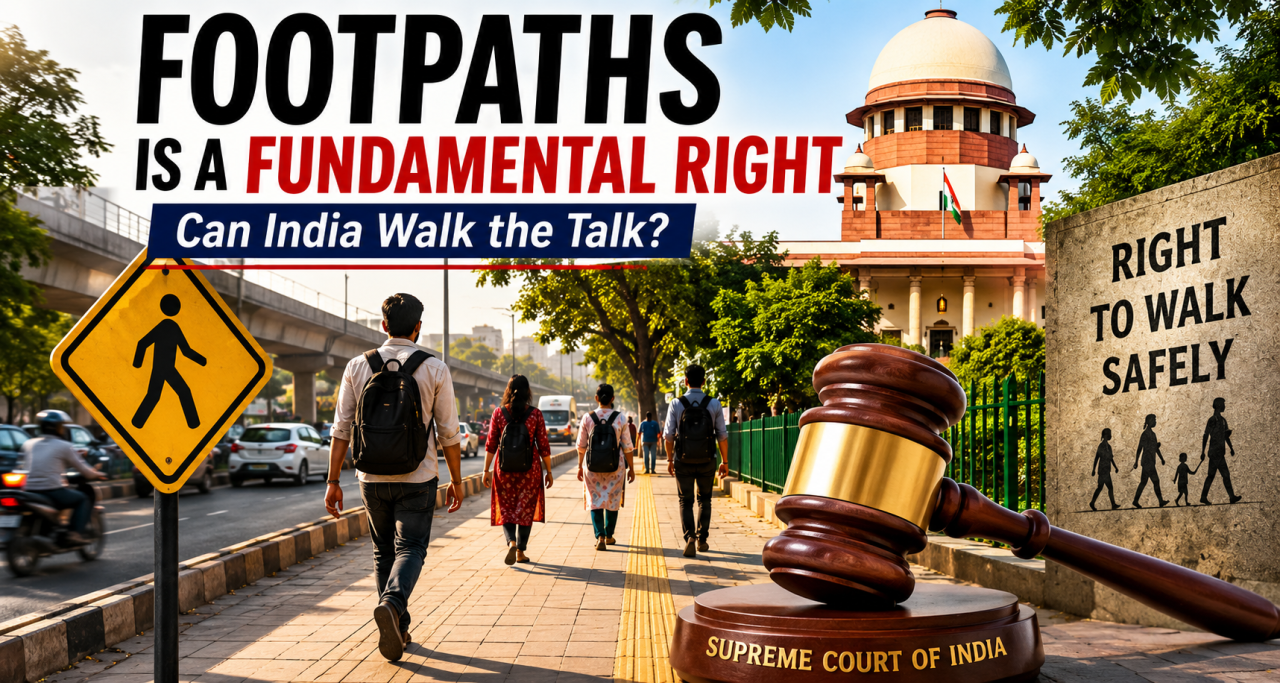
India's highest court has declared safe footpaths a fundamental right. But after decades of neglect, encroachment, and poor planning, can Indian cities finally become walkable?
For most Indians, the act of walking to work, to a bus stop, or even to the corner grocery store is not a simple exercise in commuting. It is an obstacle course — a daily negotiation with broken tiles, parked motorcycles, hawker stalls, and open drains that have quietly colonised what should be public walking space. For decades, this inconvenience was absorbed as a fact of urban life, a problem too mundane for courts and too inconvenient for governments to fix. That changed last Friday.
In a ruling that carries implications far beyond its immediate context, the Supreme Court of India elevated the right to walk safely and without obstruction on designated paths to the level of a fundamental right. The bench, hearing a case related to compensation in a pedestrian death, drew upon Articles 19 and 21 of the Constitution — the rights to freedom of movement and to life — to arrive at a conclusion that is both legally significant and long overdue: the provision of safe footpaths is no longer a matter of civic goodwill. It is a constitutional obligation.
The judgment marks a genuine shift in how urban infrastructure must be understood. Safe walking is no longer a governance concern that local bodies may or may not attend to depending on their priorities or budgets. Citizens can now seek constitutional and civil remedies if that right is breached or denied. Local governments — municipal corporations, panchayats, and urban development authorities — are legally bound to create and maintain safe footpaths. The bar has moved.
The Ground Reality Tells Another Story
Step out of any courtroom in India and the pavement beneath your feet will likely tell you how far we still have to go. Large stretches of our cities simply do not have sidewalks. Where they do exist, they are so narrow, so cluttered, and so poorly maintained that they offer little practical use to a pedestrian. Drains run open and unmarked. Electric poles stand in the middle of walking paths. Vendors — many of whom have nowhere else to go — set up on the only available public surface. Two-wheelers treat footpaths as parking lots or shortcuts.
The Hauz Rani fire in Delhi, which drew public attention some time ago, was a grim reminder of how chaotic our urban spaces have become. Narrow lanes, choked with encroachments and parked vehicles, leave no room for pedestrians, let alone emergency responders. These are not exceptional failures — they are the norm in Indian cities, large and small.
And the cost is real. India records the highest number of pedestrian deaths in the world each year, a figure that reflects not just reckless driving but a near-total failure of urban planning to protect those on foot. International commitments on reducing road fatalities have largely gone unmet. The Supreme Court's ruling, then, is not merely a legal milestone — it is an urgent response to a crisis hiding in plain sight.
Three Things That Must Change
The path from a landmark judgment to an actual walkable city runs through several difficult realities.
First, traffic management in Indian cities must be redesigned around pedestrians, not just vehicles. The dominance of motor traffic — particularly in metros — has shaped road planning for decades in a way that sidelines walkers entirely. That logic needs to be reversed. Road network planning must balance the ease of vehicular movement with the sheer numbers of people who walk every day.
Second, encroachments must be addressed — but thoughtfully. Street vendors, whose livelihoods depend on occupying these spaces, cannot simply be displaced without broader planning for where they go. The question of their rehabilitation is a policy challenge that the ruling does not resolve on its own. Any enforcement that ignores this will be both unjust and unsustainable.
Third, existing pavements need repair and maintenance — not someday, but urgently. In many cities, pavements exist in name only: they are uneven, unlit, inaccessible to persons with disabilities, and crumbling at the edges. Making them usable also means making them green — where trees and shrubs are planted alongside walking paths, the experience transforms. Shade changes how a city feels on foot.
If Indian cities can get even these basics right — clear, maintained, shaded footpaths free of hazards — the standard of urban living changes for the majority of residents who do not own a car.
A Right That Must Be Enforced, Not Just Declared
Several countries have long recognised pedestrian rights in law. The Nordic nations have their "freedom to roam." The United States relies on vehicle codes and zoning laws to govern walkable spaces. India now joins them, but through a constitutional route that is, in some ways, more powerful — and more demanding of follow-through.
The Supreme Court can declare a right. Only sustained civic pressure, responsible governance, and accountable local bodies can make it real. Indians have been patient walkers for long enough.
For most Indians, the act of walking to work, to a bus stop, or even to the corner grocery store is not a simple exercise in commuting. It is an obstacle course — a daily negotiation with broken tiles, parked motorcycles, hawker stalls, and open drains that have quietly colonised what should be public walking space. For decades, this inconvenience was absorbed as a fact of urban life, a problem too mundane for courts and too inconvenient for governments to fix. That changed last Friday.
In a ruling that carries implications far beyond its immediate context, the Supreme Court of India elevated the right to walk safely and without obstruction on designated paths to the level of a fundamental right. The bench, hearing a case related to compensation in a pedestrian death, drew upon Articles 19 and 21 of the Constitution — the rights to freedom of movement and to life — to arrive at a conclusion that is both legally significant and long overdue: the provision of safe footpaths is no longer a matter of civic goodwill. It is a constitutional obligation.
The judgment marks a genuine shift in how urban infrastructure must be understood. Safe walking is no longer a governance concern that local bodies may or may not attend to depending on their priorities or budgets. Citizens can now seek constitutional and civil remedies if that right is breached or denied. Local governments — municipal corporations, panchayats, and urban development authorities — are legally bound to create and maintain safe footpaths. The bar has moved.
The Ground Reality Tells Another Story
Step out of any courtroom in India and the pavement beneath your feet will likely tell you how far we still have to go. Large stretches of our cities simply do not have sidewalks. Where they do exist, they are so narrow, so cluttered, and so poorly maintained that they offer little practical use to a pedestrian. Drains run open and unmarked. Electric poles stand in the middle of walking paths. Vendors — many of whom have nowhere else to go — set up on the only available public surface. Two-wheelers treat footpaths as parking lots or shortcuts.
The Hauz Rani fire in Delhi, which drew public attention some time ago, was a grim reminder of how chaotic our urban spaces have become. Narrow lanes, choked with encroachments and parked vehicles, leave no room for pedestrians, let alone emergency responders. These are not exceptional failures — they are the norm in Indian cities, large and small.
And the cost is real. India records the highest number of pedestrian deaths in the world each year, a figure that reflects not just reckless driving but a near-total failure of urban planning to protect those on foot. International commitments on reducing road fatalities have largely gone unmet. The Supreme Court's ruling, then, is not merely a legal milestone — it is an urgent response to a crisis hiding in plain sight.
Three Things That Must Change
The path from a landmark judgment to an actual walkable city runs through several difficult realities.
First, traffic management in Indian cities must be redesigned around pedestrians, not just vehicles. The dominance of motor traffic — particularly in metros — has shaped road planning for decades in a way that sidelines walkers entirely. That logic needs to be reversed. Road network planning must balance the ease of vehicular movement with the sheer numbers of people who walk every day.
Second, encroachments must be addressed — but thoughtfully. Street vendors, whose livelihoods depend on occupying these spaces, cannot simply be displaced without broader planning for where they go. The question of their rehabilitation is a policy challenge that the ruling does not resolve on its own. Any enforcement that ignores this will be both unjust and unsustainable.
Third, existing pavements need repair and maintenance — not someday, but urgently. In many cities, pavements exist in name only: they are uneven, unlit, inaccessible to persons with disabilities, and crumbling at the edges. Making them usable also means making them green — where trees and shrubs are planted alongside walking paths, the experience transforms. Shade changes how a city feels on foot.
If Indian cities can get even these basics right — clear, maintained, shaded footpaths free of hazards — the standard of urban living changes for the majority of residents who do not own a car.
A Right That Must Be Enforced, Not Just Declared
Several countries have long recognised pedestrian rights in law. The Nordic nations have their "freedom to roam." The United States relies on vehicle codes and zoning laws to govern walkable spaces. India now joins them, but through a constitutional route that is, in some ways, more powerful — and more demanding of follow-through.
The Supreme Court can declare a right. Only sustained civic pressure, responsible governance, and accountable local bodies can make it real. Indians have been patient walkers for long enough.






















Leave a Comment